


10 novembre 2026
Citrus fertilizer: which one to choose for your lemon tree, and when
By the Germis · reviewed by the Germiflor technical team · · 17 min read
Early November: the potted lemon tree has just left the terrace for the conservatory. Madame Germi runs a finger over an old leaf, yellow all over: “It’s hungry. Shall we give it some fertilizer?” Monsieur Germi looks at the potting mix, still damp from the day before: “Not now. In winter it ticks over slowly. First we’ll work out why it is turning yellow, then we’ll prepare its spring.”
Lemon, orange, mandarin, kumquat: in a pot on a balcony or in the ground by the Mediterranean, citrus trees are hungry trees, but not at just any time. Here is which fertilizer to give them, when, how much, what changes between a pot and open ground, and how to read a yellow leaf before adding anything at all. The benchmarks come from our fertilizer product sheets, from agronomic publications on citrus and from the experience of Germiflor, a fertilizer manufacturer in Aussillon, in the Tarn (France), since 1885.

In winter, a potted citrus tree needs light and a frost-free shelter, not fertilizer.
The essentials in 30 seconds
Step 1: the organic soil amendment. In autumn, it feeds the soil (humus, microbial life, water reserve): BIOMAZOR or ORVEGA under the canopy in the ground, on the surface of the potting mix for a potted citrus tree. Fertilizer does not replace it.
Step 2: the organo-mineral fertilizer. On this prepared soil, FRUITIER (NPK 7-5-7 + 2% MgO) or its vegan version ORVEGA 6 (NPK 6-4-6 + 2% MgO), once a year, when growth resumes in February-March. No fertilizer in midwinter.
How much. From 200 g to 2 kg of fertilizer a year depending on the size of the tree, spread under the edge of the canopy, lightly raked in and then watered (benchmark from the product sheets). In a pot, start from the bottom of the range. ORVEGA 6 contains castor cake: work it into the soil straight away, out of reach of animals.
Step 3: the adjustments. Watering, light, frost-free shelter and leaf reading, all year round: when a leaf turns yellow, look for the cause before adding anything at all.
In 2027. By January 1st, 2027 at the latest, the French Climate and Resilience Act bans synthetic fertilizers for home gardeners. Products suitable for organic farming, like those in this method, remain allowed.
Contents
- The short answer
- What a citrus tree needs
- The steps, in order
- The organic soil amendment
- The fertilizer: content, dose, spreading
- When to fertilize
- In a pot or in the ground
- Climate and Resilience Act: 2027
- Yellow leaves: deficiency or lock-out
- Citrus in winter
- Pruning
- Aphids and scale insects
- Box for farmers
- Mazor® and Cronops®
- The summary table
- The checklist
- Frequently asked questions
- Learn with the Germis
Are you a citrus grower or a fruit grower? Go straight to the box for farmers.
Which fertilizer for citrus trees? The short answer
A citrus tree is fed with an organo-mineral fertilizer that supplies nitrogen for the shoots, potash for the fruit and magnesium to keep the leaves green, and whose nitrogen is released gradually. It is applied once a year, when the tree starts growing again, in February-March. That is the case of our fertilizer FRUITIER (NPK 7-5-7 + 2% MgO, suitable for organic farming), or of its vegan version ORVEGA 6 (NPK 6-4-6 + 2% MgO). The dose ranges from 200 g to 2 kg a year depending on the size of the tree, spread under the edge of the canopy. Fertilizer feeds the tree; the organic soil amendment, applied in autumn, feeds the soil that carries it: one does not replace the other. In midwinter, do not feed: the tree, slowed down by cold and short days, grows little and makes poor use of fertilizer. And when a leaf turns yellow, look for the cause before adding anything at all, because yellowing does not always signal a lack of fertilizer.
What a citrus tree needs, and why it is demanding
A citrus tree keeps its leaves all year round, puts out several flushes of growth a year and carries fruit that takes months to ripen, sometimes at the same time as the next bloom. So it draws on the soil almost continuously, with a peak in spring, when it flowers and sends out its new shoots.
Nitrogen builds the leaves and shoots. Potash supports flowering, fruit set and fruit swelling. Magnesium, the heart of chlorophyll, is partly drawn from the older leaves to supply the developing fruit: that is why a shortage shows first on old leaves close to the fruit (UF/IFAS, 2013, reviewed in 2025). Iron, zinc and manganese, needed in very small amounts, show on the young shoots instead.
These nutrients work together. This is Liebig’s law of the minimum: growth is limited by the nutrient that is most lacking relative to the plant’s needs, and adding another one changes nothing. They also get in each other’s way: too much potash or a very chalky soil can hold back magnesium uptake. A good citrus fertilizer therefore supplies a balance, not a single nutrient pushed to the maximum.
The Germis’ tip
A potted citrus tree lives on a limited reserve
In the ground, the roots explore a large volume of living soil. In a pot, they only have a few dozen liters of potting mix, and every watering that runs out through the drainage hole carries away part of the soluble nutrients. The reserve runs down faster: a potted citrus tree depends more on what you supply than a citrus tree in the ground.
The steps, in order: the organic soil amendment, then the organo-mineral fertilizer
Feeding a citrus tree takes three steps, always in the same order: this is the Germis’ method. Start with the soil, with an organic soil amendment; then feed the tree, with an organo-mineral fertilizer; finally, adjust all year round. The order matters: on a soil poor in humus, fertilizer is likely to be less well retained and to benefit the tree less.
Step 1 · in autumn, in the ground and in pots alike
The organic soil amendment
Between late September and late November, spread BIOMAZOR or ORVEGA under the canopy of the tree (0.5 to 1 kg per m² for maintenance) and rake it into the surface. In a pot, apply some in autumn too, in a small amount, raked into the surface of the potting mix, then again when you top-dress or repot in spring, blended into the fresh potting mix. Goal: a living soil rich in humus, which holds water and nutrients.
Step 2 · once a year, when growth resumes, in February-March
The organo-mineral fertilizer
On this prepared soil, apply FRUITIER or ORVEGA 6: from 200 g to 2 kg a year depending on the size of the tree, under the edge of the canopy, lightly raked in and then watered. An organo-mineral fertilizer is not managed like a mineral fertilizer: its nitrogen, of organic origin, is released gradually, and a single application carries the tree through the season. Goal: to feed the bloom, the new shoots and the fruit.
Step 3 · all year round
The adjustments
Regular watering in summer and spaced-out watering in winter, light, frost-free shelter, leaf reading. Goal: to correct the cause of a problem (water, cold, chalky conditions) before adding fertilizer.
The organic soil amendment: feed the soil before you feed the citrus tree
An organic soil amendment does not feed the tree directly: it feeds the soil. Part of its organic matter, the most stable part, helps form humus, which helps bind soil particles together (structure), hold water (the available water reserve) and store nutrients to release them little by little (the cation exchange capacity, or CEC). It also feeds the bacteria, fungi and earthworms that keep the soil alive. A fertilizer supplies the tree with nutrients for the season; the amendment maintains what allows the tree to absorb them year after year. This is the first step of the Germis’ method, and it holds for citrus as for the whole garden.
In the ground: in autumn, under the canopy
The amendment is spread between late September and late November, over the whole area under the canopy of the tree, then lightly raked into the surface: soil life has the winter to take it in before the fertilizer application of February-March. BIOMAZOR, which combines composted plant and animal materials, restarts the biological activity of the soil (organic matter 61%, ISMO 55, C/N 14, suitable for organic farming): its product sheet gives 0.5 to 1 kg per m² per year for maintenance, and 1 to 2 kg per m² for a poor soil. For a citrus tree with a canopy 2 meters across, or a little over 3 m² of ground, that comes to about 1.5 to 3 kg a year for maintenance.
For fully plant-based fertilization, ORVEGA plays the same role, geared toward stable humus (organic matter 61%, ISMO 52, C/N 19, vegan, suitable for organic farming). It is also the amendment for planting: 3 to 5 kg per tree, mixed well into the soil of the planting hole, without direct contact with the roots. To compare two amendments, look at the stable organic matter they are likely to supply: it is the organic matter content multiplied by the ISMO, a laboratory-measured index that gives an indication of the share of organic matter expected to remain in the soil. That comes to about 335 kg per tonne for BIOMAZOR and 319 kg for ORVEGA, according to their technical sheets.
In a pot: the potting mix is the soil
In a pot too, the organic soil amendment is applied in autumn: a small amount, raked into the top few centimeters of the potting mix, without injuring the roots. In a pot there are no earthworms to mix it in deeply: so it is really worked in when you top-dress and repot in spring, in a small proportion, blended well into the fresh potting mix. The potting mix thus regains stable organic matter and microbial life, which watering and time wear down. For the amount suited to the size of your pot, our team can advise you.
Common mistake
Believing that fertilizer is enough
A citrus tree fed on fertilizer alone ends up on a soil or potting mix poor in humus, which holds water and nutrients less well: part of the fertilizer may be lost, and the tree suffers from drought sooner. The autumn amendment and the spring fertilizer work together.
The organo-mineral fertilizer: what it supplies, how to dose it and how to spread it
Mineral, organic, organo-mineral: three ways of feeding
A soluble mineral fertilizer supplies nutrients in a form that is available right away; what the tree does not absorb quickly can be carried away by water, which is why it is often split into small applications (some mineral fertilizers, on the other hand, are slow-release). An organic fertilizer supplies nutrients bound to organic matter: its nitrogen, in particular, is only released little by little, as soil life breaks that matter down. An organo-mineral fertilizer combines the two: an organic base, supplemented with selected mineral nutrients. The differences are detailed in our article organic or mineral fertilizer.
In FRUITIER as in ORVEGA 6, the nitrogen is entirely organic: it is released gradually, as the soil warms up and its microbial life becomes active, that is, just when the tree starts growing again. The potash comes from a low-chloride potassium sulfate, and magnesium completes the formula. This is what makes it possible to feed the tree with a single application a year, without the sudden surge of wood that too fast a fertilizer can trigger, at the expense of the fruit.
What 1 kg of fertilizer contains
| Nutrient | Its role for the citrus tree | FRUITIER (in 1 kg) | ORVEGA 6 (in 1 kg) |
|---|---|---|---|
| Nitrogen (N) | Leaves and new shoots | 70 g, entirely organic | 60 g, entirely organic and plant-based |
| Phosphorus (expressed as P2O5) | Rooting, flowering | 50 g | 40 g |
| Potash (expressed as K2O) | Flowering, fruit set, fruit swelling | 70 g | 60 g |
| Magnesium (MgO) | Chlorophyll, green leaves | 20 g | 20 g |
| Sulfur (SO3) | Helps the tree make use of nitrogen | 110 g | 70 g |
| Calcium (CaO) | Tissue strength | 70 g | not stated on the product sheet |
| Organic matter | Feeds the life of the soil or potting mix | 540 g | 620 g |
These figures are the contents declared on the two product sheets (7% nitrogen corresponds to 70 g per kilo). As on all fertilizer labels, phosphorus, potash, magnesium, sulfur and calcium are expressed as oxides (P2O5, K2O, MgO, SO3, CaO), not as the pure element. They show what sets an organo-mineral fertilizer apart from a mineral fertilizer: more than half the bag is organic matter, which feeds the soil at the same time as the tree.
What dose for my tree?
The product sheets give a range for the year: from 200 g for a young tree to 2 kg for a large mature tree. In between, the dose follows the size of the canopy, because the roots to be fed lie under the foliage: the larger the disc of soil covered by the tree, the closer you get to the top of the range. As a benchmark, 1 kg of FRUITIER supplies 70 g of nitrogen, 50 g of phosphorus expressed as P2O5 and 70 g of potash expressed as K2O. In a pot, where the volume of potting mix is limited, stay at the bottom of the range. These doses are indicative: they vary with the soil, the age of the tree and the region. To measure the area under the canopy, the method is explained in our article which fertilizer for fruit trees.
How to spread it, in four moves
- Spread in a ring under the canopy, below the edge of the foliage: most of the fine roots, the ones that absorb water and nutrients, lie close to the soil surface, under the branches and a little beyond. At the foot of the trunk, there are mostly large anchoring roots.
- Rake in lightly to mix the granules with the soil or potting mix, without injuring the surface roots. ORVEGA 6 is worked into the soil right after spreading (it contains castor cake).
- Water, or spread before rain: moisture is needed for soil life to release the nutrients.
- Avoid direct contact between the product and the roots, and never leave it in a heap.
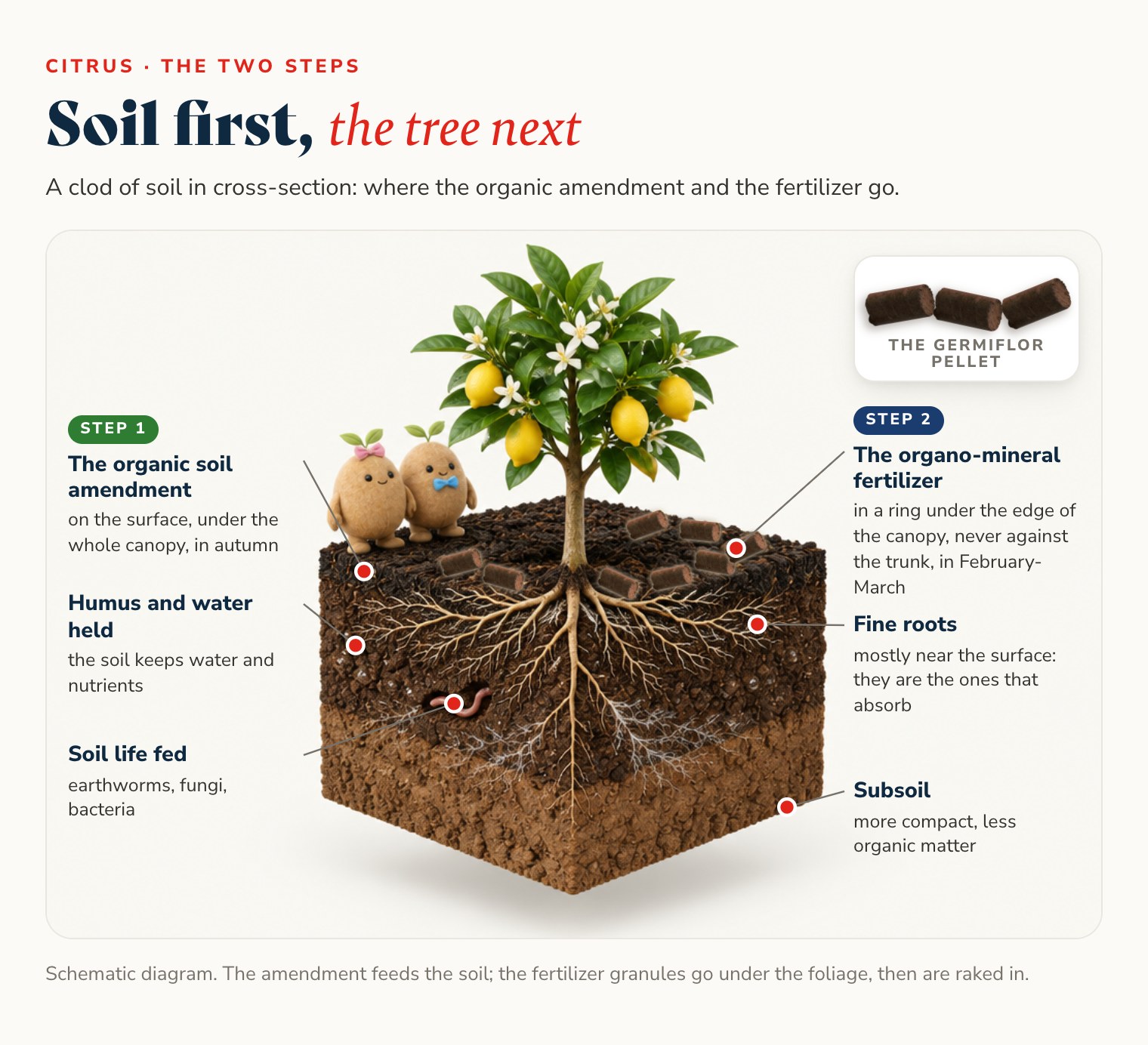
The two steps on a clod of soil: the organic soil amendment feeds the surface layer, the organo-mineral fertilizer is spread under the edge of the canopy.
More fertilizer does not mean more fruit
This is the law of diminishing returns: as long as the tree lacks a nutrient, each application benefits it; once the need is met, each extra gram yields less and less, then ends up doing harm. Too much nitrogen can push wood and soft shoots at the expense of the fruit. A late fertilizer application can delay fruit coloring and make the rind rougher (UC IPM). And an excess of potash can hold back magnesium uptake. The right dose is the one on the product sheet, applied at the right time, on a soil maintained by the amendment.
When to fertilize citrus trees?
Once a year, when growth resumes, in February-March, before the bloom and the new shoots. An organo-mineral fertilizer is not managed like a soluble mineral fertilizer, which is renewed often in small doses: its nitrogen, of organic origin, is released gradually, at the pace of soil life activity, and a single application carries the tree through the season. The dose on the product sheets, from 200 g to 2 kg depending on the size of the tree, is therefore a dose for the year, and the autumn organic soil amendment completes the program. Between November and January, do not apply fertilizer: the tree, slowed down by cold and short days, grows little, and in a pot, watering carries away part of the nutrients before they are used.
In the garden, one application a year is enough in most cases. For a large tree heavily laden with fruit, a very sandy soil or a pot that is watered often, the same yearly dose can be split in two, in February-March and then in May. You split the dose, you do not double it.
The Germis’ calendar for a citrus tree in a French climate. Dates shift by a few weeks depending on the region and the shelter.
In a Mediterranean climate: the dose can be split
In Corsica and along the Mediterranean coast, citrus growth hardly ever stops: in autumn, when the soil is still warm and the roots are active, the tree builds up the reserves that will serve the spring bloom. That is why our Corsican citrus-grower customers receive their fertilizer as early as September. In the garden, in this climate, the yearly dose can be split in two, one part in September and the other when growth resumes, as the FRUITIER product sheet indicates, always without exceeding the yearly dose.
And in November, what do we do?
For a citrus tree in the ground (Mediterranean coast, Corsica, well-sheltered gardens), this is the time for the organic soil amendment under the canopy, presented above: you have until late November to spread it and rake it into the surface.
For a potted citrus tree, November is the month for moving it under cover: bring it in before the first frosts, check that water drains freely through the bottom of the pot and cut back on watering. You can also rake a little organic soil amendment into the surface of the potting mix; the fertilizer, for its part, waits for February-March.
Common mistake
Making up for an oversight in midwinter
The fertilizer was forgotten in spring, the tree turns yellow in December, and it is given a double dose. The slowed-down tree gets almost nothing out of it, and in a pot the surplus builds up or leaves with the watering. It is better to wait for growth to resume in February-March and apply the normal dose, starting by checking the cause of the yellowing.
Citrus in a pot or in the ground: what changes
In a pot: a potting mix to maintain, measured applications
A potted citrus tree lives in a potting mix that wears out: it compacts, loses its organic matter and runs out of nutrients. In spring, the top few centimeters of potting mix are renewed (top-dressing); every two or three years as a rule, the tree is repotted into a slightly larger pot. For a livelier potting mix, a little organic soil amendment is applied in autumn, raked into the surface, then blended into the fresh potting mix at top-dressing, in a small proportion; for the amount suited to your pot, ask us for advice.
As for fertilizer, the FRUITIER product sheet states that it suits citrus in pots as well as in the ground, dosed according to the size of the tree, from 200 g to 2 kg a year. In a pot, start from the bottom of the range, spread the granules over the whole surface of the potting mix, away from the trunk, rake in lightly and water. A pot that does not drain cannot be fed: drainage comes before fertilizer.
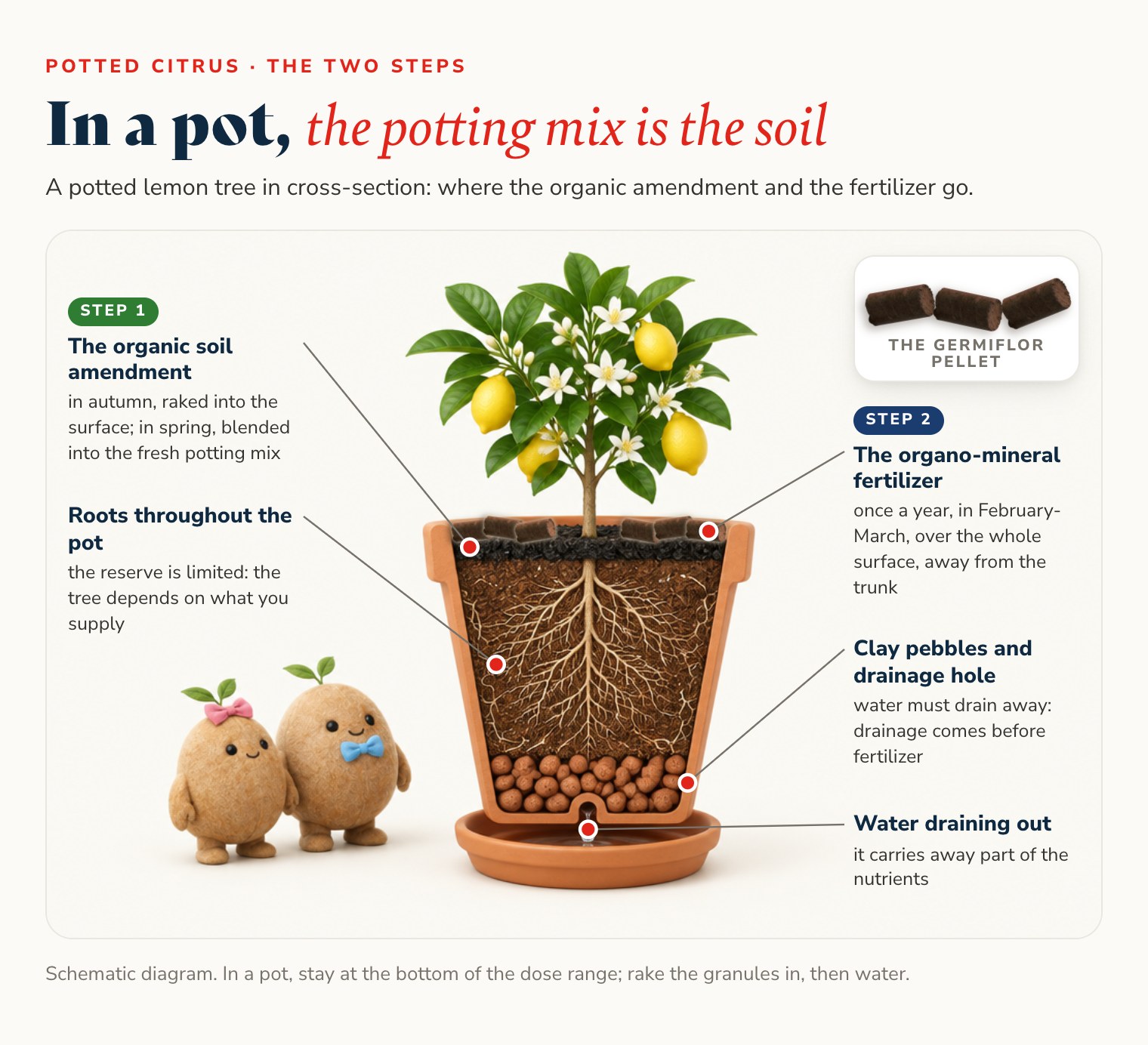
A potted citrus tree in cross-section: the potting mix plays the role of the soil, and drainage comes before fertilizer.
In the ground: feed the soil, then the tree
In the ground, the roots of a citrus tree extend out to the edge of the canopy, and often beyond. That is where the autumn amendment and the fertilizer are spread, over the whole area under the canopy, never in a heap at the foot of the trunk. The soil works for the tree: a soil rich in stable humus holds water and nutrients better (its cation exchange capacity, the CEC, increases), and releases them as microbial activity proceeds. If your soil is very chalky, a soil analysis tells you from the outset whether iron lock-out is to be expected, and guides the choice of amendment and fertilizer.
1
fertilizer application a year
When growth resumes, in February-March: the organic nitrogen is released gradually. The autumn amendment completes it.
200 g to 2 kg
per tree per year
The range on the FRUITIER and ORVEGA 6 product sheets, depending on the size of the tree, under the edge of the canopy.
2% MgO
of magnesium
In FRUITIER and ORVEGA 6, to keep the leaves green and limit the risk of magnesium being locked out by potash.
Climate and Resilience Act: what changes in 2027 for your citrus fertilizer
By January 1st, 2027 at the latest, the French Climate and Resilience Act of August 22, 2021 (article 269) bans synthetic fertilizers for non-professional uses in France: a home gardener will no longer be able to buy, use or even keep them, for the garden or for pots. Fertilizers suitable for organic farming are not affected by this ban: that is the statement to look for on the label (in France, “utilisable en agriculture biologique”).
For your citrus trees, the reflex is simple: turn over the bottle or bag of your current fertilizer. If it does not carry the statement “suitable for organic farming”, it will no longer have a place in your home after the deadline. Until then, use it at the dose on the label, or ask your local waste collection center about the rest.
The two steps in this article remain possible after 2027: an organic soil amendment, then an organo-mineral fertilizer, all suitable for organic farming. That is the case of BIOMAZOR, ORVEGA, FRUITIER and ORVEGA 6. The law changes the label to check, not the order of the moves: the soil first, the tree next. The details of the text, audience by audience, are in our article synthetic fertilizers banned in 2027.
Yellow leaves on a lemon tree: deficiency or lock-out?
A yellow leaf is not a diagnosis. It can signal a real shortage of a nutrient (a deficiency) or a nutrient that is present in the soil but that the root cannot absorb (a lock-out). The first is corrected by an application; the second is not: as long as the cause remains, the added fertilizer is of no use. The first clue is the age of the affected leaves. Nutrients that are mobile in the plant, such as nitrogen and magnesium, are moved from old leaves to young shoots and fruit: the shortage shows first on the older leaves. Iron, zinc and manganese move little: the shortage shows on the young leaves.
A simplified reading: several causes can combine. When in doubt, an analysis of the soil or potting mix and technical advice will settle the matter.
Iron, the typical case of lock-out. Iron is abundant in most soils, but a high pH, active lime or a cold, waterlogged soil make it hard to absorb: the young leaves turn yellow between veins that stay green (Agriculture and Agri-Food Canada). In a pot, very hard, lime-rich watering water can gradually raise the pH of the potting mix; rainwater, when you can collect it, limits this risk. An application of iron in chelated form relieves the plant, but only correcting the cause solves the problem.
Magnesium, the typical case of antagonism. On the old leaves close to the fruit, yellow areas start from the base, along the midrib, and end up outlining a green V at the base of the leaf. Potash-rich applications, salinity and calcareous soils can cause or worsen this shortage (UF/IFAS). The potash and magnesium balance is corrected in spring, from March onward, with a fertilizer that contains magnesium, such as FRUITIER or ORVEGA 6 (2% MgO each).
Citrus in winter: protect without feeding
Not all citrus trees are equally sensitive to cold. In their study on citrus growing in France, Chopinet and Dupouy ranked the lime as the most sensitive species, closely followed by the citron and the lemon, then the pomelos and grapefruits and the sweet orange; the sour orange, the mandarin and the kumquat held up better, and the satsuma showed great hardiness (Fruits journal, 1951). The outcome also depends on the variety, the rootstock, the age of the tree and how long the frost lasts: in a pot, moreover, the roots are exposed on all sides.
A potted citrus tree therefore spends the winter in a bright, frost-free room, cool rather than heated, with spaced-out watering: wait for the surface of the potting mix to dry before watering. A slowed-down tree drinks little, and a waterlogged soil in winter damages the roots. It goes back out once the frosts are over, gradually, to get the foliage used to the sun. The fertilizer waits for growth to resume.
The Germis’ tip
The right move at the end of winter
When the days grow longer and new shoots appear, in February-March, that is the signal: top-dress the pot or rake under the canopy, apply fertilizer at the dose on the product sheet, water. If the young leaves come out yellow, think of iron and of the watering water before doubling the fertilizer.
Should citrus trees be pruned, and when?
A citrus tree does not need pruning to crop well: light pruning is enough, to open up the center of the tree, remove dead wood and crossing branches, and keep a shape suited to the pot or the spot (UC IPM). The right time is the end of winter, just before the bloom, or just after fruit set. Avoid pruning in late summer and autumn: pruning triggers soft shoots that will not have time to harden before the cold.
The Germis’ tip
Suckers below the graft
Most citrus trees on sale are grafted. Any shoot that starts below the graft union (the bulge at the bottom of the trunk) comes from the rootstock: it will not bear the fruit of the variety and takes vigor away from the tree. Cut it off as soon as it appears, flush with the trunk, with clean, sharp pruning shears.
After the bloom, many small fruits drop: this is a natural drop, the tree is adjusting its load. As a rule there is no need to thin the fruit (UC IPM).
Aphids and scale insects: keep watch without panicking
The two most common visitors on citrus are aphids, which settle on the soft young shoots, especially in spring, and scale insects and mealybugs, small shells or white cottony clusters fixed on the twigs and the underside of the leaves. Both feed on sap and excrete a sweet, sticky liquid, honeydew, on which a black fungus, sooty mold, develops. Sticky or blackened leaves are therefore a signal: turn the leaves over to look for the cause.
What helps. A strong jet of water, early in the morning, dislodges aphids; scale insects can be removed by hand or with a cloth on a small potted tree. Ladybugs and hoverflies, whose larvae devour aphids, are natural predators of aphids: let them work, and avoid insecticides, which kill them too. Ants going up and down the trunk protect aphids and scale insects from their predators in order to harvest the honeydew: keeping them away helps the beneficial insects (UC Master Gardeners).
The link with fertilizer. Too much fertilizer causes excessive growth of soft young shoots (UC IPM), exactly the ones aphids prefer. Keeping to the dose and the calendar also limits what attracts them. In winter, under cover, where beneficial insects are absent, take a look at the underside of the leaves at each watering. For a diagnosis or a problem that is spreading, a garden center or a plant protection adviser will point you in the right direction.
Box for farmers: fertilizing a citrus orchard
For farmers
Clementine, orange and lemon trees require more nitrogen and potash than the olive tree. In the orchard, the principle is the same as in the garden, an organic soil amendment then an organo-mineral fertilizer, but fertilization is managed plot by plot, in split applications from late winter to early summer, with an autumn application in a Mediterranean climate.
First of all: measure
One soil analysis a year for monitoring, every two years at the latest, supplemented if needed by a leaf analysis. Doses are set according to the analysis and the fruit load.
In autumn: the soil
An organic soil amendment on drained, workable soil, lightly incorporated. Humiflor® Germi’One® builds the humus and the water reserve of the orchard (100% plant-based, organic matter 55%, ISMO 59, C/N 19, suitable for organic farming, 1 to 2 t/ha).
From September in Corsica: autumn nitrogen
We ship citrus fertilizer to Corsica from September. AB’Flor® 13 N helps the tree build up its reserves before the next bloom, with entirely organic nitrogen, released by soil life over the weeks (13% N, C/N 3.1, suitable for organic farming, 700 to 1,000 kg/ha, that is 91 to 130 kg of nitrogen per hectare; the dose can be split).
In February-March: complete nutrition
AB’Flor® 7-5-7 S + 2 MgO SE supports regrowth, the bloom and fruit swelling; its magnesium and sulfur help limit the antagonism between potash and magnesium (suitable for organic farming, 1,000 to 1,200 kg/ha, that is 70 to 84 kg of nitrogen, 50 to 60 kg of P2O5 and 70 to 84 kg of K2O per hectare).
On calcareous soil: iron
Citrus trees there are prone to iron chlorosis. An organo-mineral fertilizer enriched with iron, such as Mikroflor Germifer® 3-2-2 + Fe, helps prevent this chlorosis.
What to remember about doses
These ranges are those of our product sheets, product by product: they are not meant to be added up automatically. Our technical team builds the plan with you, based on the soil analysis and the fruit load. In a nitrate vulnerable zone, keep to the spreading calendar of your nitrates action program.
Delivery and equipment
We deliver as far as Corsica. On the mainland, from the south of France up to the Loire Valley, the purchase of our fertilizers comes with the loan of a storage hopper and a spreader; this equipment loan is not offered in Corsica. From 12 tonnes, a tailor-made formula can be calculated from your soil analysis.
Mazor® and Cronops®: what controlled composting changes for your citrus trees
FRUITIER, ORVEGA 6, BIOMAZOR and ORVEGA all contain Mazor®, a compost of plant materials (oilcakes from medicinal plants, grape and olive pulp, coffee grounds) obtained by the Cronops® process, patented by Germiflor (patent FR 3 121 819, application FR 2103847). For seven months, the temperature and aeration of the windrows are monitored: the material heats up beyond the sanitization threshold, pathogenic germs and weed seeds are destroyed, the carbon stabilizes and the C/N ratio falls. At the end of composting, Mazor® contains more than one billion microorganisms per gram.
For a citrus tree, this counts twice: the organic matter of the fertilizer feeds the life of the soil or potting mix while the nutrients are released, and the supply stays consistent from one bag to the next. The same raw materials, applied raw, do not do this job: the difference is between the raw state and the composted state, not between the materials. The process is detailed on our pages our process and Mazor®, a patented plant-based compost.
Citrus in one table: the Germis’ method
| Step | Citrus in a pot | Citrus in the ground | When |
|---|---|---|---|
| 1. Soil support | A little amendment on the surface in autumn; top-dressing every spring, repotting every two or three years as a rule, well-drained potting mix | BIOMAZOR (0.5 to 1 kg/m² for maintenance) or ORVEGA under the canopy | Amendment: late September to late November. Top-dressing the pot: March-April |
| 2. Nutrition | FRUITIER or ORVEGA 6, bottom of the range (from 200 g a year) | FRUITIER or ORVEGA 6, from 200 g to 2 kg a year depending on the size of the tree | Once a year, in February-March |
| 3. Adjustments | Bright, frost-free shelter, spaced-out watering in winter, water low in lime | Soil analysis, mulching, watering in summer | All year round |
The checklist for well-fed citrus trees
☐ I bring my potted citrus tree in before the first frosts, into a bright, frost-free room.
☐ I apply no fertilizer between November and January.
☐ I space out watering in winter: the surface of the potting mix dries between two waterings.
☐ I check that water drains through the bottom of the pot.
☐ Step 1: in autumn, I apply an organic soil amendment, under the canopy in the ground, on the surface of the potting mix in a pot.
☐ Step 2: I apply the organo-mineral fertilizer once a year, when growth resumes, in February-March.
☐ I dose according to the size of the tree (from 200 g to 2 kg a year, bottom of the range in a pot) and I spread under the edge of the canopy, never against the trunk.
☐ In France, I check for the statement “utilisable en agriculture biologique” (suitable for organic farming) on my fertilizers before January 1st, 2027.
☐ I work ORVEGA 6 into the soil right away and keep it out of reach of animals.
☐ Faced with a yellow leaf, I first look at whether the old or the young leaves are affected.
☐ I prune lightly at the end of winter, cut off the shoots that start below the graft, and turn over sticky leaves to look for aphids and scale insects.
☐ In the ground, I have my soil analyzed (once a year, every two years at the latest).
Frequently asked questions about citrus fertilizer
What is the best fertilizer for citrus trees?
A balanced organo-mineral fertilizer that supplies nitrogen, potash and magnesium, with nitrogen that is released gradually. FRUITIER (NPK 7-5-7 + 2% MgO) and its vegan version ORVEGA 6 (NPK 6-4-6 + 2% MgO) are formulated for citrus, in pots and in the ground alike.
When should you fertilize a lemon tree?
Once a year, when growth resumes, in February-March. The organic nitrogen of an organo-mineral fertilizer is released gradually: a single application is enough in most cases, and the tree is not fed in midwinter. For a large, heavily laden tree, a very sandy soil or a pot that is watered often, the yearly dose can be split in two, in February-March and then in May; in a Mediterranean climate, between September and the resumption of growth.
Which fertilizer for a potted lemon tree?
The same as for a lemon tree in the ground, at a dose suited to the size of the tree: FRUITIER or ORVEGA 6, starting from the bottom of the range on the product sheet (200 g a year), in a single application when growth resumes. Spread the granules over the potting mix, rake in and water.
Should citrus trees be fertilized in winter?
No. Between November and January, the tree, slowed down by cold and short days, grows little and makes poor use of fertilizer; in a pot, part of it leaves with the watering. Wait for growth to resume in February-March.
Why are the leaves of my lemon tree turning yellow?
If it is the old leaves, think of nitrogen (uniform yellowing) or magnesium (a green V at the base). If it is the young leaves with green veins, it is often an iron lock-out linked to limestone or to excess water. In winter, overwatering or a lack of light also makes the leaves yellow and drop.
Is there an organic and vegan fertilizer for citrus trees?
Yes. ORVEGA 6 is a vegan fertilizer, suitable for organic farming, whose nitrogen is entirely of plant origin. It contains castor cake: work it into the soil right away and keep it out of reach of animals.
Will citrus fertilizers be banned in 2027?
Only synthetic fertilizers, and the ban applies in France: by January 1st, 2027 at the latest, the Climate and Resilience Act bans home gardeners from buying, using and keeping them. Fertilizers suitable for organic farming, such as FRUITIER and ORVEGA 6, remain permitted.
Should the amendment or the fertilizer go on first?
The organic soil amendment first, in autumn, to feed the soil; the organo-mineral fertilizer next, when growth resumes in February-March, to feed the tree. One does not replace the other.
Does a citrus tree need an organic soil amendment?
Yes. In the ground, every autumn between late September and late November: 0.5 to 1 kg of BIOMAZOR per m² under the canopy for maintenance, or ORVEGA for a 100% plant-based version. In a pot, a little is also raked into the surface in autumn, then worked into the fresh potting mix when you top-dress or repot in spring. It maintains the humus, the water reserve and soil life; the fertilizer comes next.
When should you prune a lemon tree?
At the end of winter, just before the bloom, or just after fruit set, and lightly: dead wood, crossing branches, shoots that start below the graft. Avoid pruning in late summer and autumn, which triggers soft shoots that are sensitive to cold.
Germiflor products suited to this topic

Organo-mineral fertilizer · garden
FRUITIER
The fertilizer for citrus, olive and fruit trees: potash for the fruit, magnesium for green leaves.
NPK 7-5-72% MgOsulfursuitable for organic farming
View the product sheet
Vegan organo-mineral fertilizer · garden
ORVEGA 6
The 100% plant-based version for feeding citrus trees, with plant-derived nitrogen released gradually.
NPK 6-4-62% MgOveganwork in right away
View the product sheet
Organic soil amendment · garden
BIOMAZOR
In autumn under the canopy of citrus trees in the ground: restarts soil life and maintains the humus.
OM 61%ISMO 55suitable for organic farming
View the product sheet
Plant-based organic soil amendment · garden
ORVEGA
The 100% plant-based amendment for building humus, and for planting a citrus tree: 3 to 5 kg per tree mixed into the soil.
OM 61%ISMO 52C/N 19vegan
View the product sheetThe full range: Marcel le Jardinier range for the garden and professional fertilizers.
Learn with the Germis: the Lexicon, the Academy, the Petits Germis and the Soil Odyssey
Learn with the Germis

Humus, deficiency, lock-out, organo-mineral fertilizer: the words in this article can also be learned through play. Germiflor has created four free spaces for understanding soil and fertilization, at any age.
To understand the words
The Fertilization Lexicon
Fertilizer, amendment, NPK, the nitrogen cycle, soil pH: entries and animated diagrams for each concept. Free, with sign-up for the full Lexicon.
To test yourself
The Germis’ Academy
146 cards and 159 questions across four levels, from Discovery to Engineer, to brush up on agronomy and fertilization. Free, with sign-up.
For children
The Petits Germis
Stories, videos, comics, quizzes and games about soil and plants, for ages 3 to 18, told by Germi and Germinette. No account needed, for school and home.
To play
Germis, the Soil Odyssey
The Germis’ game for exploring the soil, at home or in class, with six worksheets for teachers.
Further reading
Which fertilizer for fruit trees? The two-season method
The calendar of applications in the orchard, apple and pear trees included.
Synthetic fertilizers banned in 2027: what the Climate and Resilience Act says
Who is affected, what stays on sale, and our infographic.
In autumn, prepare your garden with Marcel le Jardinier
The autumn moves for the garden soil.
Organic or mineral fertilizer: Marcel’s advice for choosing well
Organic, organo-mineral, mineral: the differences.
Fertilizing soils and plants: how does it work?
Feed the soil, feed the plant, and in which order.
Our company
Five generations of fertilizer manufacturers in Aussillon, in the Tarn.
A citrus tree turning yellow, a dose to adjust?
Our team helps you choose the fertilizer and the dose for your tree.
Ask for advice The Marcel le Jardinier rangeArticle written by the Germis, Germiflor’s educational mascots. Reviewed by the Germiflor technical team (Mazamet, Tarn, France), a manufacturer of organic and organo-mineral fertilizers since 1885. Sources: Germiflor product sheets (FRUITIER, ORVEGA 6, BIOMAZOR, ORVEGA, AB’Flor® 13 N, AB’Flor® 7-5-7, Humiflor® Germi’One®); French law no. 2021-1104 of August 22, 2021, article 269 (article L. 255-13-1 of the French Rural and Maritime Fishing Code); UC IPM, “Fertilizing citrus” (University of California); M. Zekri and T. Obreza, “Magnesium for Citrus Trees”, UF/IFAS (2013, reviewed in 2025); UC IPM, “Training, pruning, and thinning citrus”; UC Master Gardeners of Tulare and Kings Counties, “Honeydew-producing insects”; Agriculture and Agri-Food Canada, “Chlorose ferrique des arbres et arbustes”; R. Chopinet and J. Dupouy, “Résistance au froid de certains citrus et de leurs hybrides”, Fruits, 1951. Published on .