


28 octobre 2026
Fertilizing soils and plants: how does it work?
By the Germis · reviewed by the Germiflor technical team · · 17 min read
Madame Germi holds a clod of earth in one hand and a bag of fertilizer in the other. “People always ask me which of the two feeds the plant.” Monsieur Germi crumbles the clod: “Both. But not in the same way, and not at the same time. Once you get that, you understand fertilization.”
Fertilizing soils and plants means supplying what is missing so that crops grow well, year after year. It has two targets: the soil, which you feed with amendments, and the plant, which you feed with fertilizers. Here is how it works, what organic fertilization changes, and in which order to proceed, in a garden or on a farm. Germiflor has been making organic and organo-mineral fertilizers since 1885 in Aussillon, in the Tarn region of southern France; this is the experience we share here.

Feed the soil first, the plant second: below the surface, humus and soil life do the work.
The key points in 30 seconds
What. Feed the soil (amendment, humus, microbial life) and feed the plant (fertilizer: nitrogen, phosphorus, potash).
Why. Plants do not eat fertilizer: they absorb nutrients dissolved in soil water. A living soil supplies and holds them.
When. Amendment in the fall, fertilizer in spring, while the crop is growing.
How. Start from a soil test, then follow the order: soil support, nutrition, adjustments.
Contents
Fertilizing soils and plants: the short answer
Fertilization covers all the inputs that maintain soil fertility and meet the nutrient needs of crops. It relies on two families of products. Amendments feed the soil: they supply organic matter that becomes humus and improves soil structure, water-holding capacity and microbial life. Fertilizers feed the plant: they supply nitrogen (N), phosphorus (P), potash (K) and the other nutrients it needs to grow, flower and produce. Good fertilization starts with the soil, is based on a soil test, and supplies each nutrient when the crop needs it, neither too early nor in excess.
To choose a specific product, our guide fertilizers and amendments: how to choose compares the product families and explains how to read a label. Here, we explain how it works.
How do plants feed?
A plant makes its sugars from light, water and carbon from the air (photosynthesis). But to build its leaves, roots and fruit, it also needs mineral nutrients that it takes up from the soil, only as ions dissolved in water: nitrate and ammonium for nitrogen, phosphate, potassium, calcium, magnesium.
These nutrients fall into three groups. The primary nutrients, nitrogen, phosphorus and potassium, are used in large amounts: nitrogen drives leaf growth, phosphorus rooting and flowering, potassium fruit quality and drought tolerance. The secondary nutrients, calcium, magnesium and sulfur, are essential in smaller amounts. Trace elements (iron, manganese, zinc, copper, boron, molybdenum) are needed only in tiny quantities, but without them the whole system stalls.
The soil: the plant’s pantry and kitchen
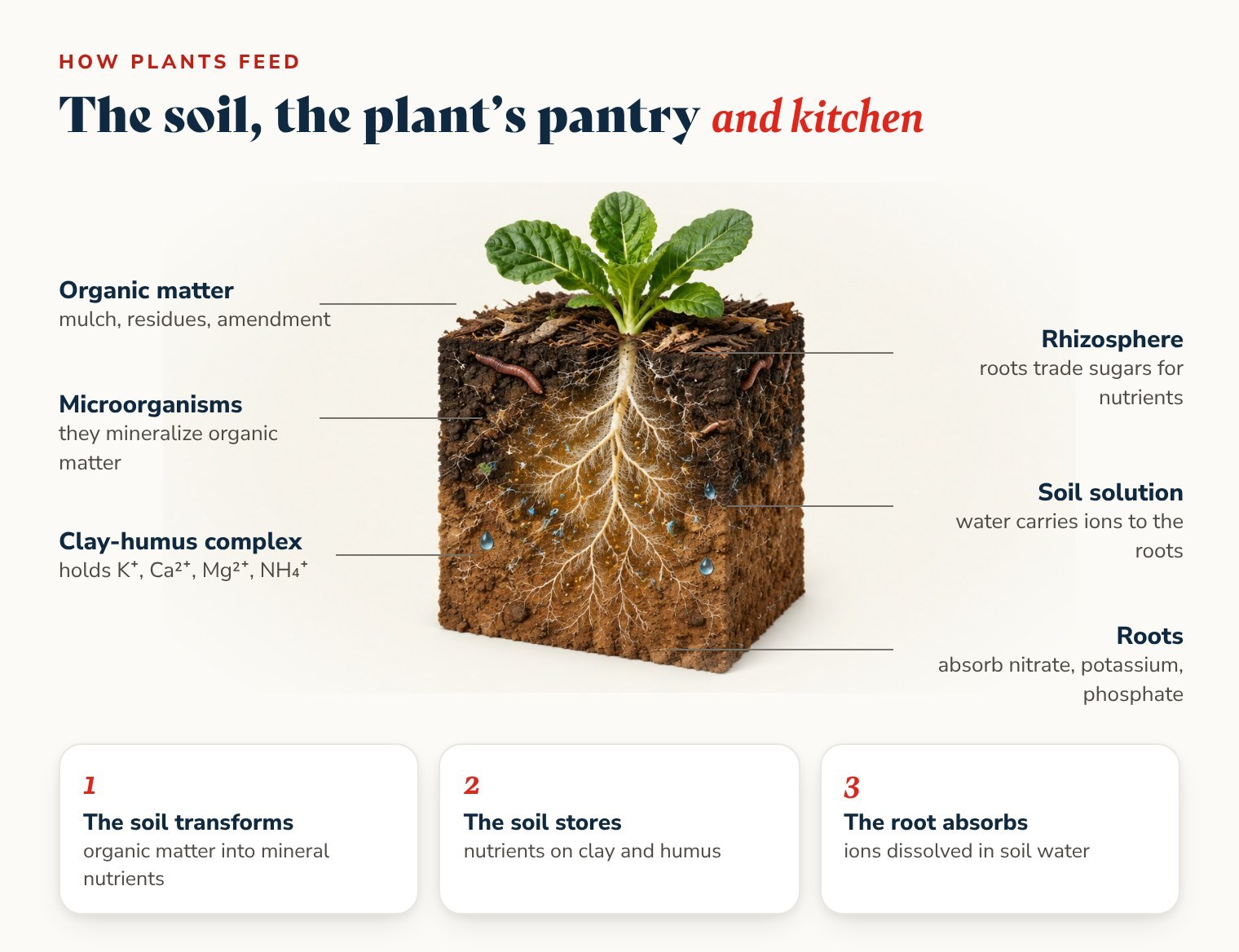
The soil turns organic matter into mineral nutrients, holds them on the clay-humus complex, then water carries them to the roots.
The soil plays two roles. It stores: clay and humus form the clay-humus complex, a negatively charged sponge that holds positively charged nutrients (potassium, calcium, magnesium, ammonium) and keeps them from washing away with the rain. This storage capacity is measured by the CEC, the cation exchange capacity. And it transforms: bacteria, fungi and earthworms break down organic matter and gradually release the nutrients it contains. This is mineralization.
The rhizosphere: where it all happens
The first few millimeters of soil around the roots form the rhizosphere, the most active zone of the soil. The plant releases part of the sugars it makes there, as root exudates: this is not waste, it is a trade. These sugars feed bacteria and fungi that, in return, release nutrients, protect the root and improve soil structure. Mycorrhizal fungi, which partner with the vast majority of crops, even extend the roots with their filaments and reach phosphorus and water where roots cannot go. Fertilizing also means feeding this partnership. Soil bacteria, allies of fertilization have their own episode (in French).
 ▶
Video · Germis Academy
The rhizosphere, a city beneath our feet
What happens around the roots, and why that is where plant nutrition is decided. In French.
The three faces of nitrogen
Nitrogen is the most heavily used and the most mobile nutrient. In the soil, it changes form. It starts out as organic nitrogen, held in the proteins of crop residues, composts and organic fertilizers; the plant cannot use it in that form. Microorganisms convert it into ammonium (NH4+), a positively charged ion that the clay-humus complex holds. Other bacteria then convert ammonium into nitrate (NO3−), the form plants absorb most easily, but which nothing holds: nitrate leaves with the rain. The whole art of nitrogen fertilization is to have nitrate available when the plant is growing, and as little as possible when it is not.
 ▶
Video · Germis Academy
The three faces of soil nitrogen
From protein to nitrate: how nitrogen changes form, and what that means for the plant and for groundwater. In French.
The Germis’ tip
A deficiency is not always a shortage
A soil can contain enough potash or iron without the plant being able to reach it: pH too high or too low, compacted soil, drought, or an excess of one nutrient blocking another. A waterlogged soil also lacks oxygen, which changes the chemical form of iron, manganese and nitrogen: pH does not tell the whole story. Before adding fertilizer, a soil test tells you whether you face a true deficiency or a lockout. We recommend a soil test every year, or every two years at most.
Feeding the soil or feeding the plant: amendment and fertilizer
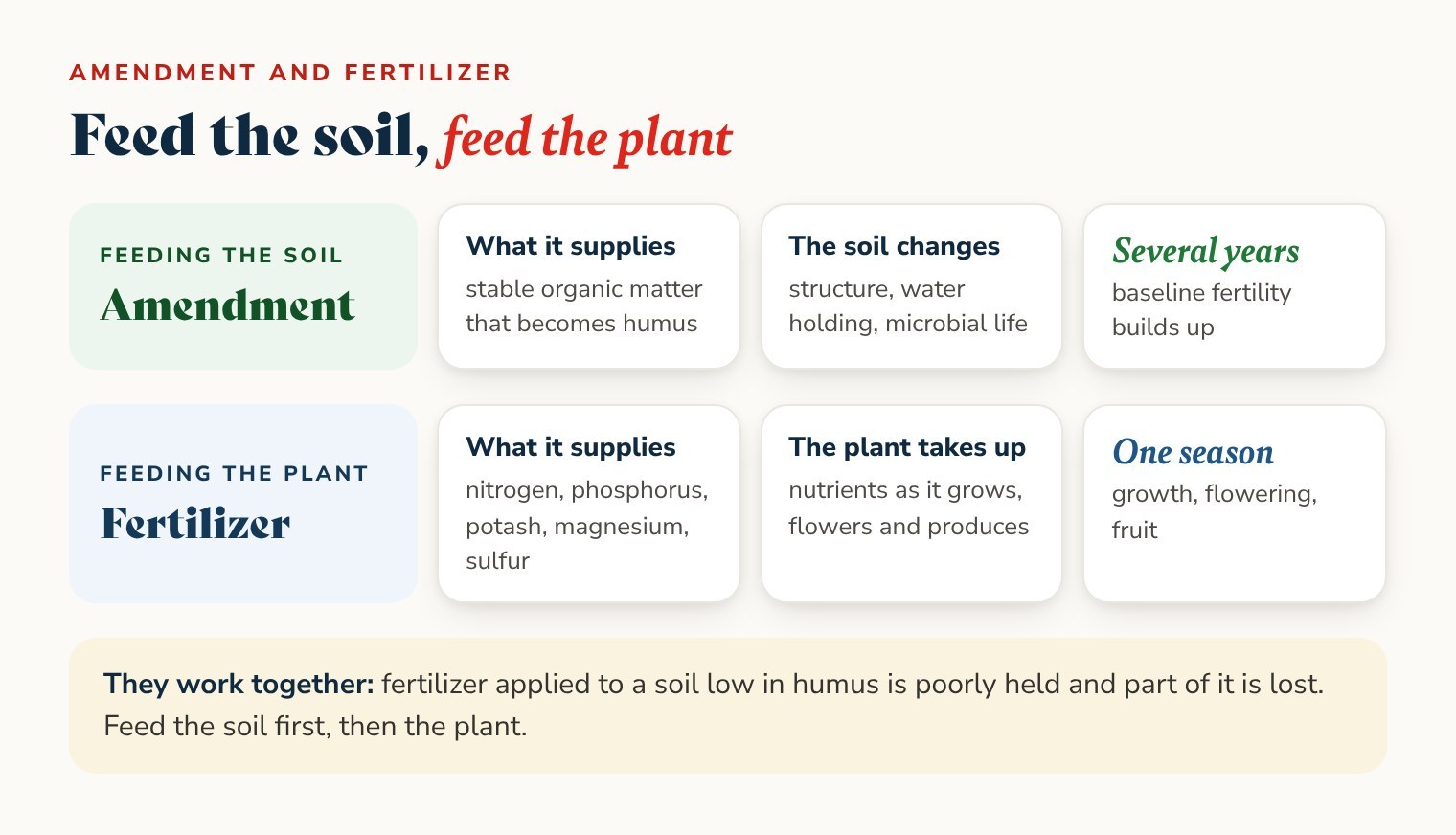
An organic amendment (a product rich in stable organic matter, covered in France by the NF U 44-051 standard) works over time: part of its organic matter becomes humus, which stays in the soil for several years. A fertilizer (covered by the NF U 42-001 standards or EU Regulation 2019/1009) supplies nutrients available within the season. The two work together: fertilizer applied to a soil low in humus is held less well and part of it is lost; a rich soil without a suitable input is not enough for demanding crops.
To learn more about the role of humus, read amendments, the key to a living soil.
| Organic amendment | Fertilizer | |
|---|---|---|
| Target | The soil | The plant |
| What it supplies | Stable organic matter, humus, microbial life | Nitrogen, phosphorus, potash, magnesium, sulfur… |
| Effect | Structure, water holding, CEC, over several years | Growth, flowering, fruit, within the season |
| Timing | Preferably in the fall | Spring, depending on crop stage |
| Key label figures | Organic matter as is, ISMO, C/N | N-P-K, magnesium, nitrogen source |
What is organic fertilization?
Organic fertilization feeds crops with materials of plant or animal origin (oilseed meals, composts, feather or meat meals) rather than soluble mineral nutrients. These materials are not directly available to the plant: soil microorganisms first have to break them down. Nitrogen is therefore released gradually, at the pace of soil life, which limits leaching losses and feeds soil organisms at the same time.
Organic, organo-mineral or mineral?
An organic fertilizer draws all its nutrients from organic materials. An organo-mineral fertilizer combines an organic base with natural mineral nutrients (finely ground rock phosphate, potassium sulfate, kieserite) to meet specific needs for phosphorus, potash or magnesium. A mineral fertilizer supplies soluble nutrients that are immediately available. Most fertilizers in the Germiflor range are organo-mineral: this is what makes it possible to balance potash and magnesium while keeping the organic base. The difference between the two families is explained in organic or mineral fertilizer: Marcel’s advice.
 ▶
Video · Germis Academy
Mineral, organic, organo-mineral: which feeds the plant, which feeds the soil?
The three families of fertilizers compared, and what each one really supplies. In French.
Labile humus, stable humus: the fuel and the capital
Not all organic matter does the same job. Part of it is labile: easy to break down, it is consumed within a few months by soil life, which it feeds, and releases nutrients. That is the fuel. The other part becomes stable humus, which stays in the soil for years, even decades: it holds water and nutrients and gives the soil its structure. That is the capital. A fertile soil needs both: fuel every year to keep its microbial life running, and capital that you rebuild as it wears down. Fresh manure or an organic fertilizer mainly feeds the fuel; a composted amendment with a high ISMO mainly builds the capital.
 ▶
Video · Germis Academy
Labile humus, stable humus: the fuel and the capital
Why a soil needs both, and how to choose the input that truly builds the stock. In French.
The organic pellet, a small biological work site
An organic fertilizer pellet does not dissolve like a mineral fertilizer: it gets colonized. As soon as it is moist, bacteria and fungi settle on its surface and digest it from the outside in, releasing nitrogen over several weeks. The warmer, wetter and more alive the soil, the faster the work goes; this is why an organic fertilizer acts slowly in cold early-spring soil and speeds up as it warms. It is also why you apply it a little ahead of the crop’s needs, not when the deficiency shows.
 ▶
Video · Germis Academy
The organic pellet, a small biological work site in the soil
How a pellet is digested by soil life, and what that changes for the timing of applications. In French.
Two figures for reading an organic product
The C/N ratio (carbon to nitrogen) shows how fast nitrogen is released. An organic nitrogen fertilizer has a low C/N (around 3) and mineralizes quickly; a composted amendment has a higher C/N (14 to 20) and releases its nitrogen slowly. ISMO (the organic matter stability index developed by the French research institute INRAE) gives the share of organic matter that will remain as stable humus: the higher it is, the more the amendment builds up the stock. All these terms are explained, with quizzes, in the Germis’ fertilization glossary.
4,000 t
The soil
One hectare to a depth of 30 cm represents about 4,000 metric tons of soil.
1 to 2 %
The losses
Every year, part of the soil’s organic matter mineralizes, often 1 to 2 % of the stock.
325 kg
The input
One metric ton of amendment with 55 % organic matter and an ISMO of 59 supplies about 325 kg of stable organic matter.
Common mistake
Thinking raw compost and a certified amendment do the same job
Coffee grounds, grape pomace or fresh oilseed meal are good raw materials. Spread raw, they ferment in the soil, can tie up soil nitrogen (this is nitrogen hunger) and their effect varies from batch to batch. Composted under control, the same materials become a stable, sanitized and consistent amendment. The difference is not the material, it is how it is transformed.
The laws of fertilization
Four agronomic principles, set out between the 19th and 20th centuries, still underpin every fertilization plan.
The law of restitution. What the harvest removes must be returned to the soil, or its fertility declines year after year. The law of the minimum (Liebig’s law). Yield is limited by the scarcest nutrient, like a barrel whose shortest stave sets the water level: adding more nitrogen is pointless if potash is lacking. The law of diminishing returns. Each extra unit of fertilizer yields less than the previous one; beyond a threshold, the input costs more than it brings and pollutes. The law of interactions. Nutrients affect one another: too much potash can hinder magnesium uptake, too much calcium can hinder iron uptake. That is why inputs are balanced rather than pushing a single one.
 ▶
Video · Germis Academy
Liebig’s law of the minimum
Liebig’s barrel explained by the Germis, and what it changes in a fertilization plan. In French. Next: the law of interdependence.
These laws apply field by field: this is the purpose of precision fertilization, which matches rates to the real needs of each zone.
When should you fertilize soils and plants?
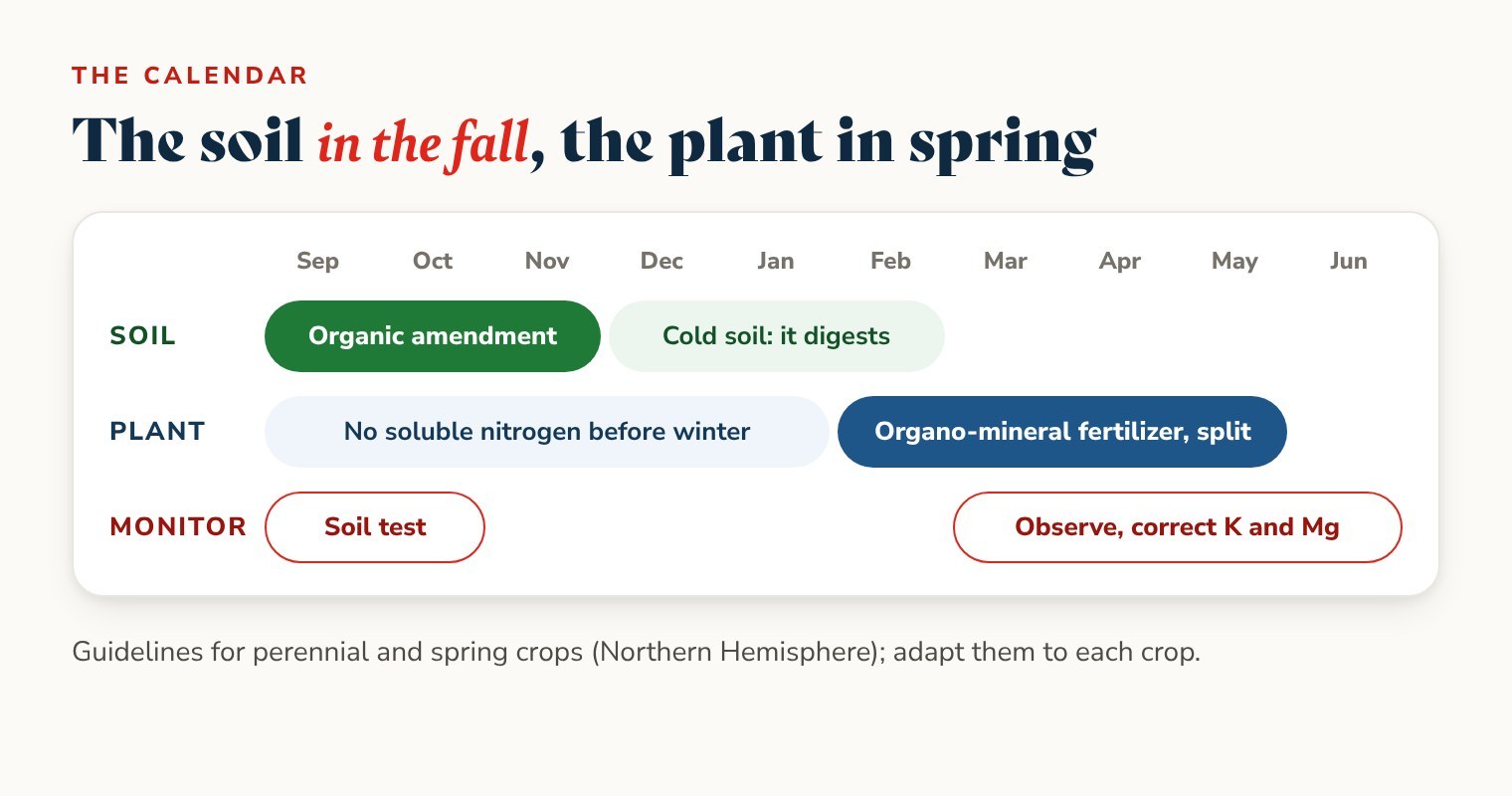
The calendar follows the life of the soil and of the plant. In the fall, the soil is still warm and moist: this is the best time for organic amendment, which soil life incorporates before winter. Soluble nitrogen, however, is avoided at this time of year, because the plant no longer absorbs it and rain carries it down to groundwater. At the end of winter and in spring, when the crop starts growing again, comes the organo-mineral fertilizer, applied as close as possible to the crop’s needs and split into two or three applications for long-season crops. Potassium and magnesium are corrected at that point, with the fertilizer, from March onward (Northern Hemisphere).
Each crop has its own calendar: see our pages on vineyards, orchards, vegetables, field crops and pastures.
The Germis’ 3-step method
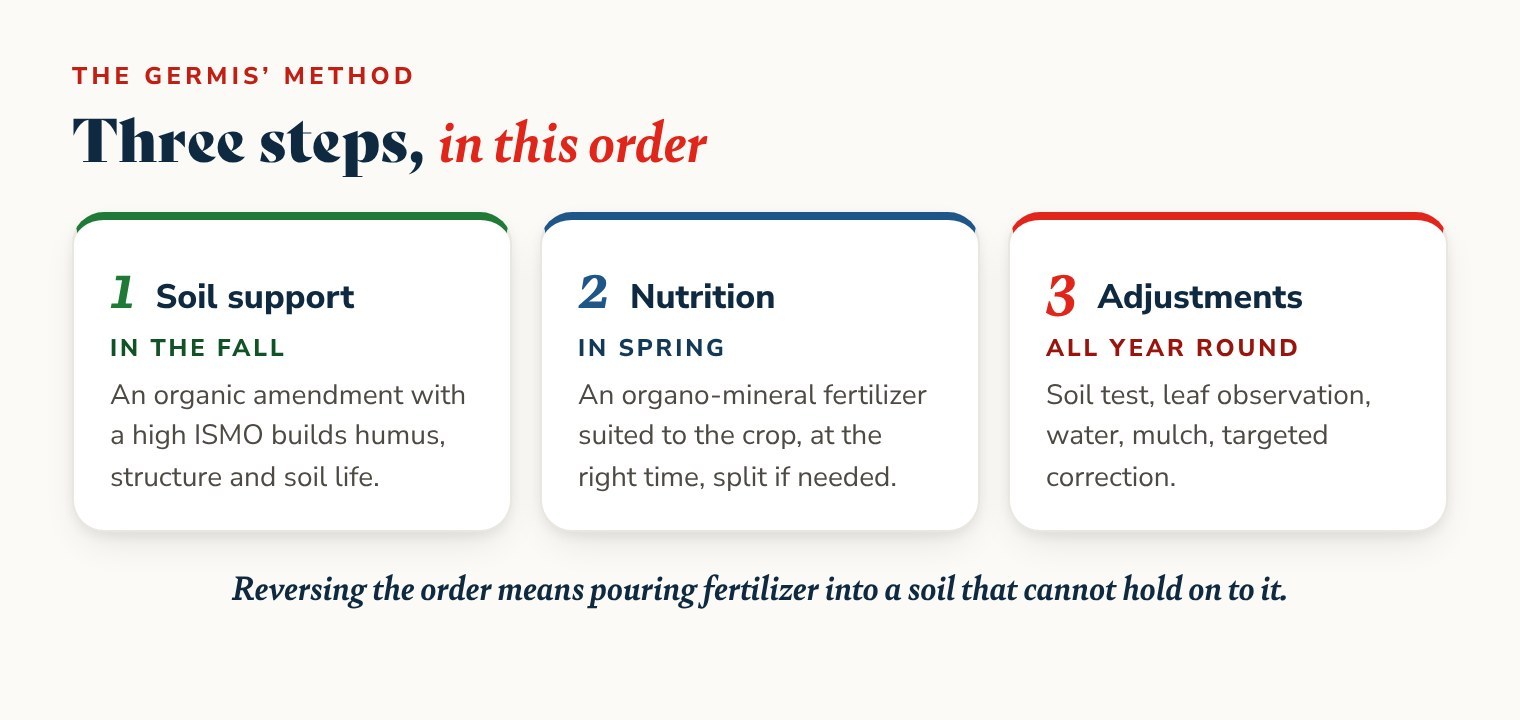
1. Soil support. First, build baseline fertility: humus, structure, water holding, microbial life, with an organic amendment with a high ISMO. 2. Nutrition. Then give the plant what the soil does not supply, at the right time, with a fertilizer suited to the crop and split if needed. 3. Adjustments. Observe and correct: soil test, leaf color, watering, mulching, targeted correction of a single nutrient. Reversing the order means pouring fertilizer into a soil that cannot hold on to it.
The Germis’ tip
In the garden, the same logic
In the vegetable garden, an amendment such as Marcel le Jardinier’s Biomazor is spread in the fall on cleared beds; the Potager fertilizer comes in spring, before sowing and planting. Two steps, two seasons, and the soil improves year after year.
Mazor® and Cronops®: why the material must be transformed
At the heart of most Germiflor fertilizers is Mazor®, a biological base guaranteed to contain one billion microorganisms per gram. It is produced by Cronops®, a patented process for the controlled composting of plant materials: meals from medicinal plants, grape and olive pomace, coffee grounds. During composting, temperature and aeration are managed to stabilize the carbon, adjust the C/N ratio, eliminate pathogens and develop a beneficial microflora. The result supplies the soil with stable organic matter and active microbial life, two conditions for fertilizers to be used well.
 ▶
Video · Germis Academy
Mazor® and the Cronops® process
Seven months of controlled composting, at the heart of our formulas. In French.
The process is presented on our page our process and in Mazor®, a patented innovation for agriculture.
Fertilization and climate: feeding without depleting
A humus-rich soil holds water better, resists compaction and erosion better, and stores carbon: every ton of stable organic matter added and kept in the soil is carbon that does not go into the air. With more frequent droughts and heavy rains, organic fertilization becomes a tool for adaptation as much as for production.
This has been Germiflor’s conviction for five generations, set out in our op-ed fertilization, a key lever for feeding tomorrow’s planet. Our fertilizers are made in France, in Aussillon, from raw materials that mostly come from the circular economy and agricultural by-products, with no inputs from urban or industrial waste; 93 % of the range is approved for organic farming. Regulations point the same way, as explained in our article on France’s Climate and Resilience Act and synthetic fertilizers.
Fertilization in one table
| Step | Goal | Products | Timing | What to check |
|---|---|---|---|---|
| 1. Soil support | Humus, structure, water, soil life | Organic amendment (organic matter, ISMO, high C/N) | Fall, soil drained | Organic matter, pH, CEC |
| 2. Nutrition | Meet the crop’s needs | Organic or organo-mineral fertilizer | Start of growth, split | Crop needs, residual nitrogen |
| 3. Adjustments | Correct without excess | Targeted correction (K, Mg, trace elements) | All year round | Soil test, leaf appearance |
The fertilization checklist
☐ I have my soil tested (once a year, every two years at most).
☐ I know the pH, organic matter content and CEC of each field.
☐ I distinguish what feeds the soil (amendment) from what feeds the plant (fertilizer).
☐ I apply the organic amendment in the fall, on a drained soil.
☐ I do not apply soluble nitrogen before winter.
☐ I choose the fertilizer according to the crop and its stage, not the price per ton.
☐ I split fertilizer applications on long-season crops.
☐ I compare amendments on the stable organic matter they supply (organic matter × ISMO).
☐ I check the potash / magnesium balance and correct it in spring.
☐ I keep the soil covered (cover crop, mulch) to protect humus.
☐ I look at the leaves and vigor before correcting.
Frequently asked questions about fertilizing soils and plants
What is soil fertilization?
It covers all the inputs that maintain or improve soil fertility: amendments for structure, humus and microbial life, fertilizers for nutrients. It is planned from a soil test and the needs of the crops.
What is the difference between fertilizing the soil and fertilizing the plant?
Fertilizing the soil means adding organic matter that becomes humus and works over several years. Fertilizing the plant means supplying, with a fertilizer, the nutrients (nitrogen, phosphorus, potash) it needs within the season. The two work together.
How can you make soil fertile naturally?
By returning stable organic matter to it (composted organic amendment, crop residues), keeping it covered, avoiding compaction and limiting deep tillage. Microbial life does the rest: it turns organic matter into humus and nutrients.
What is organic fertilization?
It is fertilization based on materials of plant or animal origin, which soil microorganisms break down before the plant can absorb them. Nitrogen is released gradually, which limits losses and also feeds soil life.
What is the best fertilizer to enrich the soil?
To enrich the soil, what you need is not a fertilizer but an organic amendment: it supplies stable organic matter that builds humus. Choose it on three figures: organic matter as is, ISMO and C/N.
What is the difference between organic and mineral fertilizer?
Organic fertilizer comes from plant or animal materials and releases its nutrients gradually, thanks to soil life. Mineral fertilizer supplies soluble nutrients that are immediately available but more exposed to leaching. Organo-mineral fertilizer combines an organic base and natural minerals.
When should you fertilize?
Organic amendment in the fall, while the soil is still warm; fertilizer in spring, when growth resumes, split on long-season crops. Avoid soluble nitrogen in the fall, as winter rains wash it away.
Which nutrients are essential for plants?
The primary nutrients (nitrogen, phosphorus, potassium), the secondary nutrients (calcium, magnesium, sulfur) and trace elements (iron, manganese, zinc, copper, boron, molybdenum). The most limiting nutrient sets the yield level: this is the law of the minimum.
Germiflor products for this topic

Organic amendment · pro range
HUMIFLOR® BIOMAZOR®
Revives soil biological activity and helps it form stable aggregates: the foundation of soil support.
organic matter 61 %ISMO 55C/N 14approved for organic farming
View product sheet
Plant-based organic amendment · pro range
HUMIFLOR® ORVEGA®
Builds stable humus and improves soil porosity, in an all-plant formulation.
organic matter 61 %ISMO 52veganapproved for organic farming
View product sheet
Organic nitrogen fertilizer · pro range
AB’FLOR® 13 N
Corrects a nitrogen shortfall when growth resumes, with organic nitrogen released by soil life.
N 13 %organic matter 82 %C/N 3.1approved for organic farming
View product sheet
Organo-mineral fertilizer · garden
POTAGER
Feeds vegetables and small fruits in spring, with magnesium and sulfur on top of NPK.
NPK 4-8-103 MgOMazor®approved for organic farming
View product sheetWhy start with an amendment: Biomazor and Orvega, feed the soil first, on video (in French). All our videos are on our YouTube channel.
The full range: professional fertilizers and the Marcel le Jardinier garden range.
Further reading
Fertilization, a key lever for feeding tomorrow’s planet
Our op-ed: why fertilization is a food security and climate issue.
Fertilizers and amendments: how to choose
The guide to choosing a product and reading a label.
Organic or mineral fertilizer: Marcel’s advice
The two families of fertilizers compared, for the garden.
Amendments, the key to a living soil
Why feed the soil before feeding the plant.
The fertilization glossary and the Germis Academy
Every fertilization term explained, with videos and quizzes.
Our company
Five generations of fertilizer makers in Aussillon, in the Tarn region.
A soil, a crop, a question?
Our technical team helps you build your fertilization plan from your soil test.
Ask for advice Professional range For the gardenArticle written by the Germis, Germiflor’s educational mascots. Reviewed by the Germiflor technical team (Mazamet, Tarn, France), maker of organic and organo-mineral fertilizers since 1885. Agronomic sources: French standards NF U 44-051 and NF U 42-001, EU Regulation 2019/1009, INRAE’s ISMO index, Germiflor product data sheets. Published on .