


02 octobre 2026
Synthetic fertilizer ban in France 2027: the Climate Act explained
By the Germis · Published on · Information current as of October 2, 2026 · Germiflor, Mazamet (Tarn, France)
The key facts in 30 seconds
By January 1, 2027 at the latest, synthetic fertilizers will be banned in France for non-agricultural uses: home gardeners, local authorities and private properties (Climate and Resilience Act, Article 269). Agricultural land is not affected. Fertilizers approved for organic farming (UAB) are exempt from the ban: that’s the mention to look for on the label.
Saturday morning, in the garden aisle of a garden center in the Tarn. A customer sets a bag of lawn fertilizer on the counter and asks the sales clerk: “Someone told me chemical fertilizers will be banned next year. Is that true?” The clerk hesitates. Perched on a pallet of soil amendment, Madame Germi whispers to Monsieur Germi: “He’s right to ask. And the clerk needs the answer as much as he does: it’s his aisle that’s about to change.”
Monsieur Germi nods: “Then let’s give them the full answer. The legal texts, the dates, what can still be sold and used. And how to get ready without panicking.”
So we read it all for you: the Climate and Resilience Act (loi Climat et Résilience), the article of the French Rural Code it created, the texts on the common base for fertilizing materials (socle commun), right down to the thresholds published in the Official Journal (Journal officiel) on October 2, 2026, and the ministry’s latest answer to the French Senate. Below: which synthetic fertilizers will be banned in 2027, for whom, what will remain on sale, and our infographic to sum it all up on one page.
Synthetic fertilizers banned in 2027: the short answer
By January 1, 2027 at the latest, France’s Climate and Resilience Act of August 22, 2021 (Article 269) bans synthetic fertilizers for non-agricultural uses. Three groups are targeted: local authorities, for the upkeep of their grounds; private properties (residences, parks, business sites); and home gardeners, who will no longer be able to buy, use or even keep them. Agricultural land is not affected, and sports facilities and historic monuments benefit from exemptions. Above all, fertilizers approved for organic farming (UAB, from the French “utilisable en agriculture biologique”) escape all of these bans. The UAB mention on the label therefore becomes the number one benchmark for the garden aisle and for green spaces. In the longer run, once the common base for fertilizing materials (socle commun) applies, a fertilizer sold for these uses will also have to be either CE-marked, or compliant with its NF U standard and classified in category A1 (or A2 for professionals).
The Germis’ tip. The habit to adopt starting today: turn the bag over. If it doesn’t carry the mention “Utilisable en agriculture biologique” (approved for organic farming) and the product is intended for gardens or green spaces, it will have no place on the shelf after January 1, 2027.
What exactly does the Climate and Resilience Act say about fertilizers?
Article 269 of Law No. 2021-1104 of August 22, 2021 created Article L. 255-13-1 of the French Rural Code (Code rural et de la pêche maritime). This text sets out three distinct bans, which are best read separately because they do not target the same people.
First ban: public bodies. The State, local authorities and their public institutions may no longer use, or have others use, synthetic fertilizers to maintain the grounds of their public or private estate, except land intended for agriculture. The words “have others use” directly target the landscaping contractors that work for them.
Second ban: home gardeners. Placing on the market, supplying, using and keeping synthetic fertilizers for non-professional use are all banned. This is the provision that affects garden centers, farm supply stores and online retail.
Third ban: private properties. Non-agricultural use of synthetic fertilizers is banned on private properties, except land intended for agriculture: condominiums, business parks, campgrounds, hotels, and the landscapers who maintain them.
The text takes effect on the date set by its implementing decree, and by January 1, 2027 at the latest. In an answer published in the Senate’s Official Journal (JO Sénat) on June 4, 2026 (written question No. 06245), the ministry stated that this decree had not yet been published. The deadline itself, however, is written into the law.
Common mistake. Believing the law targets “mineral nitrogen” or all mineral fertilizers. The text refers to “synthetic fertilizers,” a notion the decree has yet to define precisely. An organo-mineral fertilizer can contain minerals of natural origin and still be approved for organic farming. Hence the rule of thumb: trust the UAB mention, not the words “organic” or “mineral” on the packaging.
Who is affected on January 1, 2027?
The table below sums up, group by group, what becomes banned and what remains possible. It applies to non-agricultural uses: a farmer working their own fields is not covered by this law.
| Group | What becomes banned | What remains possible |
|---|---|---|
| Home gardeners (garden, vegetable patch, balcony) | Buying, using and keeping a synthetic fertilizer | UAB fertilizers and soil amendments |
| Garden centers, farm supply stores (LISA), online retail | Selling or supplying a synthetic fertilizer for non-professional use | Selling UAB products |
| Local authorities and their contractors | Using, or having others use, synthetic fertilizers on their grounds | UAB fertilizers; separate rules for agricultural land and sports facilities |
| Private properties and landscapers | Non-agricultural use of synthetic fertilizers | UAB fertilizers; land intended for agriculture is out of scope |
| Farmers, on their own land | Nothing under this law | All fertilizers otherwise authorized |
What exemptions does the law provide?
The law provides four. Land intended for agriculture remains out of scope, even when it belongs to a local authority or a private individual. Sports facilities, including racetracks and racehorse training grounds, can still receive synthetic fertilizers when this is necessary for the quality of play; this exemption applies to local authorities and private properties alike. Historic monuments also benefit from an exemption for their upkeep.
The fourth exemption matters most to everyone: fertilizers approved for organic farming are not covered by any of the three bans, whoever the user. For sports grounds, the law also called for a roadmap of good fertilization practices: the sports exemption is set to evolve.
What is a fertilizer approved for organic farming (UAB)?
A fertilizer approved for organic farming (UAB) is a fertilizer or soil amendment whose raw materials all appear on the list of fertilizers authorized by the EU organic farming regulations: Regulation (EU) 2018/848 and its Implementing Regulation (EU) 2021/1165, Annex II. The mention appears on the label, often worded “Utilisable en agriculture biologique conformément au règlement (UE) 2018/848” (approved for organic farming in accordance with Regulation (EU) 2018/848). It describes the product’s composition, not the garden or the gardener: a home gardener or a town that is not certified organic can use it without any formalities.
Agronomically, a UAB fertilizer mainly supplies organic nitrogen: plant or animal proteins, oilseed cakes, composted materials. This nitrogen is not available right away. It first has to be mineralized, that is, converted by soil microorganisms into nitrate that roots can absorb. Mineralization needs a living soil that is moist and warmed up, above roughly 10 °C. That is the real difference in practice from a synthetic fertilizer: a UAB fertilizer goes on earlier, two to four weeks before the plant needs it, and it works all the better when the soil is rich in humus. For a detailed comparison of the two families, see our tips for choosing between organic and mineral fertilizer.
The Germis’ tip. A UAB fertilizer is not a “weak” fertilizer: it works more slowly and for longer. Bring your spring application forward and split it. Two moderate applications beat one big one, which may be lost before the roots are active.
The Germiflor method, 2027 edition
With UAB products, the method does not change: it becomes the rule. Soil first, then the plant, and observation all the way.
The first step matters more than ever. A soil low in organic matter mineralizes the nitrogen in organic fertilizers poorly: it is the fall soil amendment, by rebuilding humus and microbial life, that prepares the soil to “digest” the spring UAB fertilizers. We explain this in soil amendments: the key to a living soil.
What is the common base for fertilizing materials (socle commun)?
The common base (socle commun) is a set of agronomic quality and safety criteria (maximum levels of trace metals, contaminants, pathogens and plastics) that will apply from January 1, 2027 to all fertilizing materials and growing media under the French national system: products compliant with an NF U standard, approved (homologated) products, and materials applied under a spreading plan. It does not replace the NF U standards; it comes on top of them. The first decree, No. 2026-357 of May 7, 2026, creates four categories that determine who may use which product.
| Category | Who may use it |
|---|---|
| A1 | Professionals and home gardeners |
| A2 | Professionals only, agricultural or non-agricultural (landscapers, municipal parks departments…) |
| B1 and B2 | Under a spreading plan |
The thresholds are now known. The Official Journal of October 2, 2026 published Decree No. 2026-919 of September 18, 2026, which sets the safety and agronomic quality criteria, along with two orders (arrêtés) of the same date: one sets the maximum contaminant levels for each category, the other the maximum permissible inputs of trace metals per hectare per year. All of it takes effect on January 1, 2027. The NF U standards have two years at most to be brought into line, and products that comply with them can still be marketed during that period, with one exception: a product that exceeds the maximum trace metal levels can no longer be sold or used from January 1, 2027.
A1 and A2: same contaminants monitored, different thresholds
The maximum levels of inert materials (plastic, glass, metal over 2 mm) and of trace organic compounds (PCBs, PAHs, dioxins) are identical in A1 and A2. Category A1, open to home gardeners, is however stricter on trace metals, with thresholds specific to each product type, and on pathogenic microorganisms.
| Maximum level (mg/kg dry matter) | A1, organic fertilizer | A1, organic soil amendment | A2 |
|---|---|---|---|
| Cadmium | 1.5 | 2 | 3 |
| Mercury | 1 | 1 | 2 |
| Lead | 120 | 120 | 180 |
| Nickel | 50 | 50 | 60 |
| Copper | 300 | 300 | 600 |
| Zinc | 800 | 800 | 1,500 |
Source: Order (arrêté) of September 18, 2026 setting the values and assessment methods for the safety criteria, Annexes I and II. In A2, the cadmium threshold applies to products with less than 5% P2O5; the copper and zinc thresholds do not apply when these elements are added as declared micronutrients.
CE-marked fertilizers fall under European Regulation (EU) 2019/1009: they are not covered by the common base, which only targets the national system. They are, however, still covered by the Climate and Resilience Act, because CE-marked does not mean UAB. Our Fertilization Lexicon and Germis Academy include a section on the common base, with quizzes to check what you’ve learned.
Which fertilizers can still be sold for gardens and green spaces?
By combining the Climate and Resilience Act and the common base, two “recipes” will eventually allow a fertilizer to be sold for non-agricultural use. In both cases, the essential ingredient is the UAB mention.
The two recipes for the garden aisle
While the NF U standards are being brought into line, by January 1, 2029 at the latest, the benchmark remains the UAB mention on a product that is compliant with its NF U standard or CE-marked.
Recipe No. 1: CE marking. A fertilizer CE-marked under Regulation (EU) 2019/1009, and approved for organic farming. Recipe No. 2: the national system. A product compliant with its NF U standard and the common base, and approved for organic farming: category A1 for sale to home gardeners, A1 or A2 for green spaces maintained by professionals.
At Germiflor, about 90% of our products are approved for organic farming, including the five products in the Marcel le Jardinier range for home gardeners. Our reading of the common base: our products should logically fall into category A1, open to professionals and home gardeners alike, whose thresholds have been published since October 2, 2026.
The timeline, from the 2021 law to the common base
Two sets of regulations are moving forward in parallel and converge on January 1, 2027: the ban on synthetic fertilizers outside agriculture and the entry into force of the common base criteria. The NF U standards then have two years at most, until January 1, 2029, to incorporate these criteria.
All of these dates are set by law; January 1, 2029 is the deadline for bringing the NF U standards into line.
Garden centers, local authorities, home gardeners: what to do before January 1, 2027?
For garden centers and distributors
Four steps are enough. Identify non-UAB products intended for home gardeners and green spaces, by reading the labels rather than the catalog categories: typically fertilizers based on mineral nitrogen not approved for organic farming (urea, ammonium nitrate, ammonium sulfate…). Sell through this stock before the deadline: after January 1, 2027, selling it for non-professional use is banned. Order UAB products for the 2027 season, keeping the same range logic (soil amendments, all-purpose fertilizers, specialty fertilizers). Train sales staff to give the advice that goes with them: earlier spring application, split application, fall soil amendment. Only volumes intended for sports facilities may stay on a conventional formula, for those uses only. If you are a retailer, your Germiflor sales representative can review your product assortment with you, and we can send you the list of our UAB products for green spaces and gardens.
For local authorities and landscapers
Take stock of the fertilizers held by your maintenance departments, write the UAB requirement into the specifications of your maintenance contracts, and check which sites qualify for an exemption (agricultural, sports, historic monuments): sports grounds can keep a conventional formula, for those uses only and when the quality of play requires it. On flower beds and ornamental lawns, a fertilization plan built on an organic soil amendment and a split UAB fertilizer gives consistent results, as long as you plan ahead for mineralization.
For home gardeners
Use up your synthetic fertilizers before the deadline, at the rate on the label, or ask your local recycling center about any leftovers. From then on, choose products bearing the UAB mention, and take advantage of the fall to apply an organic soil amendment: that is what will make your UAB fertilizers effective in spring.
Common mistake. Using up your stock by doubling the rates before the deadline. Excess soluble nitrogen leaches into groundwater with the first heavy storm and makes plants more vulnerable to disease. Even with the clock ticking, the rate on the label is still the rate.
The infographic: the Climate and Resilience Act on one page
Our fact sheet sums up this article: the timeline, the garden’s “rules of the road,” who needs to ease off, the common base and the two recipes. Download it and print it for your store aisle, your parks department or your gardening club.
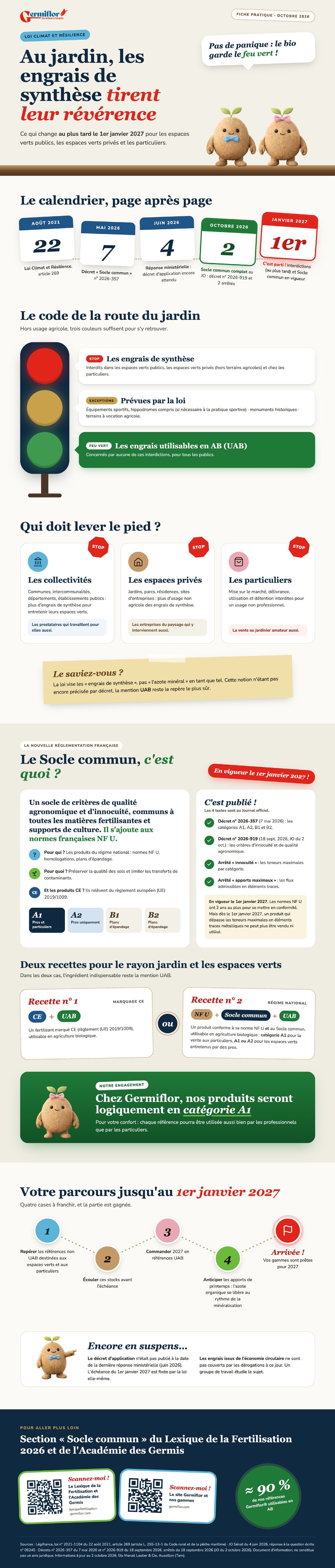
Germiflor fact sheet (in French), October 2026. For information only; does not constitute legal advice.
Why our products clear the 2027 hurdle: Mazor® and Cronops®
If almost all of our products are approved for organic farming, it is because they share the same foundation: Mazor®, a compost matured for seven months that guarantees one billion microorganisms per gram. It comes from Cronops®, our patented (FR2103847) controlled composting process, explained in detail on our process page.
Its raw materials are by-products also found in the garden or in the food industry: medicinal plant press cakes, grape and olive pulp, coffee grounds and, depending on the formulation, sterilized animal materials. In their raw state, these materials are unstable: their carbon breaks down quickly, their C/N ratio varies, and they can carry germs or temporarily lock up soil nitrogen. Controlled composting transforms them: it stabilizes the carbon as humus, balances the C/N ratio, eliminates pathogens as the temperature rises, and develops a beneficial microflora. It is this transformed material, not the raw material, that feeds the soil over the long term, which is exactly what a UAB fertilizer needs to mineralize well. The story of this innovation is told in Mazor®, a patented innovation serving agriculture.
Summary table: the 3-step method, 2027 edition
| Step | Goal | What changes in 2027 | Germiflor UAB products |
|---|---|---|---|
| 1. Soil support | Humus, structure, microbial life, available water capacity | Nothing in principle, but it is more than ever the foundation: without a living soil, organic nitrogen mineralizes poorly | BIOMAZOR, ORVEGA, Humiflor Germi’One |
| 2. Nutrition | The right nutrient at the right time | UAB fertilizers only outside agriculture; application brought forward by 2 to 4 weeks and split | POTAGER, FRUITIER, ORVEGA 6 |
| 3. Adjustments | Water, mulching, observation | Yellowing in spring often signals a soil that is still cold, not a lack of fertilizer: wait and water before adding more | Mulching, watering, reading the leaves |
Checklist before January 1, 2027
☐ I have read the label of every fertilizer in stock: UAB mention present or not.
☐ I have listed the non-UAB products intended for gardens or green spaces.
☐ I am using them up or selling them through before the deadline, at the rate on the label.
☐ I am ordering UAB products for the 2027 season.
☐ I have checked whether my sites qualify for an exemption (agricultural, sports, historic monument).
☐ Local authority: my maintenance contracts require UAB fertilizers, contractors included.
☐ I am applying an organic soil amendment this fall to prepare the soil.
☐ I am bringing my spring fertilizer application forward by 2 to 4 weeks.
☐ I am splitting the nitrogen application into two moderate passes.
☐ I am posting the infographic in the store aisle, the workshop or the maintenance department.
☐ I am asking my suppliers for the category, A1 or A2, of each product from 2027 onward.
☐ I am watching for the publication of the Climate and Resilience Act’s implementing decree.
Frequently asked questions about the 2027 synthetic fertilizer ban
▸ Can you still buy chemical fertilizer for your garden in 2027?
No, if that fertilizer is a synthetic fertilizer not approved for organic farming: selling, using and keeping it for non-professional use are banned by January 1, 2027 at the latest. Fertilizers and soil amendments bearing the UAB mention remain on sale and can be used in the garden.
▸ Can you keep your stock of synthetic fertilizer after January 1, 2027?
No: the law also bans keeping synthetic fertilizers for non-professional use. The simplest option is to use them up before the deadline, at the rate on the label; for any leftovers, ask your local recycling center.
▸ Can local authorities still fertilize their green spaces?
Yes, with fertilizers approved for organic farming. What is banned is using synthetic fertilizers on their grounds, or having a contractor use them, except on agricultural land and on sports facilities when play requires it.
▸ Are sports grounds affected by the ban?
No, not for now: sports facilities, including racetracks, can receive synthetic fertilizers when this is necessary for the quality of play. The law provides for a roadmap to roll out better fertilization practices on these grounds.
▸ What is a UAB fertilizer?
A UAB fertilizer is a fertilizer approved for organic farming (in French, “utilisable en agriculture biologique”): all of its raw materials are authorized by Regulation (EU) 2018/848. The mention appears on the label and is enough to exempt it from the 2027 ban, whoever the user.
▸ What is the difference between categories A1 and A2 of the common base?
An A1 product can be used by professionals and by home gardeners; an A2 product is reserved for professionals. The A1 thresholds, published on October 2, 2026, are stricter on trace metals (cadmium: 1.5 mg/kg dry matter for an organic fertilizer, versus 3 in A2) and on pathogens. B1 and B2 cover materials applied under a spreading plan.
▸ When does the common base apply?
On January 1, 2027, the date Decree No. 2026-919 and its two orders, published in the Official Journal on October 2, 2026, take effect. The NF U standards have until January 1, 2029 at the latest to comply, but a product that exceeds the maximum trace metal levels comes off the market as of January 1, 2027.
▸ Will a CE-marked fertilizer automatically be allowed in the garden?
No. CE marking exempts a product from the common base, not from the Climate and Resilience Act: for non-agricultural use, a CE fertilizer must also be approved for organic farming.
▸ What should garden centers do with their stock of synthetic fertilizers?
Identify it now, sell it through before January 1, 2027, and switch orders for the 2027 season to UAB products. After the deadline, these products can no longer be sold for non-professional use.
▸ Are mineral fertilizers from the circular economy affected?
As of now, they are not among the exemptions provided by the law. In June 2026, the ministry said a working group is studying the issue.
Germiflor products for this topic
BIOMAZOR
Organic soil amendment NF U 44-051-10
Prepares the soil to mineralize the nitrogen in UAB fertilizers: the go-to fall application.
63% organic matter, ISMO 55, approved for organic farming.
View product sheet →ORVEGA
100% plant-based organic soil amendment NF U 44-051-9
Builds humus and the soil’s water reserve, in a vegan formulation.
65% organic matter, C/N 19, approved for organic farming.
View product sheet →POTAGER
Organo-mineral fertilizer NF U 42-001-3
Feeds vegetables and herbs gradually, with 100% organic nitrogen.
NPK 4-8-10, 3% MgO, 39% organic matter, approved for organic farming.
View product sheet →ORVEGA 6
100% plant-based organo-mineral fertilizer NF U 42-001-3
The vegan all-purpose garden fertilizer, with 100% organic nitrogen.
NPK 6-4-6, 2% MgO, approved for organic farming.
View product sheet →Humiflor Germi’One (professional range)
Plant-based organic soil amendment NF U 44-051-9
For green spaces: structures the soil and boosts available water capacity ahead of UAB fertilizers.
55% organic matter, ISMO 59, C/N 19, UAB, vegan.
View product sheet →Further reading
Organic or mineral fertilizer: Marcel’s tips for choosing well
How a fertilizer’s origin affects how fast and how long it works.
Soil amendments: the key to a living soil
Why feed the soil before feeding the plant, even more so with UAB fertilizers.
The Fertilization Lexicon and the Germis Academy
UAB, common base, mineralization, C/N: every term in this article explained, with quizzes.
Why did we choose a 100% plant-based compost?
Behind the scenes of our raw materials and how we transform them.
Our company and where to find our products
Five generations of manufacturers since 1885, and the network of retailers near you.
Article written by the Germis, Germiflor’s educational mascots. Reviewed by the Germiflor technical team (Mazamet, Tarn, France), a manufacturer of organic and organo-mineral fertilizers since 1885. Sources: Légifrance, Law No. 2021-1104 of August 22, 2021, Article 269, and Article L. 255-13-1 of the French Rural Code (Code rural et de la pêche maritime); JO Sénat of June 4, 2026, answer to written question No. 06245; Decree No. 2026-357 of May 7, 2026. Information document current as of October 2, 2026; it does not constitute legal advice. Published on .