


03 novembre 2026
Mazor® and Cronops®: Germiflor’s patented plant-based compost
By the Germis · reviewed by Olivier Barthès, CEO of Germiflor · · 12 min read
At the foot of a four-meter windrow, Monsieur Germi reads the probe planted in the pile: 54 °C. “It’s working.” Madame Germi slides her hand into the dark, fine material, which smells like the forest floor. “Seven months of patience, and more than one billion microorganisms per gram. Mazor® is time, put in a bag.”
Mazor® is the plant-based compost at the base of all our fertilizers. Here is what it is made of, how it is made in seven months, what it contains, what its patent protects, what the trials have measured and in which products you will find it.
The essentials in 30 seconds
What. A 100 % plant-based compost, an NF U 44-051-9 organic soil amendment, made by Germiflor since 1980.
How. Seven months of controlled composting following the Cronops® process: materials sanitized by heat, windrows kept above 50 °C and turned every month, then one month of maturation.
What it contains. More than one billion microorganisms per gram, and organic carbon that is 50 % stable, 30 % labile and 20 % soluble.
The patent. FR 3 121 819, granted on December 15, 2023: it protects the process, the product and its use as a biological control agent.
Where to find it. Pure in Humiflor® Mazor® n°7, and at the base of all our fertilizers: HUMIFLOR® amendments, AB’Flor®, Mikroflor®, Deltaflor® and Fructiflor® fertilizers, and the Marcel le Jardinier range.
Contents
- The patented plant-based compost in brief
- What Mazor® is made of
- The 7 months of Cronops®
- Microorganisms, carbon, humus
- What the patent protects
- Biological control, suppressive effect
- What it changes in the soil
- Products made with Mazor®
- Our history in 6 dates
- The summary table
- The checklist
- Frequently asked questions
What is Mazor®, this patented plant-based compost?
Mazor® is a patented, 100 % plant-based compost made by Germiflor in Aussillon, near Mazamet (Tarn, France), from medicinal plant press cakes, grape and olive pulp and coffee grounds. Composted for seven months following the Cronops® process and protected by patent FR 3 121 819 (application FR 2103847), it contains more than one billion microorganisms per gram. It is the biological foundation of all our fertilizers, from soil amendments to AB’Flor® fertilizers.
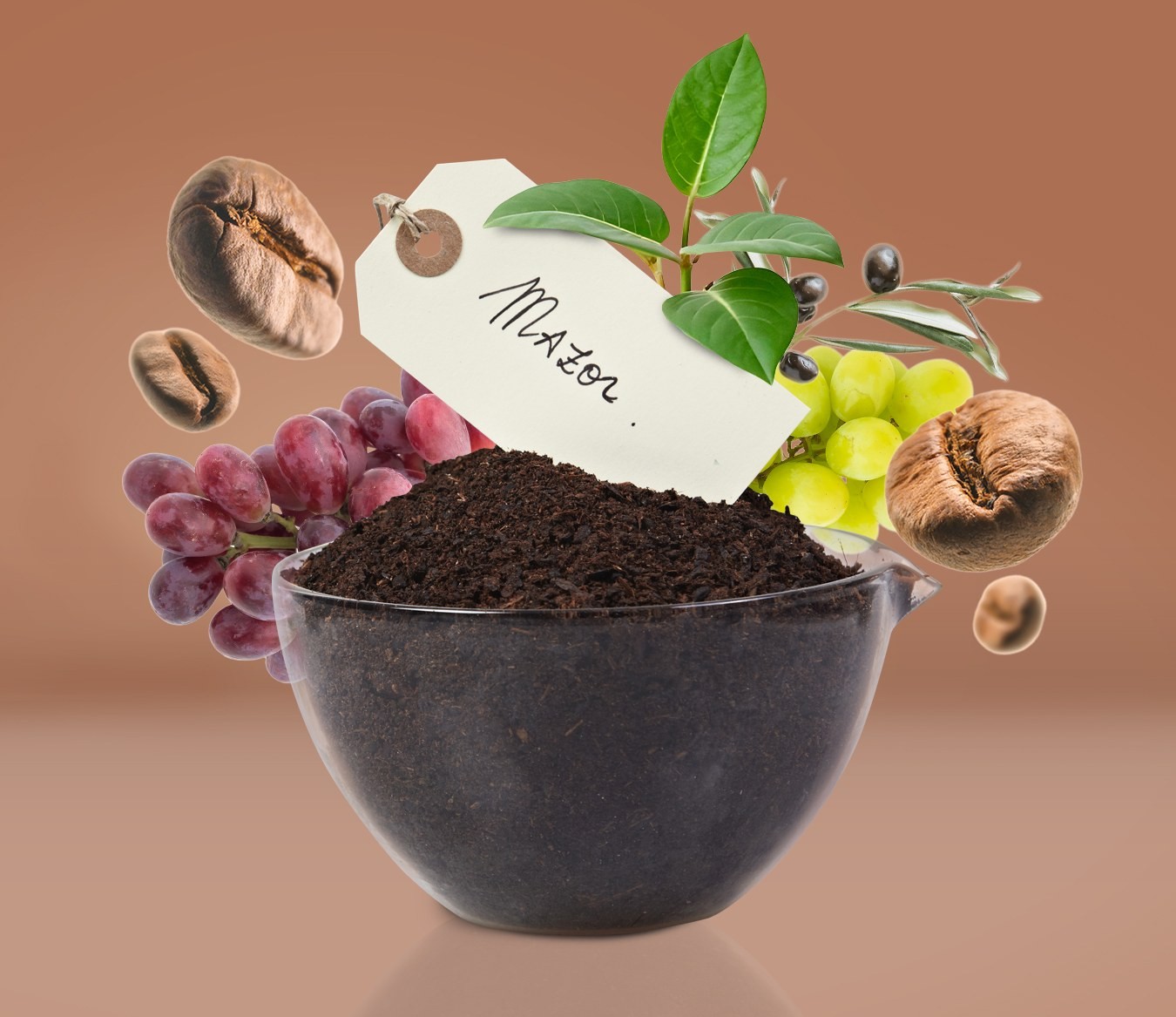
Mazor® and what it is made of: coffee grounds, grape and olive pulp and medicinal plants, composted for seven months.
From a regulatory standpoint, Mazor® is an organic soil amendment compliant with the NF U 44-051-9 standard, under the designation “compost of plant materials”, and it is suitable for organic farming under Regulation (EU) 2018/848. Our Aussillon site holds approvals as a composter and as a storer-blender (no. FR 81021129), which govern the composting, storage and blending of our materials. It is vegan: no animal material goes into its composition.
Its role comes down to one sentence: thanks to the Cronops® process, Mazor® improves the resilience of soils and plants. It supplies humus that lasts, it feeds soil life and it helps the soil hold on to water.
What is Mazor® made of?
Three families of plant materials, all coming from other industries: medicinal plant press cakes, which are what remains of the plants once their active ingredients have been extracted; grape and olive pulp, residues from pressing wine and oil; and coffee grounds. We source them as close to Mazamet as we can. This is the circular economy in the literal sense: co-products that become fertility again.
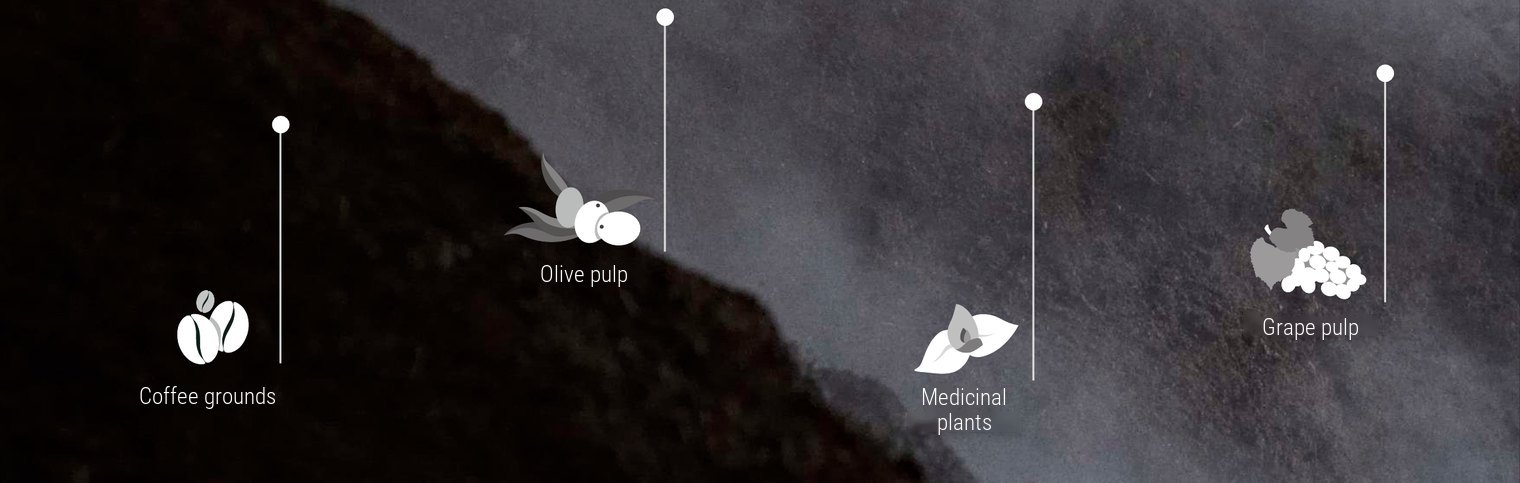
The materials of Mazor®, as presented in our brochure.
The exact proportions and the choice of plants are part of our know-how. What we guarantee are the results: every batch is analyzed before it becomes Mazor®, then again before it leaves the plant.
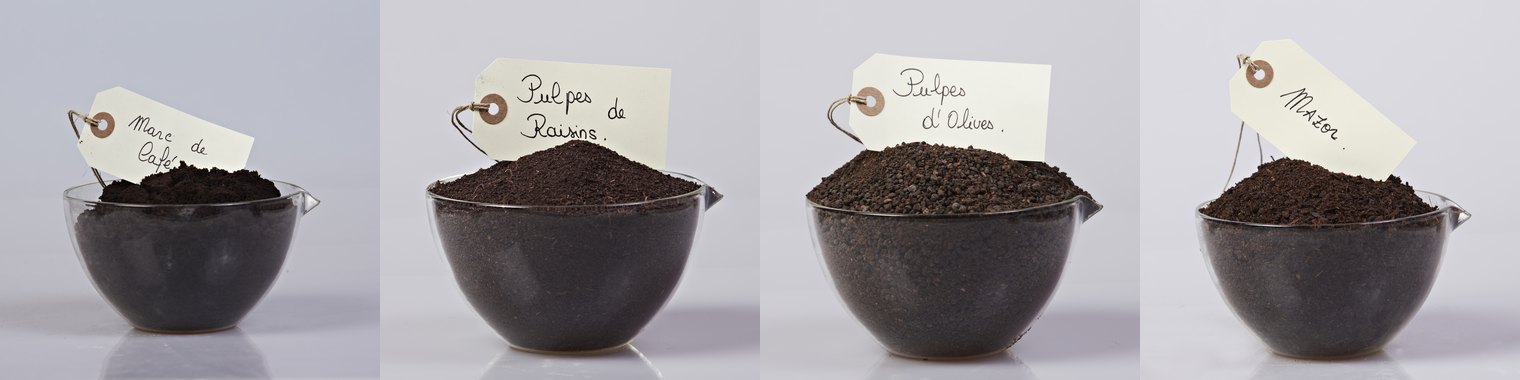
Coffee grounds, grape pulp, olive pulp… and what time makes of them: Mazor®, on the right. Photo: Germiflor laboratory.
Germis’ tip
Raw or composted: that is the whole difference
Coffee grounds and grape pulp are excellent organic materials. But applied raw, they break down unpredictably and can borrow nitrogen from the soil. Composted for seven months, the same materials become stable, sanitized and rich in microorganisms. It is not the material that changes, it is what time and the process make of it.
Why plant materials only? Our family made this choice for crop health safety and soil regeneration; we explain it in detail in why we chose a 100 % plant-based compost.
How is Mazor® made? The 7 months of the Cronops® process


Cronops® brings together two figures from antiquity: Cronos, whom tradition depicts with an hourglass as the figure of time, and Ops, the Roman goddess of abundance and fertility. Long time in the service of fertility. Our technical data sheet puts it in its own way: “time works for you.” Here is what the patent describes, month after month.

Cronos, time, and Ops, fertility: the two figures that gave the Cronops® process its name.
Before composting
Each material is sanitized by heat
Each component is treated at more than 100 °C before being blended. This step destroys pathogenic microorganisms, such as Listeria, salmonella or helminth eggs, and removes undesirable substances through steam.
Month 1
Blending and windrowing
The sanitized materials are blended, then built into windrows up to four meters high, with at least 50 % moisture. Fermentation starts and the pile heats up on its own.
Months 1 to 7
A temperature held above 50 °C
The patent describes a weekly reading; today, automatic probes monitor the temperature at the core of the windrows. It must stay above 50 °C, ideally between 50 and 55 °C, without exceeding 60 °C. Hot enough to sanitize, but not so hot that it burns the life out of the compost.
Every month, from the 2nd onward
Turning and sampling
The windrow is turned to aerate it, and samples are sent for physico-chemical and microbiological analysis. In the 4th month, bacteria and fungi grow intensely.
Month 5
Screening and sieving
The compost is ground, broken up, cleared of any metal particles by a magnet, then sieved to 6 mm. The oversize goes back into a younger batch: nothing is lost.
Months 6 and 7
More than one billion microorganisms, then maturation
From the 6th month, the compost contains more than one billion microorganisms per gram. In the 7th month, it matures: it is then ready to use, on its own or as the base of our fertilizers.
Industrial composting or garden compost: what changes
Mazor® comes from industrial composting, that is, composting carried out on an approved platform (approvals as a composter and as a storer-blender, no. FR 81021129), in large windrows, with the temperature monitored by automatic probes, regular turning and analyses at every stage. A garden compost relies on the same biological principles, but it heats unevenly, its duration varies and it is not analyzed. Industrial composting is only as good as its control: that is what guarantees sanitization, carbon stability and a consistent composition from one batch to the next.

Every month, the loader turns the windrow to aerate it.
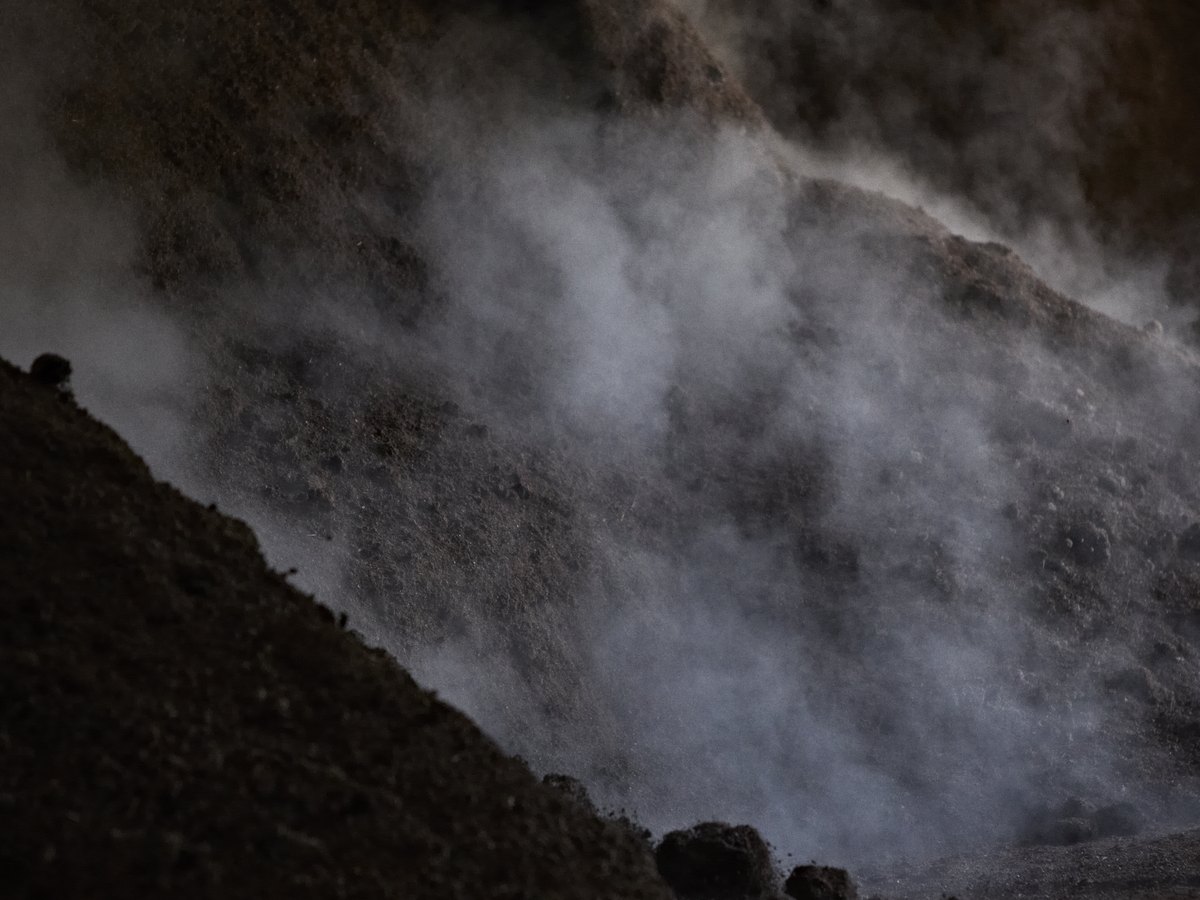
Above 50 °C, the windrow steams: automatic probes monitor its temperature.
 ▶
On video · Académie des Germis
Mazor® and the Cronops® process (in French)
Plant materials, seven months of monitored composting, billions of microorganisms: the compost at the base of our fertilizers, in two minutes.
To see the plant and every step, from raw material analysis to delivery, discover our manufacturing process.
What does Mazor® contain? Microorganisms, carbon and humus
A fertile soil is first and foremost a living soil: it is soil microorganisms, bacteria and fungi, that turn organic matter into humus and nutrients. Mazor® reaches the soil already populated. Counts carried out over six consecutive years by RITTMO Agroenvironnement®, a technological research center approved by the French Ministry of Research, give these benchmarks:
> 1 billion
microorganisms / g
more than one billion natural microorganisms per gram of Mazor®.
> 109
bacteria / g
more than one billion bacteria (CFU) per gram.
> 106
fungi / g
more than one million fungi (CFU) per gram.
> 40
genera
a microbial diversity of more than forty genera.
The Microhumus® institute, a specialist in micron-scale microscopic imaging, described and catalogued these microorganisms at the heart of Mazor®. The patent specifies the main families present: bacteria from the phyla Proteobacteria (including nitrogen fixers), Actinobacteria, Firmicutes and Thermotogae, and Ascomycete fungi, including the genus Penicillium.

Mazor® under the microscope, from the 1st to the 6th month of composting (Microhumus® images, MAZOR® brochure): in the 4th month, bacteria and fungi grow intensely; by the 6th, there are more than one billion microorganisms per gram.
Carbon at three speeds
The carbon in Mazor® does not act as a single block. According to our measurements, it splits into three fractions, each with its own role:
| Fraction | Share | What it does in the soil |
|---|---|---|
| Soluble carbon | 20 % | Available immediately: it restarts biological activity as soon as it is applied. |
| Labile carbon | 30 % | Available in the medium term: it feeds bacterial growth and stimulates the soil’s exchange capacity. |
| Stable carbon | 50 % | It builds lasting humus and increases the cation exchange capacity (CEC), that is, the soil’s ability to hold and then release calcium, magnesium and potassium. |
The result at the scale of a bag: Humiflor® Mazor® n°7 supplies 323 kg of stable organic matter per tonne (organic matter 42 % on fresh weight, ISMO 77, C/N 15), according to its technical data sheet. ISMO (organic matter stability index, XP U44-162 standard) measures the share that will become lasting humus: at 77, it is the highest in our range. To understand the difference between labile humus and stable humus, watch the Germis’ video (in French). To compare with manure, see the stable humus supplied per tonne, product by product.
Good to know
Analyzed, batch after batch
Our in-house laboratory, named Henri, analyzes every incoming raw material and approves every shipment. In 2022-2023, we carried out 2,473 analyses, 114 of them by COFRAC-accredited laboratories, with a quality and research budget of €300,000 per year. Mazor® is free of pathogens, organic trace compounds (PAHs), phytotoxicity risk and weed seeds, as stated on its technical data sheet.
What does the Cronops® patent protect?
Patent FR 3 121 819 is titled “Procédé de fabrication d’un amendement organique et son utilisation comme agent de lutte biologique” (process for manufacturing an organic soil amendment and its use as a biological control agent). Filed with INPI, the French patent office, in 2021, it was granted at the end of 2023 after examination and a search report. Its record is public: you can view it on the INPI website.
| The patent in brief | |
|---|---|
| Number | FR 3 121 819 (application FR 2103847) |
| Title | Process for manufacturing an organic soil amendment and its use as a biological control agent |
| Holder | Ets Marcel Lautier et Cie, Fertilisants Germiflor |
| Inventor | Jacques Barthès |
| Filing | April 14, 2021 |
| Publication of the application | October 21, 2022 |
| Grant | published on December 15, 2023 |
| Claims | 11 |
| Protection | until April 2041 at the latest |
Its eleven claims protect three things, which form a whole.
1. The manufacturing process
Plant materials (medicinal plants, grape and olive pulp, coffee grounds) sanitized at more than 100 °C, then composted for at least seven months with an initial moisture content of at least 50 % and a temperature held above 50 °C, with screening and sieving from the 5th month. This is the timeline described above.
2. The resulting product
A fine organic soil amendment (99 % of particles between 1 and 5 mm), with a C/N ratio between 12 and 18, containing at least one billion microorganisms per gram and polyphenols, and free of Listeria monocytogenes, salmonella and viable helminth eggs.
3. Its use as a biological control agent
This is the heart of the invention. The patent covers the use of Mazor® to prevent fungal diseases caused by soilborne fungi: fusarium diseases (Fusarium), damping-off (Pythium), rhizoctonia (Rhizoctonia) and certain mildews (Phytophthora), in vineyards, vegetable crops and cereals. Its description also attributes a soil disinfection action to it, and observations by the Microhumus® institute confirmed the sanitary and disinfecting properties of its microorganisms.
Biological control and suppressive effect: what the Mazor® trials show
Biological control, or biocontrol, means using living organisms or natural substances to hold back harmful organisms. In the soil, it works through known mechanisms: competition for space and food, the production of antimicrobial substances, the parasitism of pathogenic fungi and the stimulation of the plant’s defenses. Researchers speak of “suppressive” compost: a compost whose living microorganisms hold back soilborne diseases. A review published in 2020 in Frontiers in Microbiology points out that a sterilized compost loses this effect: it really is the life in the compost that does the work. Trials by Jacques Fuchs at FiBL, the Research Institute of Organic Agriculture, also observe this in practice: compared with the same compost sterilized, only the living compost protects the plants, because it brings “a whole, balanced microbial population” (FiBL poster, 2017, in French).
That is what the trials described in the patent measured on Mazor®, first in the laboratory, then in pots.
In the laboratory: fungal growth held back
An aqueous extract of Mazor® was placed in culture dishes with four pathogenic fungi, and their growth was compared with that in control dishes:
| Pathogenic fungus | Associated diseases | Growth reduced by |
|---|---|---|
| Fusarium graminearum | fusarium head blight of cereals | 52.4 % |
| Phytophthora sp. | rots, certain mildews | 39 % |
| Rhizoctonia solani | rhizoctonia, damping-off | 36.8 % |
| Fusarium oxysporum | fusarium wilt | 12 % (at 8 days) |
In pots: a suppressive effect on three soilborne diseases
Seedlings were then grown with or without Mazor®, in the presence of increasing doses of pathogens. The result: a suppressive effect, that is, plants less affected by the disease, on all three soilborne pathogens tested. With Pythium ultimum on cress, seedling mortality and shoot weight loss were significantly reduced at the two lowest pathogen doses tested. With Rhizoctonia solani on basil, the disease was significantly suppressed. With Fusarium oxysporum on flax, the plants withstood the pathogen better after two months of growth.
An honest reading
What these trials say, and what they do not
They show a measurable suppressive effect under controlled conditions: culture dishes and pots, known pathogen doses. They explain why a soil fed with Mazor® is a more resistant soil. They do not replace a field trial and do not make Mazor® a treatment product: Mazor® is not a plant protection product. It is placed on the market as an organic soil amendment (NF U 44-051-9) and is used at amendment rates, as indicated on its technical data sheet.
What does Mazor® change in the soil?
Three effects that reinforce one another.
It builds humus that lasts
Its half of stable carbon becomes humus, which binds soil particles into aggregates: the soil breathes, water soaks in, roots go deeper. This is the Germis’ method, in order: first soil support, then nutrition, finally adjustments. To learn everything about this first step, read our guide to organic soil amendments.
It helps the soil hold on to water
In our laboratory, 570 g of soil received the equivalent of 35 mm of rain, with or without Mazor®:
+5.4 %
at 1 t/ha
water retention capacity compared with the soil alone.
+7.4 %
at 2 t/ha
water retention capacity.
+59 %
moisture at day 30
at 2 t/ha (+40.8 % at 1 t/ha): the soil stays moist longer.
A soil that holds water gets through droughts and heat waves better. That is the point of our commitment: thanks to the Cronops® process, Mazor® improves the resilience of soils and plants. Mulching, watering, postponing fertilizer: our advice on protecting soil during a drought or a heat wave.
It feeds and strengthens soil life
Its microorganisms and soluble carbon restart biological activity as soon as it is applied; its labile carbon feeds soil bacteria over the following months. Active microbial life recycles nutrients, maintains structure and occupies the space that unwanted organisms would otherwise take. To see these bacteria at work, watch the Germis’ video on soil bacteria (in French).
This life needs air: a compacted or waterlogged soil tips into asphyxia, and humus also buffers swings in pH, as detailed in the FiBL technical sheet on humus management (in French). We explain it in soil life, oxidation-reduction and buffering effect.
Which products contain Mazor®?
Mazor® is sold pure, and it is the base of all our fertilizers: HUMIFLOR® amendments, AB’Flor®, Mikroflor®, Deltaflor® and Fructiflor® fertilizers, and the entire Marcel le Jardinier range. For the amendments, the technical data sheets state its share:
| Product | Share of Mazor® | For whom |
|---|---|---|
| Humiflor® Mazor® n°7 | 100 % Mazor® | professionals |
| Humiflor® Orvega®, ORVEGA® | 100 % Mazor® and composted plant press cakes | professionals, gardeners |
| Humiflor® Germi’One® | 89 % Mazor® and composted plant press cakes, 11 % pozzolan | professionals |
| Humiflor® Biomazor®, BIOMAZOR® | 91 % Mazor® and composted plant press cakes, 9 % sterilized animal proteins and bone | professionals, gardeners |

Plant-based organic soil amendment · pro range
HUMIFLOR® MAZOR® n°7
Mazor® in its pure form: the most stable organic matter in the range, in bulk or in 400 kg big bags.
ISMO 77323 kg stable OM/tover 1 billion microorganisms/gvegan
View product sheet
Organic soil amendment · pro range
HUMIFLOR® BIOMAZOR®
Mazor® enriched with sterilized animal proteins, to restart the biological activity of soils.
OM 61 %ISMO 55335 kg stable OM/tsuitable for organic farming
View product sheet
Organic soil amendment · garden
BIOMAZOR®
Mazor® in the garden: it restarts the life of a tired soil and builds humus.
Mazor® baseNF U 44-051-10vegetable garden, flower beds, orchard
View product sheet
Plant-based organic soil amendment · garden
ORVEGA®
100 % plant-based and vegan, to build structure and humus that last.
Mazor® base100 % plant-basedvegan
View product sheetThe full range: Marcel le Jardinier range and professional fertilizers.
 ▶
On video · Académie des Germis
How is a fertilizer made? (in French)
From soil analysis to delivery: how Mazor® goes into the making of our amendments and fertilizers at the Aussillon plant.
Where does Mazor® come from? Our history in 6 dates
1885
“Bourru” fertilizers
Gabriel and Philomène Lautier found the Maison Gabriel Lautier. In Mazamet, they make fertilizers called “bourru”, from wool and leather waste left over from fellmongering (pulling the wool from sheepskins): circular economy already.
The time of Marcel and Isabelle
Plant and animal
Marcel and Isabelle Lautier settle in Mazamet and improve the “bourru” with Henri Solomiac, our first chemical engineer, who summed it up: “plants feed the soil, animals stimulate soil life.”
1980
Mazor® is born
The family creates Mazor®, a plant-based compost, composted for seven months, which becomes the base of our fertilizers.
After the mad cow crisis
All plant-based
With the end of fellmongering and the mad cow crisis, we stop making composts of animal origin: Mazor®, 100 % plant-based, becomes the base of all our products.
2021
Filing the patent
On April 14, 2021, we file the patent for the Cronops® process and its use as a biological control agent with INPI.
2023
The grant
Patent FR 3 121 819 is granted; the grant is published on December 15, 2023.
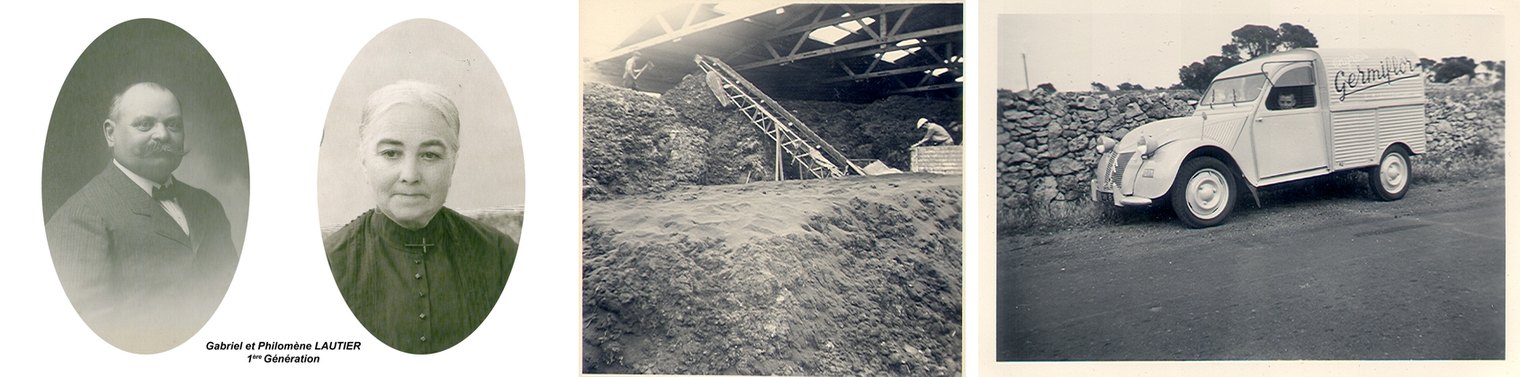
From our archives: Gabriel and Philomène Lautier, the first generation; a compost pile and its “sauterelle” (elevator conveyor) in the old shed; the delivery 2CV.
Five generations and more than 140 years later, the story continues in Aussillon. It is told in full on our company page.
Mazor® in one table: the Germis’ method
| Method step | The role of Mazor® | With which products |
|---|---|---|
| 1. Soil support | Supply stable humus, microorganisms and the means to hold water | Humiflor® Mazor® n°7, Biomazor®, Orvega®, Germi’One®; BIOMAZOR® and ORVEGA® in the garden |
| 2. Nutrition | Serve as the biological foundation for organic and organo-mineral fertilizers | All our fertilizers, in the pro range as in the garden |
| 3. Adjustments | Maintain a living, resilient soil every year | Soil analysis, observation, maintenance applications |
The checklist for making good use of a Mazor®-based amendment
☐ I have my soil analyzed before choosing the product and the rate.
☐ I choose between pure Mazor® n°7, Orvega® (100 % plant-based) or Biomazor®, depending on my soil and my production standards.
☐ I preferably spread it in fall or late winter, on soil that has drained.
☐ I mix the product into the top few centimeters of soil, without direct contact with the roots.
☐ I follow the rate on the technical data sheet: 1 to 2 t/ha for maintenance, 3 to 5 t/ha at planting for Mazor® n°7 in vineyards or orchards.
☐ I store it under cover: it is a living product.
☐ I cover the soil after applying it, with mulch or a green manure.
☐ I repeat the application every year or every two years, depending on the analysis.
Frequently asked questions about Mazor®
What is Mazor®?
Mazor® is a 100 % plant-based compost made by Germiflor since 1980 from medicinal plant press cakes, grape and olive pulp and coffee grounds. Composted for seven months following the patented Cronops® process, it contains more than one billion microorganisms per gram and is the base of all our fertilizers, from HUMIFLOR® amendments to AB’Flor® fertilizers.
What is a plant-based compost?
A plant-based compost is an organic soil amendment obtained by composting plant materials only. In France, it falls under the NF U 44-051 standard, under the designation “compost of plant materials.” Its quality depends on the starting materials and on the duration and control of composting: that is what sets Mazor® apart, composted for seven months following a patented process.
What is the Cronops® process?
Cronops® is the patented composting process behind Mazor®: materials sanitized at more than 100 °C, then at least seven months of composting above 50 °C, with one turning per month, sieving to 6 mm in the 5th month and one month of maturation. Its name combines Cronos, time, and Ops, fertility.
Is Mazor® patented?
Yes. Patent FR 3 121 819 (application FR 2103847), filed on April 14, 2021 and granted on December 15, 2023, protects its manufacturing process, the resulting product and its use as a biological control agent. Its record can be viewed on the INPI website.
Is Mazor® a plant protection product?
No. Mazor® is an organic soil amendment (NF U 44-051-9) and is used at amendment rates. Its patent covers its use as a biological control agent, studied in the laboratory and in pots, but it is not placed on the market as a plant protection product.
Does Mazor® have a suppressive effect on soilborne diseases?
Yes. The trials described in its patent measured a suppressive effect in pots on three soilborne pathogenic fungi: Pythium ultimum on cress, Rhizoctonia solani on basil and Fusarium oxysporum on flax. In the laboratory, a Mazor® extract reduced the growth of four pathogenic fungi by 12 to 52 %.
How many microorganisms does Mazor® contain?
More than one billion microorganisms per gram: more than one billion bacteria and more than one million fungi per gram, belonging to more than forty genera, according to counts carried out six years in a row with RITTMO Agroenvironnement®.
Is Mazor® suitable for organic farming?
Yes. Mazor® is suitable for organic farming under Regulation (EU) 2018/848, as stated on the technical data sheet of Humiflor® Mazor® n°7. It is also 100 % plant-based and vegan.
What is the difference between Mazor®, Biomazor® and Orvega®?
Mazor® is the base compost. Orvega® is 100 % Mazor® and composted plant press cakes: it remains 100 % plant-based. Biomazor® combines 91 % Mazor® with 9 % sterilized animal proteins and bone, to stimulate soil life even more.
What is the difference between Mazor® and a green waste compost?
A green waste compost recycles grass clippings, prunings and leaves. Mazor® is made from selected plant materials, sanitized by heat, composted for seven months under temperature control on a site approved as a composter and storer-blender, and analyzed batch after batch, with a counted microflora and a patented process.
Can Mazor® be used in the garden?
Yes, through the soil amendments of the Marcel le Jardinier range: BIOMAZOR® and ORVEGA® are made from Mazor® and sold in bags for the vegetable garden, flower beds and orchard.
Does Mazor® help soil during a drought?
Yes. In our laboratory, Mazor® increased a soil’s water retention capacity by 5.4 % at the equivalent of 1 t/ha and by 7.4 % at 2 t/ha, and the soil held up to 59 % more moisture thirty days after watering.
Learn with the Germis
Humus, ISMO, microorganisms: all the vocabulary, for free
The Lexique de la fertilisation, our fertilization glossary, explains soil and fertilizer terms. The Académie des Germis offers quizzes and videos to test what you know.
Discover the Lexique and the Académie · All the Germis’ videos on YouTube (in French)
Further reading
Organic soil amendment: definition, standards, choice and rates
What an amendment brings to the soil, and how to read its label.
Why did we choose a 100 % plant-based compost?
Crop health safety and soil regeneration: our choice explained.
Fresh manure, composted manure or Mazor®: which to choose?
The comparison in figures.
Precision fertilization
Innovation serving the agriculture of tomorrow.
Our process
From raw material analysis to delivery.
Our company
140 years of family history in Mazamet and Aussillon.
Mazor® for your soils?
Our team helps you choose the product and the rate based on your soil analysis.
Ask for advice Professional range For the gardenArticle written by the Germis, Germiflor’s educational mascots. Reviewed by Olivier Barthès, CEO of Germiflor and fifth generation of the founding family, with the Germiflor technical team (Mazamet, Tarn, France), maker of organic and organo-mineral fertilizers since 1885. Sources: patent FR 3 121 819 (application FR 2103847, grant published on December 15, 2023; INPI record, patent text), MAZOR® brochure (Germiflor laboratory, RITTMO Agroenvironnement®, Microhumus®), 2025-2026 technical data sheets of Germiflor products, Regulation (EU) 2018/848, S. Lutz et al., “Harnessing the Microbiomes of Suppressive Composts for Plant Protection,” Frontiers in Microbiology, 11:1810, 2020, J. Fuchs, “Compost de qualité: élixir de santé pour les sols,” FiBL, 2017, FiBL, technical sheet “Gestion de l’humus,” 2024. Published on .