


03 novembre 2026
Organic soil amendment: definition, standards, choice and rates
By the Germis · reviewed by Olivier Barthès, CEO of Germiflor · · 15 min read
In the bag aisle, a gardener hesitates between “organic soil amendment”, “compost” and “pelleted manure”. Madame Germi turns a bag over and points to three lines on the label: the standard, the organic matter and the ISMO (organic matter stability index). “It’s all written here. You just have to know how to read it.” Monsieur Germi smiles: “And know what you are asking of your soil.”
An organic soil amendment does not feed the plant: it builds the soil that carries it. Here is what it really does in the ground, how it differs from a fertilizer, what the standards guarantee (NF U 44-051, EU Regulation 2019/1009 and the new French socle commun, the common base of rules for fertilizing materials), how to choose one for your soil, and when to spread it, at what rate.

Mixed into the top few centimeters, an organic soil amendment enriches the soil layer where roots and soil life are at work.
The essentials in 30 seconds
What. Organic matter, most often composted, that improves soil structure, water reserve and soil life. It contains little nitrogen, phosphorus and potassium: less than 3 % of each under the NF U 44-051 standard.
When. In fall or late winter, on drained, workable soil, a few weeks before sowing or planting.
How much. In the garden, 0.5 to 2 kg/m² depending on the product and use. On a farm, 1 to 2 t/ha for maintenance and 3 to 5 t/ha when planting a vineyard or an orchard.
Drought. It helps the soil hold water: in our laboratory, Mazor® increased a soil’s water retention capacity by 5.4 % at the equivalent of 1 t/ha and by 7.4 % at 2 t/ha.
How to choose. Read the standard and the product designation, compare the stable organic matter per tonne (OM × ISMO), then match it to your soil.
Contents
- The short answer
- What the amendment does to the soil
- Drought and heat waves
- Soil life, redox, buffering
- Amendment or fertilizer
- The standards, explained
- Stable humus per tonne
- Choosing for your soil
- When and how much
- Compost, manure, homemade
- Mazor® and Cronops®
- The summary table
- The checklist
- Frequently asked questions
What is an organic soil amendment? The short answer
An organic soil amendment is a material of plant or animal origin, most often composted, applied to improve the soil itself: its structure, its ability to hold water and nutrients, and its biological life. It differs from a fertilizer, which feeds the plant directly. An organic amendment contains little nitrogen, phosphorus and potassium, but a lot of organic matter, part of which will become stable humus. In France, most are sold under the NF U 44-051 standard, which sets their composition and their maximum contaminant levels. To compare two products, the most useful figure is the amount of stable organic matter supplied per tonne.
The technical terms in this article (humus, ISMO, C/N, CEC) are explained simply in the Lexique de la fertilisation, our fertilization glossary, and our guide to fertilizing soils and plants explains why we feed the soil before feeding the plant.
What does an organic soil amendment do to the soil?
It acts on four soil functions, all linked to organic matter and to humus, the most stable fraction of that matter.
It builds structure
Humus binds with clay to form the clay-humus complex. These bonds stick particles together into aggregates, small stable crumbs with air and water moving between them. A well-structured soil is easier to work, compacts less, resists surface crusting better after a storm, and roots explore it more deeply. In heavy soil, the amendment opens things up; in light soil, it adds cohesion.
It holds water and nutrients
Organic matter holds water like a sponge, which increases the available water capacity, that is, the water plants can actually draw on. Humus also holds positively charged nutrients (calcium, magnesium, potassium): this is the cation exchange capacity, or CEC, the soil’s ability to store these elements and then release them to the roots. Weight for weight, humus holds far more of them than most clays. A soil richer in humus therefore loses fewer nutrients to leaching.
It feeds soil life
Bacteria, fungi, earthworms: all of them feed on the carbon in organic matter. As they break it down, they gradually release nutrients and produce the glues that stabilize aggregates. The part of the matter that is not stabilized serves as fuel for this life; the stable part forms the soil’s capital, as the Germis explain in our video on labile humus and stable humus (in French). Bacteria, the first workers on the job, have their own video too.
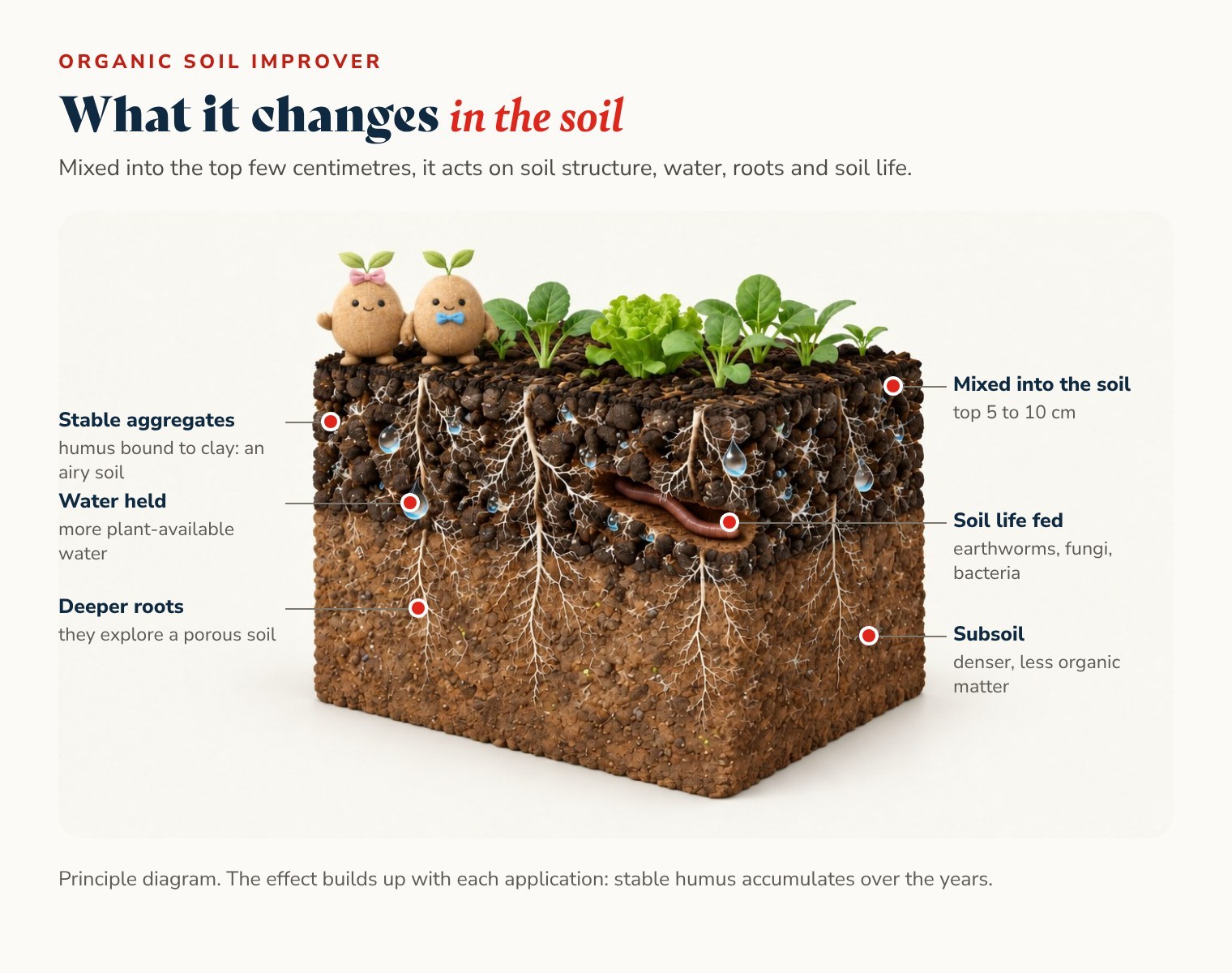
How it works: an organic soil amendment acts on structure, water, roots and soil life. The effect builds up application after application.
 ▶
On video · Académie des Germis
Biomazor and Orvega: feed the soil first (in French)
Why we always start with the soil, and what each amendment brings to it.
Organic soil amendment and drought: keeping water in the soil when it’s hot
An organic soil amendment helps the soil get through droughts and heat waves in two ways. Directly, organic matter holds water, which increases the available water capacity. Indirectly, and this is often the bigger effect, it builds a porous structure: rain or irrigation water soaks in instead of running off, the soil compacts less, no longer forms a surface crust, and roots go deeper in search of water. These effects build up application after application: it is the amendment spread in fall or late winter that prepares for summer, not the one spread in the middle of a heat wave.
What we measured with Mazor®
In our laboratory, we compared the same soil (570 g) on its own, then with Mazor® added at rates equivalent to 1 and 2 t/ha. Each sample received 200 mL of water, the equivalent of 35 mm of rain, and we measured the water that drained through. The soil alone retained about 71 % of the water poured; with the equivalent of 1 t/ha of Mazor®, 74.8 %; with 2 t/ha, 76.4 %. Mazor® therefore increased the soil’s water retention capacity by 5.4 % at 1 t/ha and by 7.4 % at 2 t/ha. Thirty days later, the amended soil was still clearly moister than the soil alone: 40.8 % more moisture at 1 t/ha, 59.2 % at 2 t/ha.
+5.4 %
Water retention · 1 t/ha
Soil retention capacity with the equivalent of 1 t/ha of Mazor®, compared with the soil alone.
+7.4 %
Water retention · 2 t/ha
With the equivalent of 2 t/ha of Mazor®, in the same test.
+59 %
Moisture at 30 days
Soil moisture thirty days after watering, at 2 t/ha (+41 % at 1 t/ha).
This test was run in our laboratory, on a single soil and under controlled conditions: it gives an order of magnitude, not a promise for every plot, because the real effect depends on soil texture, depth and compaction. The figures were measured on Mazor® itself, the base of our BIOMAZOR® and ORVEGA® amendments.
Thanks to the Cronops® process, Mazor® improves the resilience of soils and plants, that is, their ability to absorb a stress and then bounce back. Against drought and heat, this resilience comes down to three things: soil that holds the water of the last rains for longer, a structure that lets roots go deep, and soil life that stays active and keeps feeding the plant when water returns.
How much more water? The agronomic benchmarks
Published studies give cautious orders of magnitude. An international review (Minasny and McBratney, European Journal of Soil Science, 2018) estimates that a 1 % increase in soil organic carbon, about 1.7 points of organic matter, increases plant-available water by about 1.2 mm per 10 cm of soil. Arvalis, the French arable crops institute, finds that for deep clay loams, an extra half point of organic matter in the top 30 centimeters improves the available water capacity by about 4 mm. The same institute points out that abnormal compaction of the worked layer can cost 13 mm: keeping a soil aerated matters as much as enriching it, and that is where the structure built by the amendment makes the difference.
Before summer: preparing the soil
Spread the amendment in fall or late winter: soil life has time to incorporate it before the heat. In spring, cover the soil with 5 to 10 cm of mulch (straw, wood chips, dried grass clippings): it limits evaporation and keeps the surface cooler. On soil that crusts, light hoeing breaks up the cracks through which water escapes; as gardeners have long said, “one hoeing is worth two waterings”.
During a heat wave: the right moves
During a heat wave, the priority is water, not food. Water early in the morning or in the evening, at the base and generously, rather than a little every day: deep watering encourages roots to go down. Do not work dry, scorching soil, you will only dry it out further. Postpone fertilizer applications: in dry soil, soil life slows down and mineralizes little, and the fertilizer stays on the surface without feeding the plant; wait until rain or watering has moistened the soil again. Finally, keep the mulch in place: it protects soil life from the heat.
Germis’ tip
The right order before summer
Amend in fall, mulch in spring, water deeply during the heat. The amendment builds the reserve, the mulch protects it, watering fills it.
Soil life, oxidation-reduction, buffering capacity: what organic matter regulates below the surface
An organic soil amendment does more than fill the soil with matter: it feeds a population, helps the soil breathe and cushions the swings of the season. These three effects are linked. Soil life needs carbon and oxygen; oxygen depends on structure; and the humus that this life produces gives the soil its inertia, its buffering capacity.
A population to feed
Beneath one hectare of soil live on average about a dozen tonnes of living organisms, roots included: about 6 t of roots, 3.5 t of fungi, 1.5 to 2.5 t of bacteria and 1 to 5 t of animals, according to the synthesis by Gobat and colleagues cited by the Hauts-de-France Chambers of Agriculture. A single gram of soil can host up to a billion bacteria. Earthworms weigh from 500 kg to 5 t per hectare depending on the soil, according to the Languedoc-Roussillon Chambers of Agriculture.
Each has its job. Bacteria and fungi break down organic matter, release nitrogen, phosphorus and sulfur in a form the plant can absorb, and produce the glues and filaments that hold aggregates together. Mycorrhizal fungi extend the roots and fetch water and phosphorus from farther away. Earthworms churn the soil: the vertical burrows of anecic earthworms, which can last up to eight years, let rain soak in deep, and their casts on the surface limit crusting. Around the roots, the plant itself feeds this life with part of its sugars: this is the rhizosphere.
This whole population feeds on carbon: organic matter is its source of energy. In soil poor in organic matter, it runs slowly, and so does the mineralization that feeds crops. The labile part of an amendment feeds this life within the year; the stable part, humus, gives it a lasting habitat. Mazor® adds its own microflora: more than one billion microorganisms per gram, developed during its Cronops® composting.
Abundant soil life also holds back certain pathogenic fungi: it occupies the space, uses up the resources and produces substances that slow them down. Researchers speak of a “suppressive” soil or compost. This is the subject of the Cronops® patent and its trials.
 ▶
On video · Académie des Germis
The rhizosphere, a city beneath our feet (in French)
What happens around the roots: the sugars the plant gives, the nutrients soil life gives back.
Oxidation-reduction: a soil needs to breathe
pH measures a soil’s acidity. The oxidation-reduction potential, or redox potential (written Eh), measures something else: the tendency of the medium to give up or take up electrons, which in practice means whether it is well oxygenated or not. Researcher Olivier Husson (Cirad) showed, in a review published in 2013 in the journal Plant and Soil, that pH and redox potential are, separately and together, two major drivers of how soils, plants and microorganisms function, and that these in turn adjust both around the roots.
In an aerated soil, microorganisms breathe the oxygen in the air held in the pores. When the soil is waterlogged or compacted, oxygen runs out: microorganisms then fall back on other compounds, first nitrates, then manganese, iron and sulfates. The nitrogen in nitrates goes back into the air as gas (this is denitrification); reduced iron becomes mobile and leaves gray mottles and rust spots in the profile, signs of a soil that regularly lacks air; in extreme cases, a rotten-egg smell appears. Roots deprived of oxygen take up water and nutrients poorly, even when they are present.
Organic matter works both ways. Stable, in the form of humus, it builds the aggregates and pores through which air enters: a soil rich in humus drains faster and stays oxygenated. Fresh and in excess, buried in wet, compacted soil, it does the opposite: its decomposition uses up oxygen and can tip the soil into asphyxiating conditions where humification stops, as the Languedoc-Roussillon Chambers of Agriculture point out. That is one more reason to prefer a composted, stabilized amendment to a raw material, and to spread it on drained soil, mixed into the top few centimeters.
 ▶
On video · Académie des Germis
Soil redox potential: pH doesn’t tell the whole story (in French)
Why a soil short of air changes the form of iron, manganese and nitrogen, and what that means for the plant.
Buffering capacity: organic matter cushions the swings
Humus carries chemical groups on its surface (carboxyls, phenols) that capture or release hydrogen ions depending on the medium. A soil rich in humus therefore resists pH swings better, those brought by rain, the nitrification of nitrogen or certain fertilizers: this is buffering capacity, which the Swiss research institute FiBL counts among the chemical properties of humus.
The same mechanism regulates nutrition. Humus stores calcium, magnesium and potassium on its exchange capacity, then releases them as the roots draw on them, instead of letting them drain away with the water. It also retains part of the trace metals and pesticide residues, which limits their transfer to plants and groundwater. And, as we have seen, it cushions water shortages. The soil gains inertia: it copes better with a storm, a drought, a badly placed fertilizer application.
Buffering is not correcting: an organic soil amendment does not lower the pH of a chalky soil and does not replace liming on an acid soil. It smooths out the swings, which gives soil life and roots a more stable environment.
Germis’ tip
Reading soil life in an analysis
Ask the laboratory for organic matter and microbial biomass, in addition to pH and CEC. The Languedoc-Roussillon Chambers of Agriculture consider microbial biomass very low below 100 mg of carbon per kilo of soil and adequate between 200 and 300 mg. In the field, count the earthworms in a spadeful of soil in spring and smell the soil: a forest-floor smell signals a soil that breathes, a rotten-egg smell a suffocating one.
Organic soil amendment or fertilizer: what’s the difference?
An organic soil amendment works for the soil, over several years; a fertilizer works for the crop, over the season. They are not covered by the same standard and are not dosed the same way.
| Organic soil amendment | Organic or organo-mineral fertilizer | |
|---|---|---|
| Role | Improve the soil: structure, humus, water reserve, biological life | Supply the crop with the nutrients it needs |
| French standard | NF U 44-051 | NF U 42-001 |
| N, P₂O₅, K₂O content | Less than 3 % each and less than 7 % in total (on fresh weight) | Guaranteed contents, higher |
| Figures to read | Organic matter, ISMO, C/N | N-P-K, nitrogen form, magnesium |
| Effect | Slow and lasting | Fast, over the season |
| Timing | Fall, late winter | Start of growth, in split applications |
| Germiflor examples | BIOMAZOR®, ORVEGA®; Humiflor® range | POTAGER, FRUITIER; AB’Flor® range |
The two complement each other: that is the Germis’ method, applied in this order. To learn more about fertilizers, read about the differences between organic and mineral fertilizers.
 ▶
On video · Académie des Germis
Organic, mineral, organo-mineral: what really changes (in French)
An amendment enriches the soil with humus, a fertilizer feeds the plant: the three families of fertilizers and what each one brings, in a minute and a half.
On the fertilizer side, a crop needs all nutrients at once: the one in shortest supply limits growth, as the video on the law of the minimum and interdependence (in French) reminds us. And in an organic fertilizer, each pellet becomes a small biological worksite in the soil: soil life breaks it down and releases its nutrients little by little.
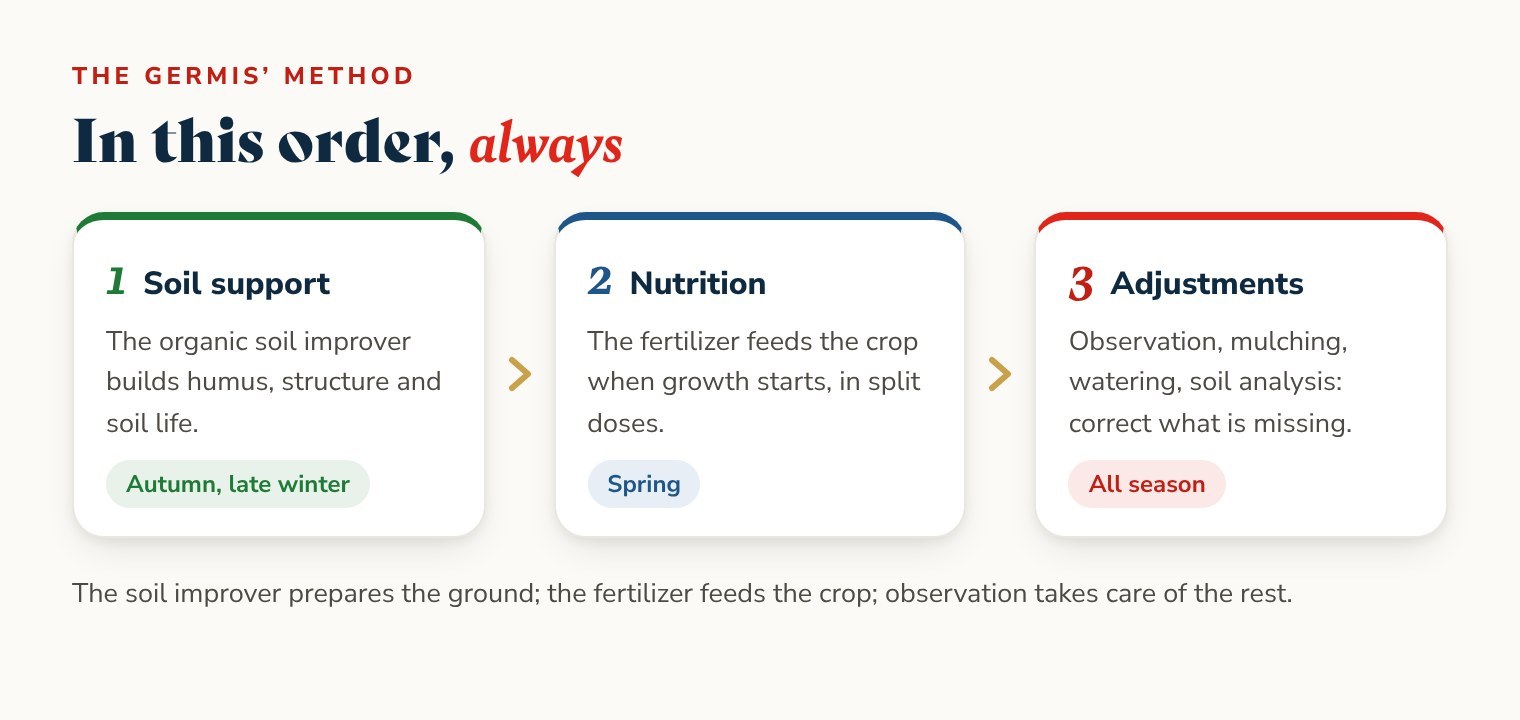
Common mistake
Thinking an amendment replaces fertilizer
An organic soil amendment supplies a little nitrogen, phosphorus and potassium, but releases them slowly and in small amounts. It prepares a soil able to use fertilizer; it does not cover the needs of a crop in full growth. In spring, fertilizer is still needed, at the right rate.
What standards govern an organic soil amendment?
A bag of amendment carries precise guarantees, provided you know how to read them. The French NF U 44-051 standard says what an organic soil amendment is and what its label must declare. The French socle commun sets the safety criteria for all products sold through a French route; its maximum metal contents apply from January 1, 2027. EU Regulation 2019/1009, for its part, covers CE-marked products.
The routes for placing a fertilizing product on the market
In France, a fertilizing material is sold through one of these routes: compliance with a standard made mandatory (NF U 44-051 for organic soil amendments, NF U 42-001 for fertilizers), a marketing authorization issued by Anses, the French agency for food, environmental and occupational health and safety, specifications approved by regulation, or the CE marking provided for by Regulation (EU) 2019/1009. Our amendments are placed on the market under the NF U 44-051 standard.
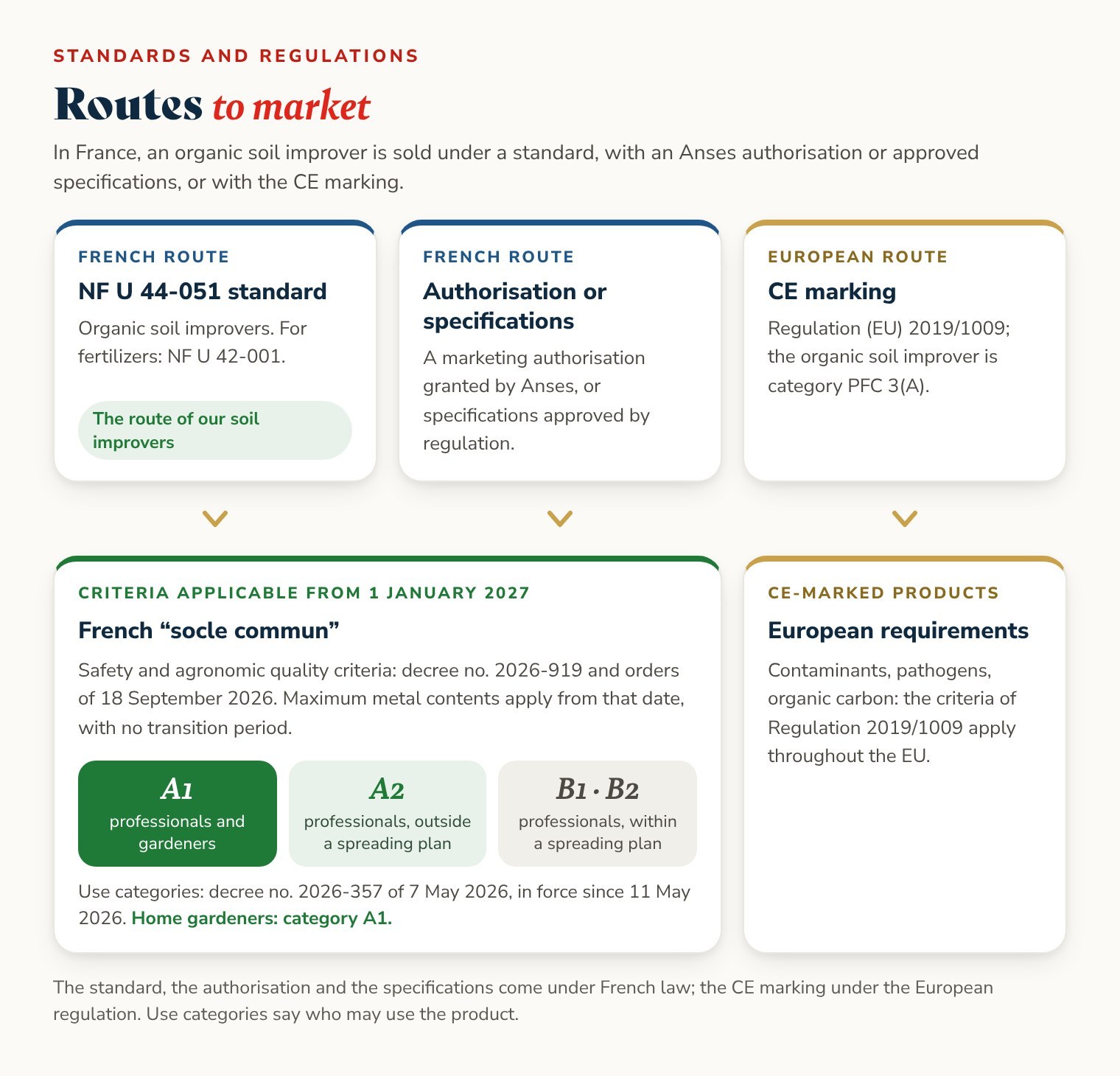
The standard, the authorization and the specifications fall under French law; the CE marking falls under the EU regulation. The use categories of the socle commun say who may use the product.
The socle commun: the criteria that apply from January 1, 2027
The socle commun is the new French regulatory base for fertilizing materials and growing media sold under a standard, an authorization or approved specifications; CE-marked products are not covered, they follow the EU regulation. Decree No. 2026-357 of May 7, 2026, in force since May 11, 2026, places each material in a use category: A1 for professional and non-professional users, A2 for professionals only outside a spreading plan, B1 and B2 for professionals within a spreading plan. It also requires manufacturers to run analyses at least every six months, and labels to state the category, the authorized uses, the annual rate and the frequency of applications. Decree No. 2026-919 and two orders of September 18, 2026, published in the Journal officiel (the French official gazette) of October 2, 2026, set the criteria and their values, applicable from January 1, 2027.
For a gardener, the category to remember is A1: it is the only one open to non-professionals, and the most demanding. Our products logically fall into this category. For an organic soil amendment, the order sets the following maximum contents for A1:
| Socle commun criterion (category A1) | Maximum content for an organic soil amendment |
|---|---|
| Trace metals (mg/kg of dry matter) | cadmium 2; hexavalent chromium 2; mercury 1; nickel 50; lead 120; arsenic 40; copper 300; zinc 800 |
| Inert impurities over 2 mm (g/kg of dry matter) | plastic 3 (2.5 for composts), glass 3, metals 3, and 5 in total |
| Organic trace compounds (mg/kg of dry matter) | PCBs 0.8; PAHs 6 for the sum of the 16 (or fluoranthene 4, benzo[b]fluoranthene 2.5 and benzo[a]pyrene 1.5); dioxins and furans 20 ng TEQ/kg |
| Pathogens (on fresh weight, five samples) | Salmonella: absent in 1 g; Escherichia coli or enterococci: 1,000 per gram, no sample at 5,000 or more |
Source: order of September 18, 2026 setting the values and assessment methods for the safety criteria, Annex I.
For metals, there is no grace period: from January 1, 2027, a product that exceeds the category A1 maximum contents can no longer be sold to gardeners, and a product that exceeds the category A2 maximum contents can no longer be sold or used, stocks included.
The second order of September 18, 2026 adds a rule of use: the directions for use must make it possible not to exceed, each year and per hectare, 3 g of cadmium, 10 g of mercury, 90 g of arsenic, 300 g of nickel, 600 g of chromium, 900 g of lead, 1,000 g of copper and 3,000 g of zinc. A professional may make a one-off application up to three times higher, provided later applications are then spaced out; the label then says so with a mandatory statement: “Do not use more than once every x years”. Example with ORVEGA®: at 2 t/ha, the maintenance rate for a vineyard or an orchard, it supplies about 51 g of copper and less than 0.2 g of cadmium per hectare, very far below these ceilings.
The NF U 44-051 standard: what an organic soil amendment is
The standard defines the product. According to the Chambers of Agriculture fact sheet on regulatory thresholds, to be called an organic soil amendment, a product must contain more than 30 % dry matter, a minimum organic matter content that depends on its designation (15 to 25 % of the fresh product), less than 3 % each of nitrogen, phosphorus (P₂O₅) and potassium (K₂O) and less than 7 % in total, and its carbon-to-nitrogen ratio (C/N) must be above 8. Beyond these nutrient contents, it is a fertilizer. The standards have two years, until January 1, 2029, to be brought into line with the socle commun.
On the label, the number attached to the standard indicates the product designation: “NF U 44-051-9” means a compost of plant materials (this is the case for ORVEGA®, Germi’One® and Mazor® n°7), “NF U 44-051-10” a compost of plant and animal materials (this is the case for BIOMAZOR®). The label must also declare dry matter, organic matter, total nitrogen and its organic share, the C/N, and phosphorus, potassium and magnesium from 0.5 %. Here is the example of the ORVEGA® technical data sheet:
| What the ORVEGA® label says | Declared value | Requirement of the standard |
|---|---|---|
| Dry matter | 80 % | more than 30 % |
| Organic matter on fresh weight | 61 % | minimum depending on the designation |
| Total nitrogen (N) | 1.6 %, organic, non-urea | less than 3 % |
| Phosphorus (P₂O₅) | 0.3 % | less than 3 % |
| Potassium (K₂O) | 1.9 % | less than 3 % |
| Total N + P₂O₅ + K₂O | 3.8 % | less than 7 % |
| C/N | 19 | more than 8 |
| ISMO | 52 % of the organic matter | not required: a plus for comparing products |
Two statements on the same label deserve an explanation. “Type 1, in accordance with the Nitrates Directive”: a C/N above 8 places the product among type I fertilizers, those that release their nitrogen slowly, which sets its spreading periods in nitrate vulnerable zones. “In accordance with Regulation (EU) 2018/848”: the product is suitable for organic farming.
Regulation (EU) 2019/1009 and the CE marking
Since July 16, 2022, this regulation has harmonized CE-marked fertilizing products, which circulate freely throughout the Union. It places each product in a product function category: the organic soil amendment (“organic soil improver” in the regulation) is category PFC 3(A). It must be of exclusively biological origin for at least 95 % of its mass, contain at least 20 % dry matter and at least 7.5 % organic carbon. Its maximum metal contents are the same as those of socle commun category A1; Salmonella must be absent in 25 g, and Escherichia coli or enterococci limited to 1,000 per gram.
The CE marking coexists with the French routes: an amendment sold under the NF U 44-051 standard is not CE-marked and follows French rules, including the socle commun. On the metals measured, ORVEGA® is well below both references:
| Metal (mg/kg of dry matter) | ORVEGA® (analysis) | Socle commun A1 | EU regulation, PFC 3(A) |
|---|---|---|---|
| Cadmium | less than 0.1 | 2 | 2 |
| Mercury | less than 0.2 | 1 | 1 |
| Nickel | 2.7 | 50 | 50 |
| Lead | less than 2 | 120 | 120 |
| Copper | 31.9 | 300 | 300 |
| Zinc | 28.9 | 800 | 800 |
Source: ORVEGA® 2025-2026 technical data sheet; order of September 18, 2026; Regulation (EU) 2019/1009. Chromium is not compared: both texts limit hexavalent chromium, while the technical data sheet gives total chromium.
The Lexique de la fertilisation has a page on the EU regulation and another on the socle commun, and the Académie des Germis lets you test your knowledge while having fun.
Germis’ tip
Reading a label in five lines
The standard and its designation (NF U 44-051-9 or -10); the use category (A1 or A2) and the annual rate, which the label must now state; the organic matter on fresh weight; the ISMO or, better, the stable organic matter per tonne; the C/N. With this information, you know what you are buying, whether you are allowed to use it, and you can compare two bags.
How much stable humus does an organic soil amendment supply?
What matters for the soil in the long term is the share of organic matter that will become stable humus. It is calculated by multiplying the organic matter on fresh weight by the ISMO, the organic matter stability index defined by the XP U44-162 standard. Example with BIOMAZOR®: 61 % organic matter, or 610 kg per tonne; with an ISMO of 55, about 335 kg are likely to join the soil’s stable organic matter. The rest is mineralized by soil life in the following months and feeds the crops.
According to their 2025-2026 technical data sheets, ORVEGA® supplies 319 kg of stable organic matter per tonne, Germi’One® 324 kg and Mazor® n°7, 323 kg: the latter contains less organic matter (42 %), but the most stable in the range (ISMO 77). According to the organic products guide of the Languedoc-Roussillon Chambers of Agriculture (2011), a tonne of stored manure supplies around 70 to 100 kg of stable organic matter for cattle manure and up to 180 kg for horse manure on straw. The gap is mostly down to water: manure contains 60 to 80 %, BIOMAZOR® and ORVEGA® about 20 %.
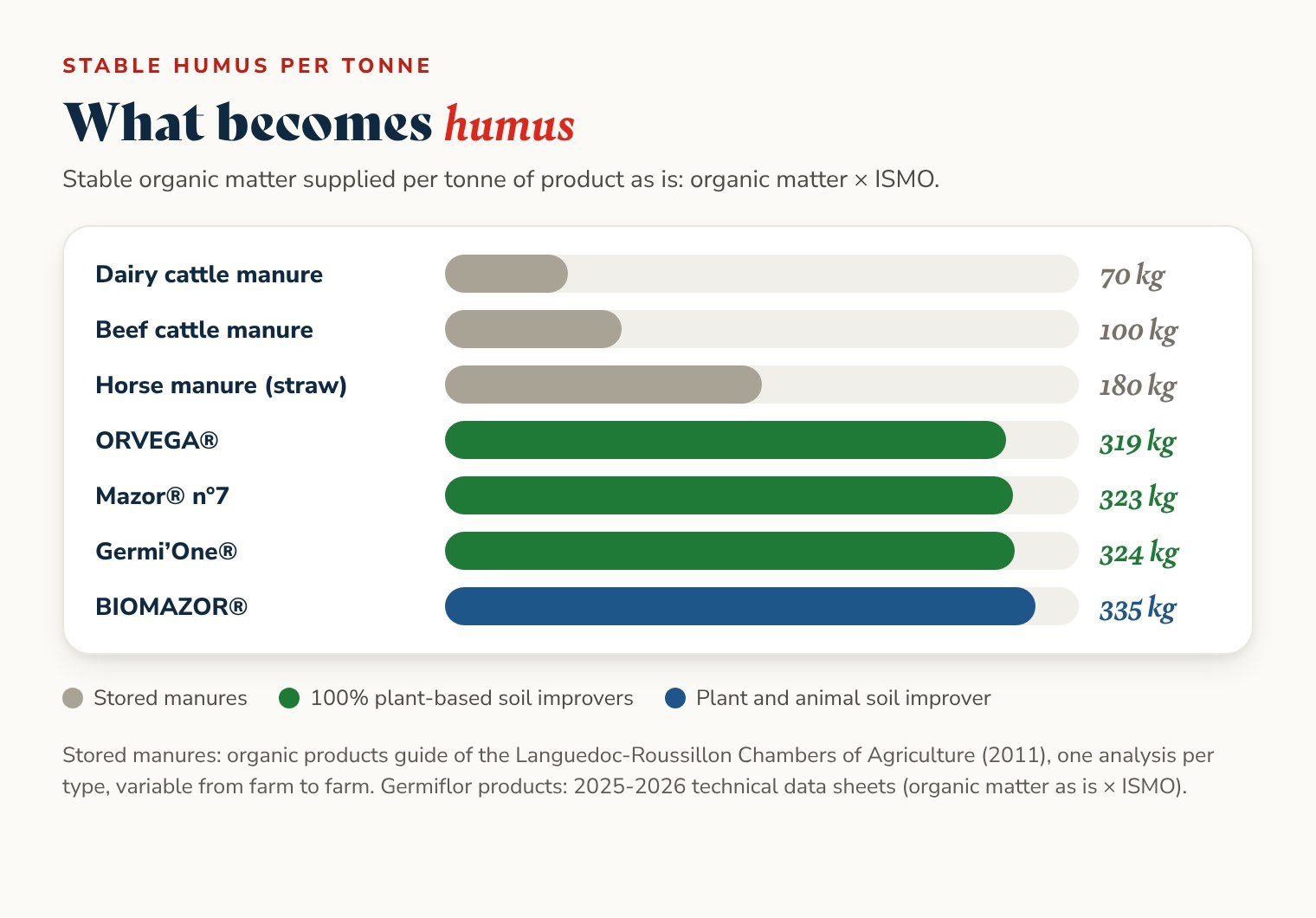
Stable organic matter per tonne of fresh product. Stored manures: one analysis per type, variable from one farm to another. Germiflor products: 2025-2026 technical data sheets.
 ▶
On video · Académie des Germis
Labile humus, stable humus: the fuel and the capital (in French)
Why part of the amendment feeds soil life within the year, and why the other part builds up the humus capital for years.
Common mistake
Comparing two bags on price alone
Two amendments at the same price can supply very different amounts of stable humus. Work out the price per tonne of stable organic matter (OM × ISMO): that is what stays in your soil.
How do you choose an organic soil amendment?
Depending on your soil
In a clay soil, heavy and sticky, an organic soil amendment promotes aggregates and porosity: the soil drains faster and is easier to work. In a sandy soil, it holds the water and nutrients that leak downward. In a silty soil, it helps resist surface crusting. In a chalky soil, it supports soil life, but does not correct the pH: that is not its role, it only cushions its swings (this is the buffering effect).
Plant-based, or plant and animal
ORVEGA® is 100 % plant-based and vegan: a compost of Mazor® and plant press cakes, with a C/N of 19, geared toward building humus and structure (319 kg of stable organic matter per tonne).
BIOMAZOR® combines Mazor® with 9 % sterilized animal proteins and bones: a little more nitrogen (2.1 %) and a C/N of 14, to restart the life of a tired soil faster (335 kg per tonne). Both are suitable for organic farming.
C/N, an indicator, not a grade
The carbon-to-nitrogen ratio tells you how nitrogen will behave, not how good the product is. Above about 25, a fresh material may take nitrogen from the soil to decompose: this is nitrogen hunger. A mature compost, around 12 to 20, releases little in the first year and asks almost nothing of the soil. The product’s maturity and its ISMO count as much as the C/N, as the Germis’ video on nitrogen hunger (in French) shows.
Germis’ tip
Our method: the whole soil, not two isolated figures
When we recommend an amendment, we start from a complete soil analysis, made from several samples spread across the plot, cross-checked with the crop and the soil profile. We go and see the plot to judge texture and structure on site, and we discuss it with the farmer or their advisor. The product and the rate are chosen afterward, because each material reacts differently depending on the soil and the crop.
When and how do you spread an organic soil amendment?
The best time is fall, after harvest, or late winter, on drained, workable soil, a few weeks before sowing or planting. A composted, stable amendment can also be applied in spring. Spread it on the surface, then mix it into the top few centimeters of soil with light raking: the technical data sheet asks for it to be well mixed into the soil to avoid direct contact with the roots. Then cover the soil, with mulch or a green manure, to protect the humus as it forms.
Rates in the garden
| Product | Use | Rate |
|---|---|---|
| BIOMAZOR® | Soil preparation | 1 to 2 kg/m² |
| Maintenance | 0.5 to 1 kg/m² | |
| ORVEGA® | Vegetable crops, at soil preparation | 500 to 800 g/m² |
| Planting trees | 3 to 5 kg per tree, depending on size | |
| Sowing a lawn | 500 g to 1 kg/m² |
Rates from the Marcel le Jardinier product sheets. To maintain a lawn afterward, FRUITIER fertilizer is applied at 150 g/m² after the first mowing.
Rates on a farm
| Crop | Planting | Maintenance |
|---|---|---|
| Vineyards | 3 to 5 t/ha | 1 to 2 t/ha |
| Open-field vegetables | 2 to 5 t/ha | 2 to 4 t/ha |
| Greenhouse vegetables | 3 to 7 t/ha | 2 to 5 t/ha |
| Orchards | 3 to 5 t/ha | 1 to 2 t/ha |
| Horticulture | 5 to 8 t/ha | 2 to 5 t/ha |
| Green spaces | 5 to 8 t/ha | 1 to 2 t/ha |
Indicative rates from the Humiflor® technical data sheets (Biomazor®, Orvega®, Germi’One®, Mazor® n°7), to be adjusted to the soil, the crop and regional practices. For vineyards, see also organic soil amendment for vineyards after harvest.
Common mistake
Leaving the amendment on the surface, or putting it at the bottom of the hole
On the surface, it dries out and works poorly; at the bottom of the planting hole, in contact with the roots, it can burn them. Mix it into the top few centimeters of soil, over the whole area the roots will explore.
Compost, manure, coffee grounds: what about homemade amendments?
A well-matured garden compost is an excellent organic soil amendment: dark, fine, with a forest-floor smell. It varies from one heap to another and is not analyzed. Manure also makes a good amendment, as long as it is composted: fresh, it can cause nitrogen hunger and bring in weed seeds, as explained in our comparison of fresh manure, composted manure and Mazor®.
Coffee grounds, grape and olive pulp or plant press cakes are good organic materials: they go into the making of Mazor®. What changes everything is their state. Raw, a fresh material decomposes unpredictably and can borrow nitrogen from the soil; composted under the right conditions, it is stabilized, sanitized and ready to build humus.
Mazor® and Cronops®: what controlled composting changes


Mazor® is the biological foundation of all our fertilizing products, soil amendments and fertilizers alike. It is a 100 % plant-based compost: medicinal plant press cakes, grape and olive pulp, and coffee grounds. It is produced by Cronops®, our patented composting process (patent FR 3 121 819, application FR 2103847). Throughout seven months of composting, automatic probes monitor the temperature: carbon stabilizes, the C/N falls, pathogens and seeds are destroyed, and a microflora develops, with more than one billion microorganisms per gram in Mazor®.
The process’s name sums up its philosophy: Cronops® brings together Cronos, traditionally depicted with an hourglass as the figure of time, and Ops, the Roman goddess of abundance and fertility. Time in the service of fertility: seven months of composting for years of humus in the soil.
Patent FR 3 121 819, granted in December 2023, protects the process, the product and its use as a biological control agent. The seven months of composting, the microorganisms and the trials run in the laboratory and in pots are detailed on our page on Mazor® and the Cronops® patent.
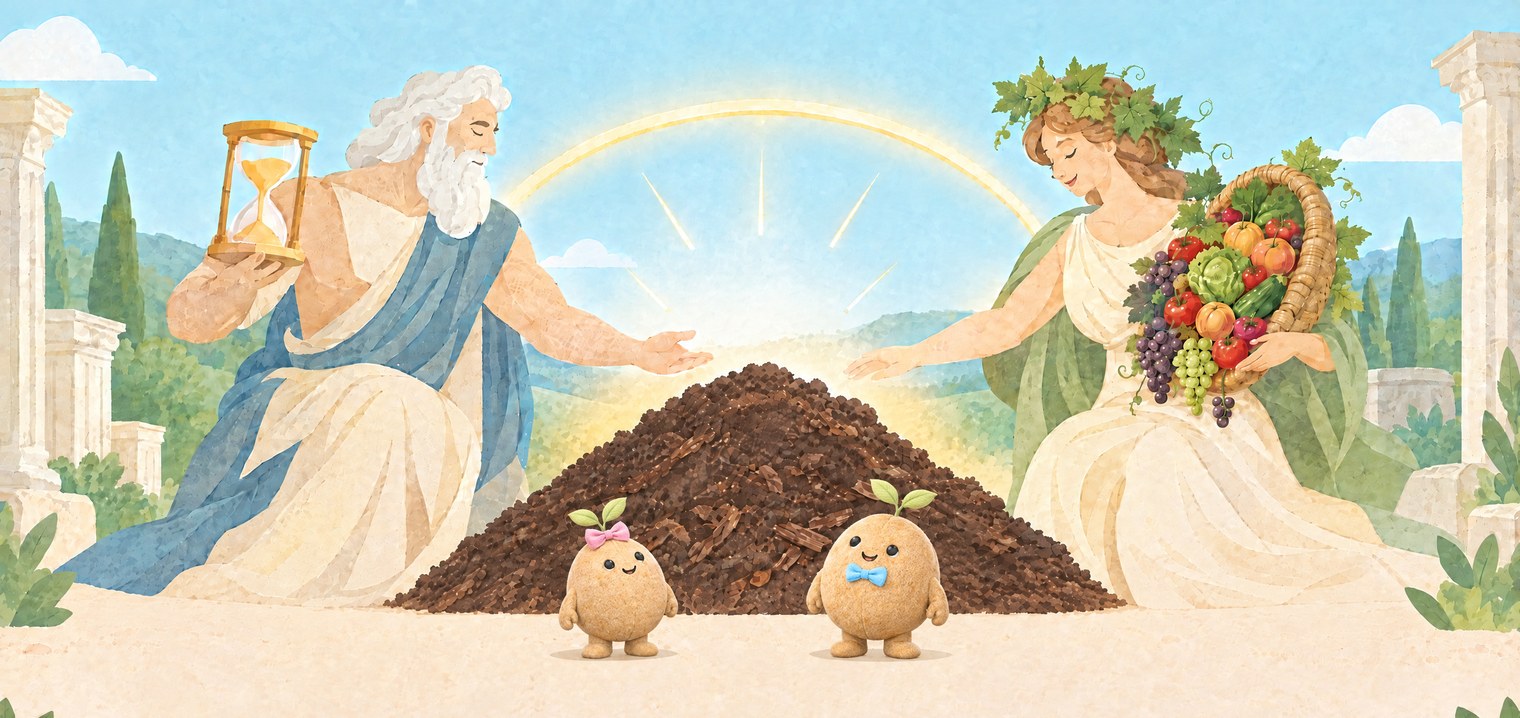
Cronos, time, and Ops, fertility: the image of the Cronops® process, taken from our video on Mazor®.
 ▶
On video · Académie des Germis
Mazor® and the Cronops® process (in French)
Plant materials, seven months of monitored composting, billions of microorganisms: the compost behind our fertilizers, in two minutes.
That is what sets a standardized amendment apart from a raw material: a declared composition, analyzed batch after batch, and organic matter that is already stabilized. To see how we work, discover our manufacturing process and Mazor® and its Cronops® patent, or watch how a fertilizer is made, from soil analysis to delivery (video in French).
Organic soil amendment in one table: the Germis’ method
| Step | In the garden | On the farm | To check |
|---|---|---|---|
| 1. Soil support | BIOMAZOR® (0.5 to 2 kg/m²) or ORVEGA® (500 to 800 g/m²), in fall or late winter | Humiflor® Biomazor®, Orvega®, Germi’One® or Mazor® n°7: 1 to 2 t/ha for maintenance, 3 to 5 t/ha at planting | Soil organic matter; standard, designation and ISMO of the product |
| 2. Nutrition | Fertilizer at the start of growth: POTAGER, FRUITIER | Organo-mineral fertilizer suited to the crop | Crop needs, soil analysis |
| 3. Adjustments | Mulching, watering, observation | Soil analysis, plot visit | Structure, leaf color, earthworms |
The checklist before spreading an organic soil amendment
☐ I have my soil analyzed, with a complete analysis, before choosing.
☐ I read the standard and the designation on the bag (NF U 44-051-9 or -10).
☐ I compare the stable organic matter per tonne (OM × ISMO), not just the price of the bag.
☐ I read the C/N as an indicator, together with the product’s maturity.
☐ I spread in fall or late winter, on drained, workable soil.
☐ I mix the amendment into the top few centimeters, never in direct contact with the roots.
☐ I follow the rates on the product sheet: 0.5 to 2 kg/m² in the garden depending on the product.
☐ I keep fertilizer for the start of growth.
☐ I cover the soil after applying: mulch or green manure.
☐ During a heat wave, I water early and deeply, and I postpone fertilizer until the next rain.
☐ I repeat every year or every two years, depending on the analysis.
Frequently asked questions about organic soil amendments
When should you apply an organic soil amendment?
In fall, after harvest, or in late winter, on drained, workable soil, a few weeks before sowing or planting. A composted, stable amendment can also be applied in spring, well mixed into the soil.
How much organic soil amendment per m²?
In the garden, 0.5 to 2 kg/m² depending on the product and use: BIOMAZOR® is applied at 1 to 2 kg/m² to prepare a soil and 0.5 to 1 kg for maintenance, ORVEGA® at 500 to 800 g/m² when preparing a crop. On a farm, allow 1 to 2 t/ha for maintenance.
What is the difference between an organic soil amendment and a fertilizer?
An organic soil amendment improves the soil (structure, humus, water reserve, biological life); a fertilizer feeds the crop. In France, the first falls under the NF U 44-051 standard, with less than 3 % each of nitrogen, phosphorus and potassium, the second under the NF U 42-001 standard.
What does NF U 44-051 mean on a bag?
It is the French standard for organic soil amendments: it defines their composition and what the label must declare. The added number indicates the designation: -9 for a compost of plant materials, -10 for a compost of plant and animal materials. From January 1, 2027, maximum contaminant contents fall under the socle commun.
What is the socle commun for fertilizing materials?
It is the French regulatory base for fertilizing materials sold under a standard, an authorization or approved specifications. Since May 11, 2026, each product is placed in a use category (A1, A2, B1, B2) shown on the label; its maximum contents for metals, impurities, organic compounds and pathogens come into force on January 1, 2027, with no grace period for metals. Category A1, the only one open to gardeners, is the most demanding.
What is the buffering effect of organic matter?
It is the ability of humus to cushion swings in the soil. Its chemical groups capture or release hydrogen ions, which slows pH changes, and its exchange capacity stores then releases calcium, magnesium and potassium. An organic soil amendment does not correct pH, it smooths out its swings.
Can an organic soil amendment be used in organic farming?
Yes, if its raw materials are authorized by Regulation (EU) 2018/848 on organic production. This is the case for BIOMAZOR® and ORVEGA®, as their technical data sheets state.
Does an organic soil amendment help the soil during a drought?
Yes. Organic matter holds water and improves structure, which helps water soak in and roots grow deep. In our laboratory, Mazor® increased a soil’s water retention capacity by 5.4 % at the equivalent of 1 t/ha and by 7.4 % at 2 t/ha. The effect builds up over several years and is completed by mulching and deep watering.
How long does the effect of an organic soil amendment last?
The part that mineralizes feeds soil life and crops in the following months; the stable part, measured by the ISMO, stays in the soil for years. Hence the value of regular applications, every year or every two years depending on the analysis.
Can you put an organic soil amendment on a lawn?
Yes. ORVEGA® is applied at 500 g to 1 kg/m² when sowing a lawn, mixed into the soil before sowing. For maintenance, FRUITIER fertilizer is spread at 150 g/m² after the first mowing.
Germiflor products suited to this topic

Organic soil amendment · garden
BIOMAZOR®
Restarts the life of a tired soil and builds humus: the most versatile in the garden.
OM 61 %ISMO 55335 kg stable OM/tNF U 44-051-10
View product sheet
Plant-based organic soil amendment · garden
ORVEGA®
100 % plant-based and vegan, to build structure and humus that last.
OM 61 %ISMO 52319 kg stable OM/tvegan
View product sheet
Organic soil amendment · pro range
HUMIFLOR® BIOMAZOR®
The base amendment for farms, in bags, big bags, hoppers or bulk.
OM 61 %C/N 14NF U 44-051-10suitable for organic farming
View product sheet
Plant-based organic soil amendment · pro range
HUMIFLOR® MAZOR® n°7
Pure Mazor®: the most stable organic matter in the range.
ISMO 77323 kg stable OM/tover 1 billion microorganisms/gvegan
View product sheetIn the professional range, two other amendments follow the same logic: Humiflor® Orvega®, 100 % plant-based, and Humiflor® Germi’One®, enriched with pozzolan and magnesium.
The full offer: Marcel le Jardinier range for the garden and professional fertilizers.
Learn with the Germis
Standards, humus, ISMO: all the vocabulary, for free
The Lexique de la fertilisation explains soil and fertilizer terms, with a page on Regulation (EU) 2019/1009 and another on the socle commun. The Académie des Germis offers quizzes and videos to test what you know, alone or with others (in French).
Discover the Lexique and the Académie · All the Germis’ videos on YouTube
Further reading
Fresh manure, composted manure or Mazor®: which to choose?
What manure really brings, and the comparison in figures.
Organic soil amendment for vineyards after harvest
When and how to amend a vineyard.
Fertilizing soils and plants: how does it work?
Feeding the soil, feeding the plant, and in what order.
Fertilizer for fruit trees: which one to choose and when
The calendar of applications in the orchard.
Fertilizing products, fertilizers, amendments: the guide
All our product families, explained.
Where to find our products
Retailers and distribution.
Which amendment for your soil?
Our team helps you choose the product and the rate based on your soil analysis.
Ask for advice For the garden Professional rangeArticle written by the Germis, Germiflor’s educational mascots. Reviewed by Olivier Barthès, CEO of Germiflor and fifth generation of the founding family, with the Germiflor technical team (Mazamet, Tarn, France), maker of organic and organo-mineral fertilizers since 1885. Sources: Germiflor product technical data sheets 2025-2026, NF U 44-051 standard (composition criteria: Chambers of Agriculture fact sheet), ISMO indicator (XP U44-162 standard), Regulation (EU) 2019/1009, Decree No. 2026-357 of May 7, 2026, Decree No. 2026-919 and orders of September 18, 2026 on safety criteria and on maximum permissible inputs (socle commun), Regulation (EU) 2018/848, Directive 91/676/EEC, organic products guide of the Languedoc-Roussillon Chambers of Agriculture (2011), Mazor® brochure (Germiflor laboratory water retention tests), Minasny and McBratney, European Journal of Soil Science, 2018, Arvalis (interview with P. Métais, 2023), “Biologie des sols” leaflet of the Hauts-de-France Chambers of Agriculture (after Gobat et al., 2003), O. Husson, Plant and Soil, 2013 (redox potential and pH), FiBL, Gestion de l’humus (humus management), 2024. Published on .