


17 septembre 2026
What fertilizer for fruit trees? The two-season method
By the Germis · Published on · Germiflor, Mazamet (Tarn, France)
Madame Germi places her hand on the trunk of an old pear tree. “Look at its leaves, Monsieur Germi. They’re already turning yellow, and that’s normal in September. But above all, look at its feet.” Under the canopy, the grass is cropped short and the soil is compacted, hard as a garden path. “The neighbor gave it fertilizer in July because he felt it wasn’t producing anything. The tree put out shoots fifty centimeters long, and still no pears.” Monsieur Germi nods. “He fed the wood, not the fruit. And he forgot the soil.”
We see this scene in every other garden. “Which fertilizer for fruit trees?” is the right question, but it calls for a two-step answer. Here is ours, the one Germiflor has applied in orchards since 1885.
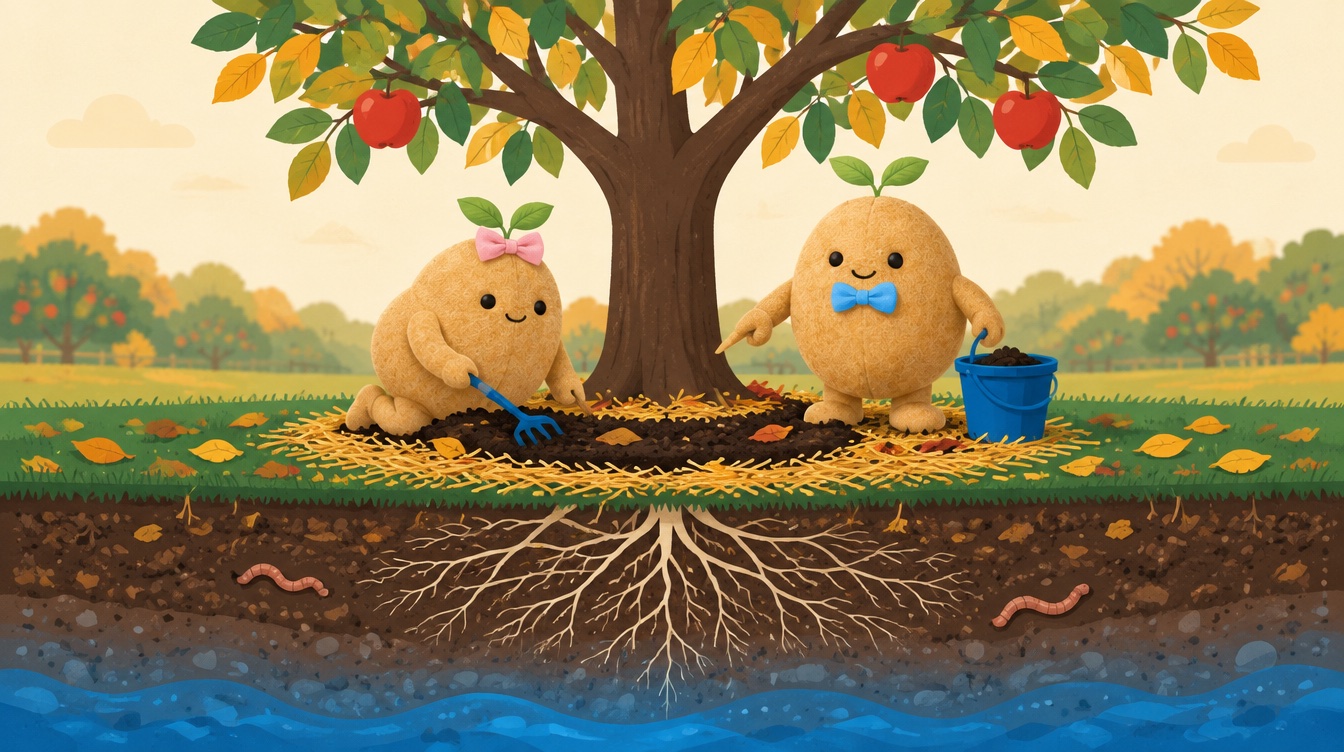
The Germis in the orchard: the amendment goes down in a ring under the canopy, never at the foot of the trunk.
What fertilizer for fruit trees? The short answer
A fruit tree needs two distinct applications a year. In fall, an organic soil amendment (a standardized compost that feeds the soil, not the tree directly), spread under the canopy just as the roots are storing their reserves. In spring, when growth resumes, a balanced organo-mineral fertilizer rich in potash and magnesium, which feeds the blossoms and then the fruit. So the best fertilizer for fruit trees is not a product, it’s a calendar: fall feeds the soil, spring feeds the tree.
The rest of this article explains why this order matters, which products to choose, at what rate, and which mistakes cost you the harvest.
The Germiflor method for fruit trees
Why does fall feed the soil and spring feed the tree?
A fruit tree doesn’t feed like a head of lettuce. It lives on its reserves. From leaf fall to budburst (the opening of the buds in spring), it stops growing above ground, but its roots keep working as long as the soil stays above 6 to 8 °C. They absorb what soil life releases and store it in the wood and the large roots. In spring, flowering and the first leaves rely almost entirely on these reserves, before the tree can draw on the soil. Feeding the soil in fall therefore means preparing next year’s bloom.
Spring, on the other hand, opens the period when the tree really takes up nutrients: fruit set (the transformation of the flower into fruit), fruit sizing, then the formation of next year’s buds in summer. That’s when fertilizer, in the strict sense, becomes useful. The distinction between the two words matters: an amendment works on the soil (structure, humus, microbial life), a fertilizer feeds the plant (nitrogen, phosphorus, potash, magnesium). An orchard needs both, in that order.
What happens under a well-fed fruit tree
The feeder roots that absorb water and nutrients sit in the top twenty centimeters, under the drip line of the canopy and beyond. At the foot of the trunk, there are only anchoring roots.
The Germis’ tip. The area to feed is not “a tree,” it’s a disk. Measure the radius of the canopy, multiply it by itself, then by 3.14: an apple tree with a 2 m radius covers about 12.5 m². The rate on the bag is calculated for that area, and that’s where to spread it, in a ring, from half the radius out to just beyond the branch tips.
Which organic soil amendment under fruit trees in fall?
From late September to late November, as long as the ground isn’t frozen, apply a standardized organic soil amendment (NF U 44-051) under the canopy, then cover it with mulch. The goal is not to supply nitrogen; it’s to restart soil life and rebuild the humus stock (the stable organic matter that holds water and nutrients). A compacted, bare orchard soil with no earthworms makes available only a small share of what it receives; the amendment corrects that cause before treating the symptoms.
The benchmark to know is ISMO, the stable organic matter index: the higher it is, the more of the applied organic matter turns into lasting humus rather than disappearing within a few weeks. An ISMO of 50 to 60 means that a little over half of the organic matter will remain in the soil for several years.
For a home orchard, BIOMAZOR restarts biological activity and soil structure thanks to its blend of plant and animal materials composted with Mazor® (organic soil amendment NF U 44-051-10, 63% organic matter, ISMO 55, approved for organic farming). It’s the most versatile amendment in the range, the one we recommend for tired soil. View the BIOMAZOR sheet.
If you garden with a 100% plant-based approach, ORVEGA does the same humus-building work in a vegan formulation (organic soil amendment NF U 44-051-9, 65% organic matter, C/N 19, ISMO 54, approved for organic farming). A C/N of 19 is the right balance for an amendment: enough carbon to build humus, enough nitrogen so that decomposition doesn’t “steal” the soil’s own (nitrogen tie-up, common with a mulch of fresh wood chips). View the ORVEGA sheet.
Either way, spread the rate on the bag over the area calculated under the canopy, rake it into the top two or three centimeters without injuring the roots, then mulch (wood chips, dead leaves, dry grass clippings). Mulch is half the job: it keeps the soil moist and alive all winter, and it prevents the short, compacted grass of our pear tree from the opening scene.
Which organo-mineral fertilizer for fruit trees in spring?
From March to April, as soon as the buds swell and the soil warms up, apply a balanced organo-mineral fertilizer rich in potash and magnesium, in a single pass under the canopy, ahead of rain. An organo-mineral fertilizer combines an organic base (animal proteins or oilseed meals, slow-release) with natural minerals such as potassium sulfate or kieserite (magnesium). It feeds the tree over two to three months, exactly the window of flowering, fruit set and early fruit sizing.
Why potash and magnesium rather than nitrogen? Because fruit is made of sugars: potash drives their transport to the fruit, while magnesium is the central atom of the chlorophyll that produces them. The two interfere with each other when one is in excess (this is K/Mg antagonism: too much potash blocks magnesium uptake, and the leaves turn yellow between the veins). A fertilizer that supplies both together, in a measured ratio, avoids this trap.
FRUITIER, Marcel le Jardinier’s organo-mineral fertilizer, was formulated for this window: NPK 7-5-7 with 2% soluble magnesium, 7% calcium and 11% sulfur, on a fully organic, slow-release nitrogen base (organo-mineral fertilizer NF U 42-001-3, approved for organic farming). Sulfur helps the tree assimilate nitrogen; calcium strengthens the fruit skin and limits storage disorders. View the FRUITIER sheet.
The Germis’ tip. A young tree planted less than three years ago gets the same treatment, over a smaller area, and above all a good mulch: its priority is to grow roots, not fruit. Never force a young fruit tree to bear.
When to fertilize fruit trees? The calendar
The calendar below follows an orchard in a temperate climate. Shift it two to three weeks earlier in the south of France, and later in the mountains or north of the Loire.
For temperate pome and stone fruit trees: two applications a year, and none between June and September. This is the most important rule in this article, and the one most often broken. Citrus trees are the exception; we come back to them below. Fertilizer applied in summer, while the fruit is sizing, restarts shoot growth at the expense of the fruit and delays the hardening off of the wood (the lignification that prepares the tree for winter). The tree goes into dormancy with soft shoots, more vulnerable to frost and disease.
The mistakes that cost you the harvest
Fruit-growing research has long documented what excess nitrogen does to a fruit tree: less colorful and less firm fruit, premature fruit drop, storage disorders, greater susceptibility to winter frost and disease. It’s counterintuitive for the gardener who sees the tree “growing strong” and thinks they’re doing the right thing. Three mistakes come up in almost every garden.
Common mistake. Doubling the rate “to make up for” a bad year. Liebig’s law of the minimum says that growth is limited by the scarcest element, not by the sum of the others: if the soil lacks magnesium or water, adding nitrogen changes nothing, except for the worse. Observe first (leaves, soil, earthworms), then correct, using the rate on the bag.
Apple, cherry, citrus: do you need a different fertilizer?
No. The two-season method works for all temperate fruit trees; what changes is the timing and the intensity, not the product.
Apple, pear, quince (pome fruit)
These are the most sensitive to excess nitrogen and to biennial bearing (a heavy crop one year, almost nothing the next). Stick strictly to the two applications. In a heavy-crop year, the spring fertilizer is essential: the tree has to feed its fruit and build next year’s buds at the same time.
Cherry, plum, peach, apricot (stone fruit)
They bloom early and grow fast. Apply the spring fertilizer as soon as the buds swell, often in early March. Avoid any form of nitrogen after harvest: peach trees in particular develop gummosis and freeze damage when their wood fails to harden off.
Citrus, olive and fig trees
Citrus trees follow a different calendar, and they are the only real exception in this article. In a Mediterranean climate, in Corsica or along the coast, their growth is almost continuous and the spring bloom is prepared from fall onward: fertilizer goes on from September, while the soil is still warm and the roots are active, then a second time when growth resumes, in February-March. Our citrus-grower customers in Corsica receive their fertilizer from September; that is standard practice in the field. Magnesium matters even more for citrus (their leaves quickly turn yellow between the veins), hence the value of a formulation that includes it. Olive and fig trees, for their part, are content with the fall amendment and a moderate spring application. For citrus, see Marcel’s detailed advice for citrus trees.
What about commercial orchards? The logic is the same, with formulations from the professional range. On Corsican citrus, the fall application relies on a slow-release organic nitrogen fertilizer, AB’Flor 13 N (13-0-0, fully organic nitrogen, NF U 42-001-2, approved for organic farming), spread from September: unlike the apple tree, citrus needs nitrogen in fall to prepare its bloom, and Corsican citrus growers who follow this calendar see more consistent, more vigorous orchards. For soil support, Humiflor Biomazor or Humiflor Germi’One serve as the fall amendment; for spring nutrition, an organo-mineral fertilizer with magnesium such as AB’Flor 7-5-7 S + 2 MgO. View the AB’Flor 13 N sheet and the full professional range.
Compost, manure, coffee grounds: how good are homemade natural fertilizers?
Mature garden compost is an excellent fall amendment, if you have enough of it: you need two to three centimeters over the whole area under the canopy, or a good wheelbarrow load per mature tree. It is rarely rich enough to replace the spring fertilizer on a bearing tree, and its composition varies from one pile to the next. Fresh manure should never go at the foot of trees (burns, uncontrolled nitrogen); once composted, it belongs in the amendment category.
Coffee grounds, wood ash and fermented plant teas show up on every list. Ash supplies potash and calcium but raises the pH: use small doses, and never on soil that is already alkaline. Nettle tea is a fast nitrogen boost, in other words exactly what a fruit tree should not receive after flowering.
Coffee grounds deserve a closer look, because they illustrate the whole difference between a raw material and a fertilizer. Spread raw at the foot of a tree, they are acidic and unbalanced, and their nutrients remain unavailable: they do no harm, but they don’t feed either. Composted, they become a different material. Coffee grounds are one of the raw materials in Mazor®, along with medicinal plant press cakes and grape and olive pulp: what changes everything is the biological transformation they undergo before they reach the soil. What matters is not what you apply, but the state in which you apply it.
Mazor® and Cronops®: what’s inside our amendments
Our amendments and fertilizers all rest on the same biological foundation, Mazor®, produced by the Cronops® process patented by Germiflor (patent FR2103847). The principle fits in one sentence: transform plant and animal materials into a stable, living organic matter, rather than spreading them as they are.
The raw materials in Mazor® are co-products you often come across in gardening advice: medicinal plant press cakes, grape and olive pulp, coffee grounds, along with sterilized animal materials depending on the formulation. The difference is not in the list; it lies in the controlled composting that follows, which stabilizes the carbon, balances the C/N ratio, eliminates pathogens and develops the microflora. Mazor® thus supplies one billion microorganisms per gram, which restart the soil’s biological activity and its ability to make nutrients available.
That’s why a BIOMAZOR or ORVEGA amendment can’t be compared to a bucket of kitchen scraps: same plant origin, different biological state, different effect on the soil. And this foundation is what allows a fertilizer like FRUITIER to feed the tree without sacrificing the soil. To understand the approach, see our manufacturing process and the story of Mazor, a patented innovation.
The method at a glance
| Step | When | What | Why |
|---|---|---|---|
| 1. Soil support | Late September to late November | Organic soil amendment (BIOMAZOR or ORVEGA) in a ring under the canopy, light raking, mulch | Humus, soil life, water reserve; the tree stores its reserves |
| 2. Nutrition | March to April, buds swelling | FRUITIER 7-5-7 organo-mineral fertilizer with magnesium, a single application | Flowering, fruit set, fruit quality, next year’s buds |
| 3. Adjustments | All year; nothing to apply from June to September (citrus: fertilizer from September) | Watering in dry summers, mulch kept topped up, reading the leaves | Correct the cause (water, soil, deficiency) before adding anything |
Checklist for a well-fed orchard
☐ I measured the canopy radius and calculated the area to feed (radius × radius × 3.14).
☐ I checked the soil under the tree: compacted, bare, no earthworms = amendment first.
☐ Organic soil amendment spread in a ring between late September and late November, on unfrozen ground.
☐ Raked in to 2 to 3 cm only, without injuring the roots.
☐ 5 to 8 cm of mulch laid after the amendment (wood chips, leaves, dry grass clippings).
☐ Organo-mineral fertilizer applied once, in March-April, ahead of rain.
☐ Rate on the bag followed, never doubled.
☐ No fertilizer between June and September (except citrus: fertilizer from September).
☐ Deep, infrequent watering in dry summers, especially in the first three years.
☐ Leaves checked in May-June: yellowing between the veins = lack of magnesium or iron, not nitrogen.
☐ Young tree (under 3 years): same steps, smaller area, roots first.
☐ Notes kept in a notebook: date, product, quantity, to compare from one year to the next.
Frequently asked questions about fruit tree fertilizer
▸ What is the best fertilizer for fruit trees?
A balanced organo-mineral fertilizer rich in potash and magnesium, applied once in spring, preceded by an organic soil amendment in fall. The “best fertilizer” is a calendar more than a product: soil in fall, tree in spring.
▸ When should you fertilize fruit trees?
For apple, pear, cherry and plum trees: in spring, between March and April, when the buds swell. The amendment goes on in fall, from late September to late November, and no fertilizer is applied between June and September. For citrus, fertilizer goes on from September, then again when growth resumes in February-March.
▸ Fruit tree fertilizer: fall or spring?
Both, but not the same product. In fall, an organic soil amendment that feeds the soil and rebuilds humus. In spring, the fertilizer that feeds the tree for flowering and fruit.
▸ Should you add fertilizer when planting a fruit tree?
No, no fertilizer in the planting hole: it burns the roots. Mix an organic soil amendment into the planting soil, water deeply, then mulch. The first fertilizer comes the following spring, at a reduced rate.
▸ How much fertilizer does a fruit tree need?
The rate is calculated per square meter under the canopy, not “per tree.” Measure the canopy radius, multiply it by itself, then by 3.14, and apply the rate on the bag to that area. An apple tree with a 2 m radius covers about 12.5 m².
▸ Why isn’t my fruit tree producing fruit?
The most common causes are, in order: excess nitrogen pushing wood at the expense of fruit, a tree that is too young, frost on the blossoms, no compatible pollinator variety, and compacted, dry soil under the canopy. Fertilizer is the answer only if the leaves are pale and growth is weak.
▸ Compost or fertilizer for fruit trees?
Mature compost can replace the fall amendment if you have a wheelbarrow load per tree. It does not replace the spring fertilizer on a bearing tree, because it is too low in potash and magnesium and its composition varies.
▸ Are coffee grounds good for fruit trees?
Spread raw, no: they are acidic and nutrient-poor, and their nutrients remain unavailable. Composted, yes: coffee grounds are one of the raw materials of Mazor®, the biological foundation of our amendments. It’s the transformation that makes the difference, not the material.
Germiflor products for this topic
BIOMAZOR
Organic soil amendment NF U 44-051-10
Restarts soil life and structure under fruit trees: the go-to fall application.
63% organic matter, ISMO 55, approved for organic farming (AB).
View product sheet →ORVEGA
100% plant-based organic soil amendment NF U 44-051-9
Builds humus and the soil’s water reserve, in a vegan formulation.
65% organic matter, C/N 19, approved for organic farming (AB).
View product sheet →FRUITIER
Organo-mineral fertilizer NF U 42-001-3
Feeds flowering and fruit in spring, with balanced potash and magnesium.
NPK 7-5-7, 2% MgO, 7% CaO, 11% SO3, approved for organic farming (AB).
View product sheet →Pack Jardin Fruité
BIOMAZOR 5 kg + FRUITIER 5 kg
Both steps of the method in a single pack, for two to three trees.
The fall amendment and the spring fertilizer, with free delivery.
View the pack →AB’Flor 13 N (professional range)
Organic nitrogen fertilizer NF U 42-001-2
Citrus growers’ fall application: slow-release organic nitrogen from September.
13-0-0, approved for organic farming (AB), USDA Organic.
View product sheet →Further reading
In fall, get your garden ready with Marcel le Jardinier
Seasonal tasks for the vegetable garden, flower beds and orchard.
Soil amendments, the key to a living soil
Why feed the soil before feeding the plant.
Organic or mineral fertilizer: Marcel’s advice for choosing well
How a fertilizer’s origin changes how fast and how long it works.
The Fertilization Glossary and the Germis Academy
ISMO, C/N, available water capacity, K/Mg antagonism: every term in this article explained, with quizzes.
Our ranges and where to find our products
Marcel le Jardinier products online or from a retailer near you.
Your orchard is waiting for its fall application.
Discover the Marcel le Jardinier range Ask the Germis a questionArticle written by the Germis, Germiflor’s educational mascots. Reviewed by the Germiflor technical team (Mazamet, Tarn, France), maker of organic and organo-mineral fertilizers since 1885. Agronomic sources: technical sheets from the French chambers of agriculture on orchard fertilization, and work by the IRDA apple network on excess nitrogen. Published on .