


02 novembre 2026
Fresh manure, composted manure or Mazor®: which to choose?
By the Germis · reviewed by the Germiflor technical team · · 12 min read
At the end of the vegetable garden, the neighbor has dropped off a trailer of horse manure, still steaming. Madame Germi lifts a forkful: “Straw, droppings, and it’s hot. Shall we spread it on the beds right away?” Monsieur Germi shakes his head: “Not like that. Manure is good material, but fresh, it will help itself from your soil before giving it anything.”
Horse, cow, sheep or chicken manure: it is the oldest soil amendment in the garden, and it is still useful. But fresh manure and composted manure do not do the same job, and neither one supplies as much humus as people imagine. Here is what manure really brings to the soil, the pitfalls of fresh manure, how to compost it, and a side-by-side comparison in figures with a composted, standardized amendment such as Mazor®, which Germiflor has made in Aussillon, in the Tarn, for five generations.

On the left, fresh, strawy manure; on the right, the same manure once composted: dark, fine, ready for the soil.
The essentials in 30 seconds
Fresh. Rich in straw, it can starve the crop of nitrogen, sow weeds and lose its nitrogen to the air. Keep it for the fall, on a cleared bed, away from roots, then cover it for the winter.
Composted. After a well-managed hot phase (above 55 °C for two weeks, or above 50 °C for six) and a few months of curing, it is sanitized if it heated throughout, stabilized, and the risk of nitrogen hunger becomes low: this is the right form for the soil.
Humus. One tonne of stored manure supplies 70 to 180 kg of stable organic matter depending on the animal and the bedding; one tonne of Biomazor® supplies 335 kg, mainly because it contains much less water.
The right choice. Well-composted manure if you have some on hand; otherwise, a standardized amendment such as Biomazor®: more than three times less product than an average manure for the same stable organic matter, ready to use, sanitized and of known composition.
Contents
Fresh manure or composted manure: the short answer
To feed the soil, you need composted manure, not fresh manure. Fresh manure is young material, rich in straw and in unstabilized carbon: dug in as is, it ties up soil nitrogen for several weeks (this is nitrogen hunger), it brings in weed seeds, and it loses part of its nitrogen as ammonia if it stays on the surface. Well composted, it has gone through a hot phase (at least two weeks above 55 °C), which sanitizes it and destroys most seeds, then a few months of curing; its carbon has partly stabilized and its carbon-to-nitrogen ratio has dropped. Composted manure is therefore a true organic soil amendment. It still varies from one pile to the next; a standardized amendment (NF U 44-051) follows the same logic with a declared composition and a rate you can adjust.
If you are just starting out, first read our guide to fertilizing soils and plants: it explains why we feed the soil before feeding the plant.
What does manure contain, and what does it really bring to the soil?
Manure is a mix of animal droppings and bedding, usually straw. It supplies three things: organic matter, which feeds soil life and part of which will become humus; nutrients, mainly nitrogen and potash, in modest and variable amounts; and a large amount of water. Cattle manure usually contains more than 70 % water, horse manure on straw around 60 %: you haul and spread a lot of water.
What matters for the soil in the long run is the share of organic matter that will become stable humus, the kind that holds water and nutrients for years. It is calculated by multiplying the organic matter on an as-is basis by the ISMO (the organic matter stability index, defined by the XP U44-162 standard based on INRA research). Example: an amendment with 60 % organic matter contains 600 kg per tonne; with an ISMO of 55, about 330 kg are likely to join the soil’s stable organic matter; the rest is mineralized by soil life over the following months. According to the organic products guide of the Languedoc-Roussillon Chambers of Agriculture (2011, one analysis per type of stored manure), one tonne of manure supplies roughly 70 to 100 kg of stable organic matter for cattle manure, 140 kg for sheep manure and up to 180 kg for horse manure on straw; fresh horse manure supplies closer to a hundred (IFCE Valfumier program, 2022). A composted, standardized amendment supplies from nearly two to more than four times as much per tonne of as-is product, and a good farm compost comes close to it. The gap comes mainly from water: manure contains 60 to 80 %, our amendments about 20 %.
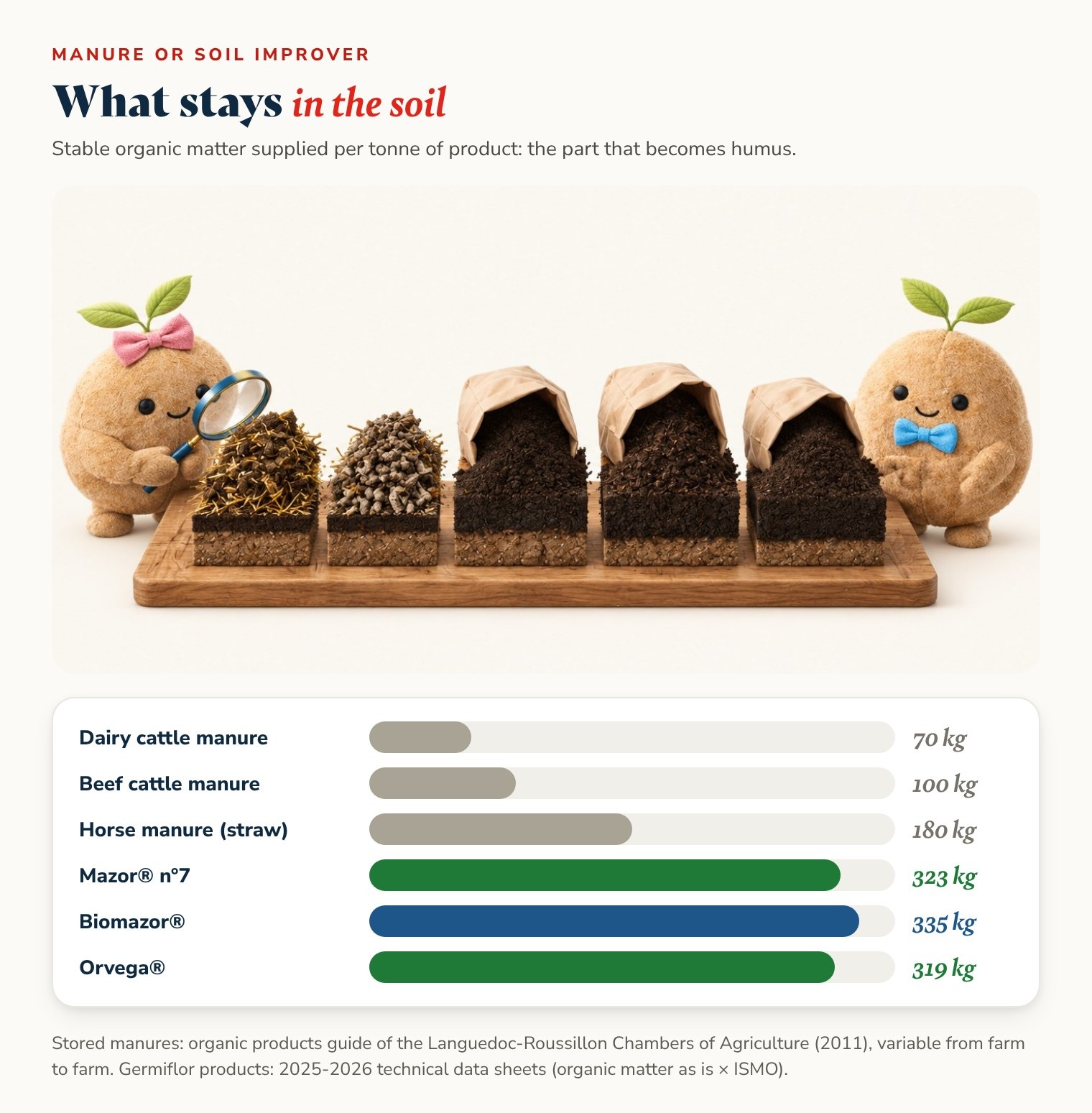
Stable organic matter per tonne of as-is product. Stored manures: organic products guide of the Languedoc-Roussillon Chambers of Agriculture (2011), one analysis per type, variable from one farm to another; Germiflor products: technical data sheets.
Labile humus, stable humus: what changes is the concentration
The stability of manure’s organic matter varies widely. Its ISMO ranges from about 38 % for fresh horse manure (Valfumier program) to 67 to 94 % for manures stored a long time (Languedoc-Roussillon guide). Fresh manure therefore feeds soil life first: it is the fuel, and that is a good thing. As it ages, its material stabilizes and becomes capital. What mainly sets a dry, composted amendment apart is quantity: with 80 % dry matter instead of 25 to 40 %, one tonne contains much more organic matter, and therefore more stable organic matter. Both roles are explained in our video on labile humus and stable humus.
 ▶
On video · Académie des Germis
Labile humus, stable humus: the fuel and the capital (in French)
Why a soil needs both, and what each input feeds.
Why not spread fresh manure in the vegetable garden?
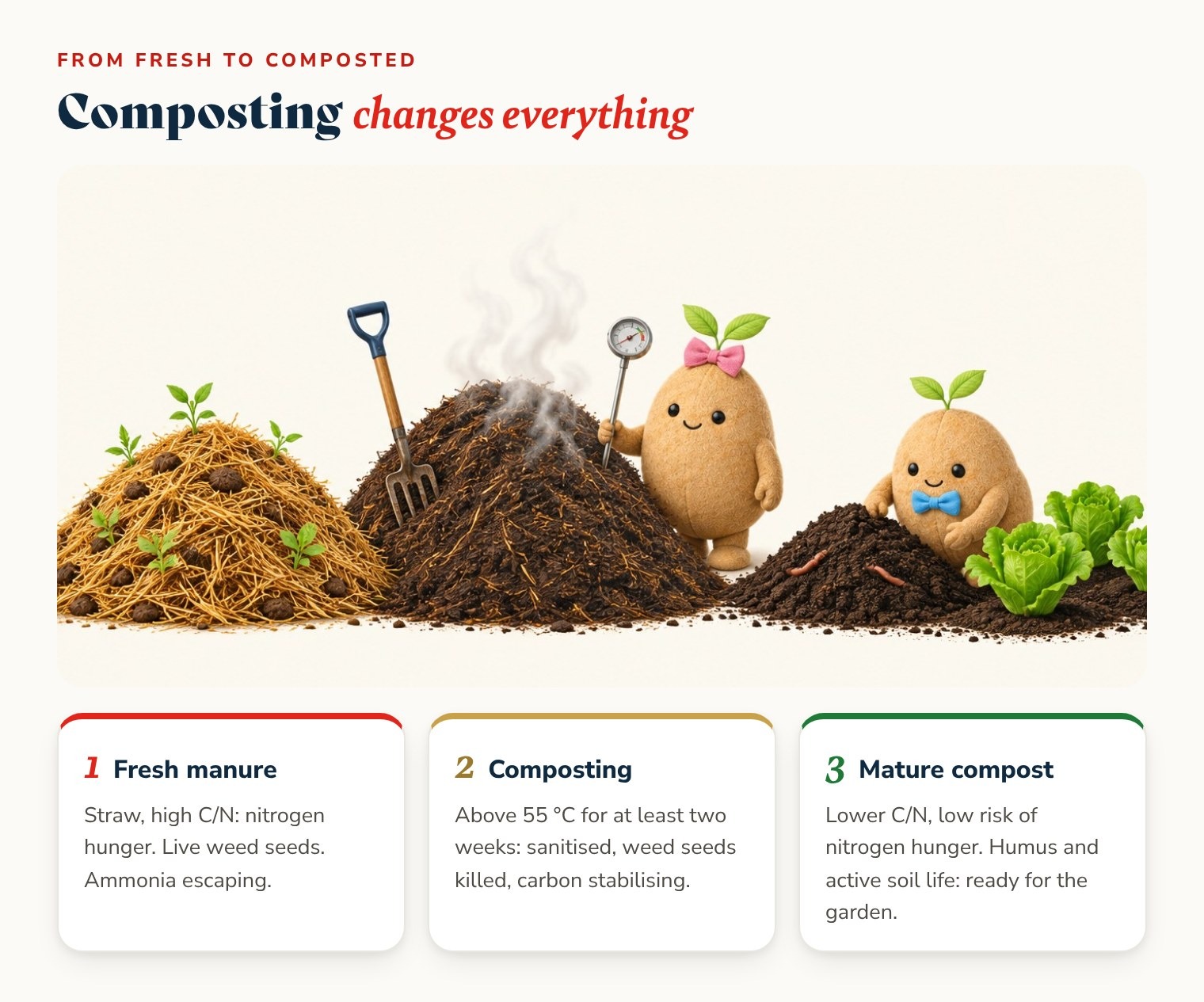
From fresh manure to composted manure: the hot phase sanitizes the material and destroys seeds, curing stabilizes it.
Nitrogen hunger
Wheat straw contains about a hundred times more carbon than nitrogen. To break it down, soil microorganisms need nitrogen, which they take from the soil, right next to the roots. For a few weeks, the crop runs short: leaves turn pale, growth slows, often at the start, when any delay is hard to make up. The nitrogen comes back when the microbes die, but often too late. Analyses of horse manure from the IFCE Valfumier program, relayed by the Aude Chamber of Agriculture, give a carbon-to-nitrogen ratio (C/N) of about 25 on average for fresh manure, with wide variations depending on the bedding, versus 13 on average once composted. At that level, the risk of nitrogen hunger becomes low, though not zero: C/N is only an indicator, and the maturity of the product matters just as much. The Germis explain it in the video on nitrogen hunger.
 ▶
On video · Académie des Germis
Nitrogen hunger: when the soil eats the crop’s nitrogen (in French)
The mechanism explained on grapevines, the same as in the vegetable garden with strawy manure dug in too fresh.
Weed seeds and germs
Bedding and droppings contain weed seeds that are still alive, and germs you would rather not see on lettuce or strawberries. Fresh manure drops them as is into the beds. The temperature rise during composting destroys most of them: this is sanitization.
Nitrogen that escapes into the air
Part of the nitrogen in fresh manure is in ammonium form. Left on the surface, especially in hot, windy weather, it escapes as ammonia: you can smell it, and it is nitrogen lost to the crop. Hence the rule of working it in quickly, and shallowly, if it is spread fresh.
Common mistake
Putting fresh manure at the base of a tree or in the planting hole
In contact with roots, fresh manure ferments, heats up and can burn them; it also creates a wet pocket where roots rot. At the base of fruit trees as in the vegetable garden, only well-rotted manure is applied, raked into the surface, never in direct contact with the roots. For fruit trees, our article fertilizer for fruit trees: which one to choose and when details the calendar.
How do you compost manure?
Build the manure into a pile at least one meter high, sheltered from heavy rain but without letting it dry out. The material first heats up strongly: this is the phase when seeds and germs are destroyed. Turn the pile at least twice to aerate it and restart the heat. Then the temperature drops and the material cures: it becomes dark and fine, smells like forest soil, and the straw is no longer recognizable. Allow several weeks of hot phase: the French reference for on-farm composting (the French circular of January 17, 2002) requires at least two turnings and above 55 °C for 15 days, or above 50 °C for six weeks; then two to three months of curing with no fresh additions. If weeds sprout en masse on the pile, it often did not heat enough.
 ▶
On video · Académie des Germis
Soil bacteria, allies of fertilization (in French)
They are the ones that do the composting, then turn organic matter into humus and nutrients in the soil.
Germis’ tip
The bag test
To find out whether manure is mature, put a moist handful in a closed bag somewhere warm for two days. A smell of ammonia or rotten eggs: it is not ready. A smell of soil: it can go into the garden.
Manure and health safety: what you need to know
Fresh manure can contain microorganisms of digestive origin, including pathogenic bacteria (some salmonella, some strains of Escherichia coli, Listeria) and parasite eggs. The risk mainly concerns vegetables eaten raw that grow close to the ground: lettuce, radishes, strawberries, herbs. This is the first reason never to spread fresh manure on a standing crop.
Composting solves most of the problem: the hot phase, above 55 °C for at least two weeks in a turned pile, destroys most germs and seeds. This is what the regulations on fertilizing materials placed on the market control. In France, the French “socle commun” regulation (common base for fertilizing materials; the order of September 18, 2026, applicable from January 1, 2027) requires the absence of salmonella, Listeria monocytogenes and viable helminth eggs in 1 g of product, and in 25 g for vegetable crops. For a CE-marked organic soil amendment, Regulation (EU) 2019/1009 requires the absence of salmonella in 25 g and limits E. coli or enterococci to 1,000 per gram. These texts also set maximum levels of trace metals: for a CE-marked organic soil amendment, 2 mg of cadmium, 1 of mercury, 50 of nickel, 120 of lead, 300 of copper and 800 of zinc per kilo of dry matter. This is a point to watch with some livestock effluents, which can be loaded with copper and zinc from animal feed and veterinary care. A pile of manure composted in the garden is not subject to any control: you do not know whether it heated enough throughout, especially at the edges.
Other countries set useful benchmarks: in organic farming in the United States, uncomposted manure must be incorporated at least 120 days before harvesting a vegetable whose edible part touches the soil, and 90 days for others. In the garden, remember the simple rule: fresh manure only in the fall, on a cleared bed, and never on a crop you will eat raw that season.
Herbicide residues, a little-known trap
Some herbicides in the pyridine carboxylic acid family (aminopyralid, clopyralid), used depending on the country on pastures, cereals or grassed areas, pass through the animal and can persist in straw, manure and even compost. At very low doses, they distort the leaves of tomatoes, potatoes, beans and peas. If you do not know where the manure comes from, do a simple test: sow a few beans in a pot of composted manure mixed half and half with potting soil, and others in a control pot of potting soil alone; compare the leaves for two to four weeks.
Germis’ tip
Have manure? Use it, the right way
It would be a shame to go without: it is a good amendment. Preferably compost it; if it is fresh, apply it in the fall on cleared beds. Heavy feeders that are eaten cooked, such as squash, pumpkins and leeks, benefit the most. What matters for health risk is not how much water the vegetable contains, it is whether it is eaten raw and touches the soil: lettuce, radishes, carrots, strawberries and herbs only receive well-composted manure, applied long before harvest. Wear gloves to handle it, wash your hands afterwards, wash harvested vegetables thoroughly, and ask the farmer or the riding stable how the animals were fed and treated.
Mazor®, the base of our amendments, is 100 % plant-based: it is sanitized by its composting, the patented Cronops® process. The animal materials added to Biomazor® do not go through this composting: they are sterilized separately, before blending. For products containing processed animal materials, European regulations (Regulations (EC) 1069/2009 and (EU) 142/2011) also require a 21-day interval between spreading and turning animals out to graze or harvesting forage; manure is exempt, and the rule concerns livestock farmers, not the vegetable garden.
Horse, cow, sheep or chicken manure: which one to choose?
Each manure has its own character, which depends on the animal, its diet and the bedding. These are tendencies, not guaranteed values: two piles from the same farm can differ.
| Manure | Character | What it’s for | Watch out |
|---|---|---|---|
| Horse | Strawy, dry, heats up fast (“hot” manure) | Heavy, cold soils; hotbeds for early sowing | Very rich in straw: compost before using in the vegetable garden |
| Cow | Wet, slow, more balanced (“cold” manure) | Light, sandy soils that dry out fast | Wet and heavy to handle |
| Sheep | Drier, more concentrated in nitrogen and potash | Fruiting vegetables, fruit trees | Fairly concentrated: moderate rates |
| Chicken (droppings) | Very rich in nitrogen, almost a fertilizer | Nitrogen boost in spring | Burns roots when fresh; compost it or dose with caution |
Horse manure is the most sought after in the vegetable garden, because it is easy to find near riding stables. It is also the strawiest: it is the one that most needs composting before going onto the beds. Dehydrated or pelleted manures sold in garden centers are dried and sanitized; they are easy to handle, but their effect on humus remains that of a manure.
Manure or Mazor®: the comparison in figures
Mazor® is the biological base of our fertilizers: plant materials (medicinal plant oilseed cakes, grape and olive pulp, coffee grounds) composted for seven months using the patented Cronops® process. Biomazor® combines it with sterilized animal proteins and bones; Orvega® is its 100 % plant-based, vegan version. Compared with manure, they do the same job, feeding the soil, with three differences: more stable organic matter per tonne, a composition declared batch after batch, and material that is already stabilized.
335 kg
Per tonne
Of stable organic matter in one tonne of Biomazor®, versus 70 to 180 kg for one tonne of stored manure depending on the animal and the bedding.
1 to 2 kg
Per m²
The rate of Biomazor® to prepare a bed, where it would take 2 to 9 kg of stored manure, depending on its origin, for the same stable organic matter.
7 months
Of composting
For Mazor®, with temperature monitoring: sanitized material, free of weed seeds.
| Manure | Composted manure | Standardized amendment (Biomazor®, Orvega®) | |
|---|---|---|---|
| Stable organic matter | About 100 kg per tonne for fresh horse manure; 70 to 180 kg for stored manures | Of the same order per tonne: composting loses part of the organic matter, and what remains is more stable | 319 to 335 kg per tonne (2025-2026 technical data sheets) |
| Nitrogen hunger | Real risk if the manure is strawy | Low if the compost is mature | Low: composted and stabilized product |
| Weed seeds | Present | Reduced if the pile heated well | Destroyed by controlled composting |
| Composition | Not declared (known through analysis) | Not declared (known through analysis) | Declared, NF U 44-051 standard |
| Water hauled | 60 to 80 % | 40 to 80 % | About 20 % (80 % dry matter) |
| Organic farming | Depends on the farm of origin | Depends on the farm of origin | Suitable for organic farming (Regulation (EU) 2018/848) |
Per hectare, the math changes: a livestock farmer who spreads 15 to 30 tonnes of manure per hectare, often every two or three years and within the limit of 170 kg of organic nitrogen per hectare per year in a nitrate vulnerable zone, supplies more stable organic matter than with one or two tonnes of amendment. When manure is produced on site, it remains the benchmark, and it is better to compost it than to buy it elsewhere. A composted amendment meets a different need: supplying humus where there is no livestock, with a concentrated, consistent and sanitized product.
What a Germiflor amendment brings that manure does not
For the same stable organic matter, the difference shows in the wheelbarrow. To supply 300 g of stable organic matter on one square meter of vegetable garden, you need a little under one kilo of Biomazor®, versus about 3 kg of fresh horse manure or stored beef cattle manure, and more than 4 kg of dairy cattle manure. On a field, offsetting 500 kg of organic matter lost per hectare takes about 1.5 tonnes of Biomazor®, versus 5 to 7 tonnes of manure, with all the water that has to be hauled and spread.
Ready to use. Mazor® has already spent seven months in controlled composting, with temperature monitoring: no pile to build, turn and watch for months, no odor, and it can be applied year-round, preferably in fall or spring, as the Biomazor® label states.
Sanitized and controlled. The hot phase of composting destroys weed seeds and germs, and an amendment placed on the market must meet the safety criteria of its standard (NF U 44-051) and, from 2027, those of the socle commun. Farm manure, on the other hand, is not analyzed before it reaches the garden.
Known composition. Organic matter, C/N, dry matter and nutrients are declared on the label: you know what you are applying, and you can set the rate. Manure varies from one pile to the next and can only be known through analysis.
Active microbial life. Mazor® contains more than one billion microorganisms per gram: the microflora that recolonized the material after the hot phase reaches the soil along with the humus.
No livestock needed. Most gardeners, winegrowers, fruit growers and vegetable growers have no animals. The amendment supplies humus where there is no manure, in organic farming as in conventional.
This is not about pitting manure against Mazor®: good composted manure remains an excellent amendment. The difference is not the material, it is how it is transformed and how consistent it is. If you have horse manure available, compost it and use it. If you don’t, or if you want to know exactly what you are applying, a standardized amendment does the same job with much less product to haul and spread, because it contains much less water.
 ▶
On video · Académie des Germis
Biomazor and Orvega: feed the soil first (in French)
Why a composted amendment comes before fertilizer, and how to choose between the two.
When and how much manure to apply in the garden?
Timing. In the garden, fresh manure is applied only in the fall, on a cleared bed, raked into the surface, then covered with mulch or a green manure: winter gives it time to break down before sowing. Composted manure and standardized amendments are best applied in the fall, or at the end of winter, a few weeks before sowing or planting. Avoid applying on waterlogged soil, which you would compact.
Rate. For well-composted manure, the usual benchmark in the vegetable garden is 2 to 4 kg per m² per year, adjusted to the richness of the soil and the demands of the crops. For Marcel le Jardinier Biomazor®, the data sheet indicates 1 to 2 kg per m² to prepare a soil, then 0.5 to 1 kg per m² for maintenance; it supplies 335 kg of stable organic matter per tonne (61 % organic matter, ISMO 55, 2025-2026 technical data sheet). These rates are higher than in the field because a vegetable garden is cropped intensively and worked every year.
Orvega® (61 % organic matter, ISMO 52, C/N 19; 319 kg of stable organic matter per tonne, 2025-2026 technical data sheet) does the same job in a 100 % plant-based version, at 0.5 to 0.8 kg per m² in the vegetable garden according to its technical data sheet.
On a farm. A soil with 1.2 % organic matter over 30 cm (about 4,000 tonnes of soil per hectare) contains nearly 50 tonnes; it mineralizes 1 to 2 % of it each year depending on climate, clay and tillage, or roughly 500 to 1,000 kg per hectare. Offsetting this takes about 1.5 to 3 tonnes of amendment at 320 to 335 kg of stable organic matter per tonne, or 5 to 10 tonnes of a manure at 100 kg. Rates for Humiflor® Biomazor® range from 1 to 2 t/ha for vineyard maintenance to 2 to 5 t/ha in vegetable production; they are set based on the soil analysis with our agronomy service. Irrigated, market garden or intensively tilled soils lose more: soil analysis makes it possible to adjust.
Germis’ tip
Manure and fertilizer do not do the same job
Neither manure nor amendment replaces fertilizer for a demanding crop. In the vegetable garden, the amendment goes on in the fall, the fertilizer in spring; for fruit trees, Fruitier fertilizer (NPK 7-5-7 with magnesium and sulfur) comes as a complement, when growth starts.
A number is not enough: think through the soil, the crop and the plot
The benchmarks in this article (stable organic matter, ISMO, C/N, rates) are for comparing products with one another. On their own, they do not tell you what to apply on a given plot: the same amendment is not reasoned the same way on heavy clay and on sand, on a hillside vineyard and on an irrigated vegetable garden. Sound application advice starts from the whole situation.
The analyzed soil. Organic matter content, texture (share of clay, silt and sand), lime, pH, cation exchange capacity (CEC), soil C/N and the balance between elements. This takes a complete analysis, not a basic one, made from several samples spread across the plot, less than two years old and ideally from the current year.
The soil profile. Depth available to roots, stoniness, compaction, excess water in winter, available water capacity: what you see with a spade or in a soil pit, and what a soil test does not tell you.
Soil life. When biological measurements are available (microbial biomass, free and bound organic matter fractions, carbon and nitrogen mineralization), they refine the diagnosis: a soil lacking bound organic matter does not need the same input as a soil whose life is short of fuel.
The crop and the plot’s history. The crop’s needs, what the harvest removes, the residues and cover crops returned, organic inputs from past years and tillage, which speeds up the mineralization of organic matter.
Climate and constraints. Rainfall, irrigation, nitrate vulnerable zone and spreading calendar, the farm’s specifications (organic farming, vegan).
Fieldwork and dialogue. Figures do not replace the field. Our teams visit the plot to judge the soil’s texture and structure on site, along with its crops and uneven patches, and talk with the farmer or their advisor: history, yields, problems observed, constraints of the farm. That is often where the piece of information that changes the recommendation comes up.
A tailored formulation. When we formulate a fertilizer for a specific situation, each component is chosen according to the soil and the crop, because the same material does not behave the same way everywhere: phosphorus availability depends on pH and lime content, excess potash can hinder magnesium uptake, and organic matter mineralizes faster in a warm, aerated, worked soil than in a cold clay. So we weigh the whole picture before choosing the raw materials and their proportions, rather than one or two isolated figures.
It is this combination that determines the product, the rate and the timing; that is the work of our agronomy service with each customer, based on their soil analysis. In the garden, the approach is the same, only simpler: observe your soil, have it analyzed every one to two years, and adjust from one season to the next.
Mazor® and Cronops®: what controlled composting changes
Composting means transforming. During the seven months of the Cronops® process, patented by Germiflor (patent FR 3 121 819, application FR 2103847), the temperature and aeration of the windrows are monitored throughout composting: the material heats beyond the sanitization threshold, pathogenic germs and weed seeds are destroyed, the carbon stabilizes and the C/N ratio drops. At the end of composting, Mazor® contains more than one billion microorganisms per gram, the microflora that recolonizes the material after the hot phase: it brings stable organic matter and active microbial life to the soil. Mazor® n°7, its pure form, has the highest ISMO in our range (77).
The same raw materials, spread raw, do not do this work: the difference lies between the raw state and the composted state, not between the materials. The process is explained on our pages our process and Mazor®, a patented innovation serving agriculture.
Manure in one table: the Germis’ method
| Step | In the garden | On the farm | To check |
|---|---|---|---|
| 1. Soil support | Composted manure (2 to 4 kg/m²), Biomazor® (0.5 to 2 kg/m²) or Orvega® (0.5 to 0.8 kg/m²) in the fall | Amendment based on the organic matter lost each year (1.5 to 3 t/ha of Humiflor® Biomazor® depending on the soil) | Soil organic matter content, product ISMO |
| 2. Nutrition | Fertilizer in spring (Potager, Fruitier) | Organo-mineral fertilizer suited to the crop | Crop needs |
| 3. Adjustments | Mulching, watering, watching the leaves | Annual soil analysis | Signs of nitrogen hunger, pH |
The checklist before spreading manure
☐ I know where the manure comes from (animal, bedding, treatments used on the farm).
☐ I spread fresh manure only in the fall, on a cleared bed, away from roots, and I cover the soil for the winter.
☐ I compost strawy manure for several months before using it in the vegetable garden.
☐ I check that it is mature: dark, fine, smells of soil, no recognizable straw left.
☐ I work it in shallowly, without letting it dry on the surface.
☐ I never put it in contact with roots or in the planting hole.
☐ I never spread fresh manure on vegetables eaten raw, and I wear gloves.
☐ I adjust the rate: 2 to 4 kg/m² of composted manure, 0.5 to 2 kg/m² of standardized amendment depending on the product and use.
☐ I compare products on the stable organic matter they supply (OM × ISMO).
☐ I keep fertilizer for spring: manure does not replace it.
☐ I have my soil analyzed every one to two years.
Frequently asked questions about manure
Can you put fresh manure in the vegetable garden?
Yes, but only in the fall, on a cleared bed, raked into the surface and then covered, so that it breaks down over the winter. In spring or in contact with crops, fresh manure can cause nitrogen hunger, bring in weed seeds and burn roots.
What is the difference between fresh manure and composted manure?
Fresh manure is young, strawy, unstable material. Composted manure has gone through a hot phase (at least two weeks above 55 °C), then cured for several months: it is sanitized if it heated throughout, rid of most seeds, and its carbon has stabilized, which makes the risk of nitrogen hunger low.
Is horse manure good for the vegetable garden?
Yes, once composted. It is a hot, very strawy manure, ideal for lightening heavy soils or making hotbeds, but too rich in straw to be spread fresh on crops.
How much manure per m²?
For well-composted manure, allow 2 to 4 kg per m² per year in the vegetable garden. A standardized amendment such as Biomazor® is applied at 1 to 2 kg per m² to prepare a soil, 0.5 to 1 kg for maintenance: it is more concentrated, because it contains much less water.
When should you put manure around fruit trees?
In late fall or late winter, well rotted, raked into the surface over the whole root zone, never piled against the trunk. Fresh manure at the base of a tree can make the roots ferment and rot.
What is the best manure for fruit trees?
Well-composted cattle or horse manure, or a standardized amendment, to maintain humus; then a suitable fertilizer in spring for fruiting. Chicken manure, very high in nitrogen, is best kept to small doses.
Is pelleted manure as good as composted manure?
It is dried and sanitized, so it is convenient and seed-free, but it is still manure: the stable humus it supplies depends on its organic matter and its ISMO. Compare labels on these two figures.
Is fresh manure a health hazard?
It can be for vegetables eaten raw: fresh manure can contain pathogenic bacteria and parasite eggs. Composting, with a hot phase of at least two weeks above 55 °C, destroys most of them. In the garden, never apply fresh manure on a standing crop, and wash vegetables well.
Manure, compost or standardized amendment: which supplies the most humus?
Per tonne of as-is product, a dry, standardized amendment: roughly 320 to 335 kg of stable organic matter for our amendments, versus 70 to 180 kg for stored manure according to analyses; a good farm compost comes close. On a dry matter basis, the gap narrows: it comes mainly from the water that manure contains.
Germiflor products suited to this topic

Organic soil amendment · garden
BIOMAZOR®
The alternative to composted manure: revives soil life and builds humus, without weed seeds.
OM 61 %ISMO 55335 kg stable OM/tsuitable for organic farming
View product sheet
Plant-based organic soil amendment · garden
ORVEGA®
The 100 % plant-based, vegan version, to build humus that lasts.
OM 61 %ISMO 52319 kg stable OM/tvegan
View product sheet
Organic soil amendment · pro range
HUMIFLOR® BIOMAZOR®
To replace or complement manure on the farm, with a composition declared batch after batch.
OM 61 %ISMO 55C/N 14NF U 44-051-10
View product sheet
Plant-based organic soil amendment · pro range
HUMIFLOR® MAZOR® n°7
Mazor® in its pure form: the highest ISMO in the range, to build humus for the long term.
ISMO 77323 kg stable OM/tmore than 1 billion microorganisms/gvegan
View product sheetThe full range: Marcel le Jardinier range for the garden and professional fertilizers, or our organic fertilizers page.
Further reading
Fertilizing soils and plants: how does it work?
Feeding the soil, feeding the plant, and in what order.
Soil amendments, the key to a living soil
Why humus underpins long-term fertility.
Fertilizer for fruit trees: which one to choose and when
The orchard feeding calendar.
Organic or mineral fertilizer: the differences
Organic, organo-mineral, mineral: the comparison.
Our company
Five generations of fertilizer makers in Aussillon, in the Tarn.
Manure, compost, amendment: have a question?
Our team helps you choose the input and the rate based on your soil.
Ask for advice For the garden Professional rangeArticle written by the Germis, Germiflor’s educational mascots. Reviewed by the Germiflor technical team (Mazamet, Tarn, France), maker of organic and organo-mineral fertilizers since 1885. Sources: Germiflor product technical data sheets, NF U 44-051 standard, ISMO indicator (XP U44-162 standard), organic products guide of the Languedoc-Roussillon Chambers of Agriculture (2011), IFCE Valfumier program (2022) relayed by the Aude Chamber of Agriculture, the French circular of January 17, 2002 on on-farm composting, Regulations (EC) 1069/2009 and (EU) 142/2011, Regulation (EU) 2019/1009, the order of September 18, 2026 (socle commun for fertilizing materials). Published on .