


12 octobre 2026
Organic soil amendment for vineyards after harvest: the method
By the Germis · reviewed by the Germiflor technical team · · 18-minute read
The last grape trailers left last night. In the vineyard block, the Syrah leaves are still green, barely flecked with red, and Monsieur Germi kneels between two rows. He pushes his hand under the crust: “Warm. And moist underneath. It’s still working, you know.” Madame Germi looks at the tractor parked at the end of the row. “The grower thinks he can take a break until pruning.” Monsieur Germi smiles: “A break, yes. Forgetting the soil, no. April’s budburst is being prepared right now.”
Harvest closes the grape season, not the soil season. Between the last trailer and leaf fall, the vine rebuilds its reserves and the soil is still warm enough to digest what it receives. It is the best window of the year for organic soil amendment in the vineyard. Here is how we make the most of it, with the method Germiflor has applied in vineyards since 1885.

After harvest, as long as the leaves are green, the vine rebuilds its reserves and the soil keeps working.
The essentials in 30 seconds
When. Between the end of harvest and leaf fall, on soil that has drained enough to work, neither frozen nor waterlogged.
What. A composted organic soil amendment with a C/N ratio above 8 and a high ISMO. No nitrogen fertilizer before spring.
How much. 1 to 2 t/ha for maintenance, 3 to 5 t/ha at planting, for a concentrated amendment.
How. As close to the roots as possible, worked into the top 5 to 10 cm, never buried deep.
Contents
Organic soil amendment for vineyards: the short answer
Organic soil amendment for vines (a standardized compost that feeds the soil and rebuilds its humus, rather than feeding the plant directly) is best spread between the end of harvest and leaf fall, on soil that has drained enough to work, neither frozen nor waterlogged. Choose a product with a C/N ratio above 8, rich in stable organic matter (high ISMO), at 1 to 2 tonnes per hectare for maintenance with a concentrated amendment, and 3 to 5 tonnes at planting. Fertilizer waits for spring: applied in the fall, its soluble nitrogen is washed away by winter rain before the vine starts growing again.
The rest of this article explains why this window matters, how to read an amendment label, how to calculate the rate, and which mistakes cancel out the benefit. For an overview of inputs throughout the year, see our page on fertilizers and soil amendments for vineyards.
The Germiflor method applied to vineyards
Why apply the amendment right after harvest?
Once the crop is picked, the vine does not stop. As long as its leaves stay green, it keeps producing sugars and stores them as starch in the wood and roots. These reserves will fund budburst and the first leaves in spring, before the roots really get back to work. In many vineyards, the roots also go through a second growth flush in the fall, as long as the soil stays warm and moist.
The soil, for its part, is in its best condition of the year. The first rains have moistened it again, it still holds the summer’s warmth, and its biological life (bacteria, fungi, earthworms) is still very active. An amendment applied now is taken up before winter: broken down and mixed into the surface horizon, it begins to join the clay-humus complex, the reservoir that holds water and nutrients (this is the soil’s CEC, or cation exchange capacity). When the soil drops below about 5 °C, this activity becomes very slow and the amendment waits for spring, lying on the surface.
Finally, there is a practical reason. The blocks are free, harvest no longer dictates the schedule, and the soil still carries machinery before the heavy winter rains. It is also when many estates sow their winter cover crops: amendment and cover crop complement each other, as we will see below.
The Germis’ tip
Before spreading, do the boot test. Walk in the inter-row and look at your footprint: if the soil sticks to your sole and the footprint stays smooth and shiny, the soil is too wet, so wait a few days. If the soil crumbles under your heel, the window is open.
When should you spread organic amendment in the vineyard?
The ideal window opens at the end of harvest and closes at leaf fall, which means mid-September to mid-November depending on the region and the grape varieties. It extends into winter as long as the soil stays workable, but the amendment then works more slowly. Three conditions matter more than the date: soil that has drained enough to carry machinery without compaction; soil that is neither frozen, snow-covered, flooded nor waterlogged; and, ideally, moderate rain forecast in the following days to bed the amendment into the soil.
The vineyard fall at a glance
Indicative timings for a vineyard in southern France: shift by one to three weeks depending on your region and grape varieties.
Regulations
Nitrate vulnerable zones: check your calendar
In a nitrate vulnerable zone, France’s nitrate action program sets periods when spreading is prohibited, depending on the type of fertilizer, the crop and your region (national program of January 30, 2023, supplemented by a regional program). Amendments with a high C/N ratio, known as type 1, are the least restricted, though not always exempt. Before spreading, check the dates that apply to your municipality using the ministry’s official tool or with your local DDT(M) office.
Which organic amendment should you choose for vineyards?
Not all amendments do the same job in the soil. Three figures on the label are enough to choose, and a simple calculation settles the choice between two products.
Reading an amendment label: OM, ISMO and C/N
Organic matter as is (OM) tells you how much organic matter a tonne of product contains. A concentrated pelleted amendment contains 40 to 60%; a raw compost contains much less, because it holds more water and mineral matter.
ISMO (stable organic matter index, developed by France’s INRAE) gives the share of this organic matter that will remain in the soil as stable humus. The higher it is, the more the amendment builds up the stock; the lower it is, the faster it feeds soil life, then disappears. Plant materials generally have a higher ISMO than animal materials.
The C/N ratio (carbon to nitrogen) shows how fast nitrogen is released. Above 8, nitrogen stays bound to the organic matter and is released slowly: that is what you want before winter. Below 8, nitrogen leaves quickly, and in the fall it mostly heads for the groundwater. Conversely, fresh uncomposted material with a very high C/N, such as straw, can temporarily lock up soil nitrogen: this is nitrogen hunger. All these terms are explained, with quizzes, in the Germis’ fertilization glossary.
The calculation that settles the choice between two products is a single multiplication: OM × ISMO = stable organic matter applied. One tonne of an amendment with 55% OM and an ISMO of 59 supplies about 325 kg of stable organic matter. This figure, not the price per tonne, is what you should compare from one product to another.
Common mistake
Multiplying the ISMO by 10
You sometimes read that an amendment with an ISMO of 59 supplies 590 kg of stable humus per tonne, simply by multiplying the ISMO by 10. That is wrong: the ISMO is expressed as a percentage of the organic matter, not of the product. You first have to take the organic matter content as is into account: 55% × 59% = 0.325, or about 325 kg of stable organic matter per tonne. The shortcut overestimates the supply by almost two times and skews every comparison between products.
The right amendment for each vineyard goal
| Goal for the block | Profile to look for | Germiflor amendment | Benchmarks (technical sheet) |
|---|---|---|---|
| Raise a low organic matter level | High ISMO, C/N of 15 to 20, plant-based | Humiflor® Germi’One® | OM 55%, ISMO 59, C/N 19 |
| Revive tired, inactive soil | High OM, moderate C/N, plant and animal | Humiflor® Biomazor® | OM 61%, ISMO 55, C/N 14 |
| Rebuild a lasting humus stock | Very high ISMO, microorganisms | Mazor® n°7 | OM 42%, ISMO 77, 1 billion microorganisms per gram |
| Lighten clay soil that compacts | Structuring amendment, long-lasting organic nitrogen | Humiflor® Humomaze® | OM 59%, ISMO 52, C/N 15, 5% wool |
| 100% plant-based specification | Plant-based, vegan, stable humus | Humiflor® Orvega® | OM 61%, ISMO 52, vegan |
On a vineyard where the soil analysis shows a low organic matter level, Humiflor® Germi’One® is our first choice: 100% plant-based, it builds stable humus and improves available water capacity, which matters on dry hillsides (OM 55%, ISMO 59, C/N 19, suitable for organic farming, vegan). See the Germi’One® product page
When the soil is above all lacking in life (few earthworms, surface capping, pruning residues that do not break down), Humiflor® Biomazor® revives biological activity thanks to its blend of composted plant and animal materials (organic soil amendment NF U 44-051, OM 61%, ISMO 55, C/N 14). See the Humiflor® Biomazor® product page
Mazor® n°7 is the most stable amendment in the range: 77% of its organic matter is set to become humus, and it supplies 1 billion microorganisms per gram. It is the tool for blocks where you want to rebuild the stock over several years. See the Mazor® n°7 product page
On heavy clays, Humiflor® Humomaze® flocculates and aerates the soil thanks to 5% washed and sanitized wool, while releasing long-lasting organic nitrogen (OM 59%, ISMO 52, C/N 15). See the Humomaze® product page
For a fully plant-based specification, Humiflor® Orvega® supplies stable humus in a vegan formula, suitable for organic farming (OM 61%, ISMO 52). See the Orvega® product page
How much organic amendment per hectare of vineyard?
For a concentrated amendment such as those in the Humiflor® range, the reference rates are 3 to 5 tonnes per hectare at planting, then 1 to 2 tonnes per hectare per year for maintenance. A raw compost, being less concentrated, requires volumes several times higher, often applied every three or four years: what should be comparable from one solution to another is the amount of stable organic matter that reaches the soil.
The humus balance in three lines (orders of magnitude)
48 t
The stock
Over 30 cm, one hectare of vineyard represents about 4,000 tonnes of soil. At 1.2% organic matter, it contains about 48 tonnes of it.
700 kg
The losses
Each year, part of the stock is mineralized, often 1 to 2%. At 1.5%, about 700 kg of organic matter disappears per hectare.
650 kg
The input
Two tonnes of an amendment with 55% OM and an ISMO of 59 supply about 650 kg of stable organic matter. Shredded prunings, roots and the cover crop do the rest.
These figures are orders of magnitude to give you a sense of scale. Your soil analysis (organic matter content, C/N, clay, limestone, pH) refines the balance for each block. Trials point the same way: according to the IFV (French Vine and Wine Institute) fact sheet “Apport d’amendements organiques” (November 2025), vineyard soils generally contain 0.5 to 2% organic matter, and a level below 1% can become a problem; a green waste compost or cattle manure raised the average level from 0.7 to 1.3% in four years, and in the “Matière organique” trial network, compost-amended blocks produced a cumulative 30 tonnes more grapes per hectare than the controls over ten years. The same fact sheet points out that there is no point aiming for a high level on granitic or sandy soil that is poor in clay.
The Germis’ tip
Have the soil analyzed right after harvest, before the amendment. The re-moistened soil gives reliable values, and you have the results in hand to choose the product and the rate. Look first at the organic matter content, C/N, pH, CEC and the balance between potassium and magnesium: excess potash locks up magnesium, which is not a deficiency but a lockout. One analysis every four to five years is enough on a stable block.
How should you spread the amendment on a vineyard with grass cover or tilled soil?
As close to the roots as possible. In a vineyard that is weeded or tilled under the row and grassed in the inter-row, spread first on the row strip, where the feeder roots are concentrated. In a fully tilled vineyard, spread across the whole surface.
On the surface, not deep down. A light harrowing to 5 to 10 cm is enough to bring the amendment into contact with the soil and keep it from being washed away by runoff. Burying it deep by plowing places it outside the most living zone of the soil and starves it of oxygen.
With a winter cover crop. Sown right after harvest, a cover crop (cereals, faba bean, vetch or phacelia depending on the region) protects the soil from rain, captures nitrogen that would otherwise leach, and in turn feeds soil life. Amendment and cover crop do not compete: one supplies stable organic matter, the other fresh matter and roots that structure the soil. This is the spirit of our six-step living soil method.
Soil profile: where the amendment works
Worked into the surface, the amendment feeds soil life, which builds the humus of the humus-rich horizon; that humus in turn helps the soil hold the water of its available water capacity.
The mistakes that cancel out the fall input
A well-chosen amendment can be useless if it is badly placed in time or in the soil. These are the three mistakes we see most often.
Common mistake
“One pass for everything”
Applying the complete fertilizer at the same time as the amendment to save a pass. Soluble nitrogen applied in October has no plant to take it up: it is lost with winter rain, at the expense of your budget and the groundwater. Keep the fertilizer for spring, between budburst and flowering.
Common mistake
Relying on raw material
Spreading fresh, uncomposted organic matter with a very high C/N, hoping it will feed the vine. The microorganisms that break it down draw on the soil’s nitrogen: this is nitrogen hunger, visible in spring as pale leaves. The problem is not the material, it is its state: once composted and stabilized, it becomes an amendment.
Mazor® and Cronops®: why a composted amendment performs better
All Germiflor amendments are built on Mazor®, our biological base, produced by the Cronops® composting process (patent FR2103847). Controlled composting turns raw materials, plant meals from medicinal plants, grape and olive pulp, coffee grounds and, depending on the formula, sterilized animal materials, into a stabilized material. Carbon is fixed in long-lasting forms, the C/N ratio is brought into the useful range, the rise in temperature eliminates pathogens and weed seeds, and a beneficial microflora develops: Mazor® guarantees 1 billion microorganisms per gram. The steps are detailed on our Our process page.
For vineyards, the loop is almost closed: grape pulp, a by-product of winemaking, returns to the soil in a form that soil life can use. Between raw pomace spread on the ground and Mazor®, the difference is not the material, it is its state: stable, uniform, free of pathogens, with a controlled C/N. That is what makes it possible to predict what the input will do in the soil, and when. To dig deeper: Mazor®, a patented innovation for agriculture.
And in spring? The next step of the method
The fall amendment prepares the soil; it does not replace the vine’s nutrition. In spring, between budburst and flowering, an organo-mineral fertilizer takes over, split into several applications and adjusted to the vigor of the block. On a balanced vineyard in maintenance, AB’Flor® 6-4-6 V + 2 MgO SE provides gradual nutrition with magnesium (2% MgO), which helps limit the risk of K/Mg antagonism when potash dominates in the analysis (100% plant-based formula, suitable for organic farming, to be worked into the soil as soon as it is spread). Depending on the soil analysis, two other organic formulas are also suitable: AB’Flor® 5-3-9 V, richer in potash, for quality and ripening, and AB’Flor® 8-10-2 S, rich in phosphorus, for new plantings and difficult establishment. See the AB’Flor® 6-4-6 V product page
The detailed calendar of spring inputs is in our article vineyard fertilization at the end of winter: the three-step method. A biostimulant can complement the program, without replacing either the amendment or the fertilizer.
The Germis’ method for vineyards, in one table
| Step | When | What | Sign of success |
|---|---|---|---|
| 1. Soil support | From harvest to leaf fall | Soil analysis, organic amendment with C/N above 8, winter cover crop | Drained soil, input harrowed into 5 to 10 cm, cover crop up before winter |
| 2. Nutrition | From budburst to flowering | Organo-mineral fertilizer split according to vigor | Steady growth, green foliage without excess vigor |
| 3. Adjustments | All year round | Reading the leaves, targeted corrections (potassium, magnesium), managing grass and water | No visible deficiency, consistent yield and ripeness from one year to the next |
Checklist: amending the vineyard after harvest
☐Soil analysis less than five years old (organic matter, C/N, pH, CEC, potassium and magnesium balance).
☐Goal for the block set: raise organic matter, revive soil life or lighten clay.
☐Amendment chosen from the label: C/N above 8, high ISMO, OM × ISMO calculated.
☐Spreading calendar checked if the block is in a nitrate vulnerable zone.
☐Soil drained, not frozen, snow-covered or waterlogged on spreading day (boot test).
☐Rate respected: 1 to 2 t/ha for maintenance, 3 to 5 t/ha at planting for a concentrated amendment.
☐Spread as close to the roots as possible, on the row or the tilled strip.
☐Light harrowing to 5 to 10 cm, never deep plowing.
☐Winter cover crop sown in the inter-row if the soil and available water allow.
☐No nitrogen fertilizer before spring.
☐Date, product and rate recorded in the block logbook for next year’s balance.
Frequently asked questions about organic amendment in vineyards
When should you apply an organic amendment in vineyards?
Between the end of harvest and leaf fall, on soil that has drained enough to work, neither frozen nor waterlogged. The still-warm soil allows its biological life to take up the amendment before winter. Applying it in winter is still possible if the soil is workable, but it acts more slowly.
Can you fertilize vines in the fall?
An organic amendment with a high C/N ratio, yes; a nitrogen fertilizer, no. Soluble nitrogen applied in the fall is not taken up by a vine going dormant and is lost with winter rain. Fertilizer is kept for spring, from budburst to flowering.
What is the best organic fertilizer for vines?
There is no single best product, but there is a right sequence: an organic amendment with a high ISMO in the fall for the soil, then an organo-mineral fertilizer in spring for the vine, adjusted to its vigor. The exact choice depends on the soil analysis.
How much organic amendment per hectare of vineyard?
For a concentrated amendment, 1 to 2 tonnes per hectare per year for maintenance, and 3 to 5 tonnes at planting. A raw compost requires volumes several times higher to supply the same amount of stable organic matter.
How do you calculate the stable humus supplied by an amendment?
Multiply the organic matter as is by the ISMO: a product with 55% OM and an ISMO of 59 supplies 0.55 × 0.59 × 1,000, or about 325 kg of stable organic matter per tonne. Multiplying the ISMO by 10 (590 kg) is a common mistake: the ISMO is a percentage of the organic matter, not of the product.
Amendment or fertilizer after harvest?
The amendment. After harvest, the goal is to feed the soil and rebuild its humus, not to make the vine grow. Fertilizer comes in spring, when the vine can use it.
What should you do in the vineyard after harvest?
For the soil, four steps: an analysis if the last one is more than five years old, an organic amendment on drained soil, a winter cover crop in the inter-row, and watching the foliage until it falls to spot deficiencies. Pruning will come in winter.
What is the vineyard fertilization calendar?
In the fall, from the end of harvest to leaf fall: organic amendment. In spring, from budburst to flowering: organo-mineral fertilizer, split into several applications. All year round: watching the leaves and making targeted corrections, for example with magnesium.
Is grape pomace a good amendment for vines?
Composted, yes: grape pulp is one of the raw materials of Mazor®, the base of our amendments. Spread raw, its effect is slow and uneven, and it can acidify the soil where it accumulates. It is the transformation that makes the difference, not the material.
Germiflor products for this topic

Plant-based organic soil amendment NF U 44-051-9
HUMIFLOR® GERMI’ONE®
Builds stable humus and available water capacity in vineyard soils low in organic matter.
OM 55%ISMO 59C/N 19suitable for organic farmingvegan
See the product page
Organic soil amendment NF U 44-051-10
HUMIFLOR® BIOMAZOR®
Revives the biological activity of tired soil and improves its structure.
OM 61%ISMO 55C/N 14suitable for organic farming
See the product page
Organic soil amendment, Cronops® process
MAZOR® n°7
Rebuilds a lasting humus stock and supplies dense microbial life.
ISMO 771 billion microorganisms per gramvegan
See the product page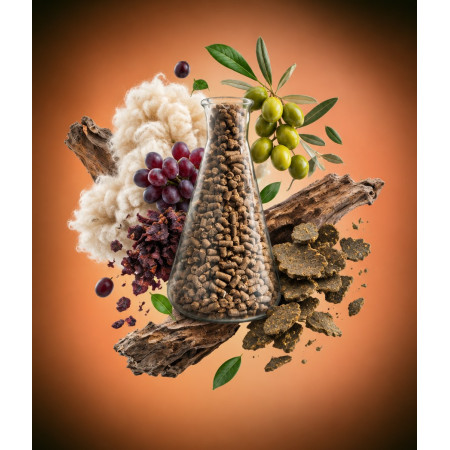
Organic soil amendment NF U 44-051-8
HUMIFLOR® HUMOMAZE®
Flocculates and aerates clay soils, with long-lasting organic nitrogen.
OM 59%ISMO 52C/N 155% washed and sanitized wool
See the product page
Plant-based organic soil amendment NF U 44-051-9
HUMIFLOR® ORVEGA®
Supplies stable humus within a 100% plant-based specification.
OM 61%ISMO 52suitable for organic farmingvegan
See the product pageFurther reading
Vineyard fertilization at the end of winter: the 3-step method
The logical next step after this article: what to apply from budburst to flowering.
Soil amendments, the key to a living soil
Why feed the soil before feeding the plant.
When the art of viticulture meets the richness of Mazor®
What Germiflor’s biological base changes in vineyard soil.
Synthetic fertilizers banned in 2027: the Climate and Resilience Act explained
The regulatory framework pushing farms toward organic fertilizers.
Our solutions for vineyards and where to find our products
Germiflor amendments and fertilizers by vine growth stage, and our distributor network.
Your blocks are waiting for their fall input.
Our technical team helps you choose the amendment and the rate based on your soil analysis.
Ask for advice See the professional rangeArticle written by the Germis, Germiflor’s educational mascots. Reviewed by the Germiflor technical team (Mazamet, Tarn, France), maker of organic and organo-mineral fertilizers since 1885. Agronomic sources: IFV fact sheet “Apport d’amendements organiques” (November 2025), French national nitrate action program (decree of January 30, 2023), Germiflor product technical sheets. Published on .