


29 septembre 2026
Teaching kids about soil: free games, videos and experiments
· Reading time: 10 minutes · By the Germis
“Why does the worm eat the dirt?” The question comes from a six-year-old kneeling at the edge of a vegetable patch, a plastic shovel in hand. We’re Germi and Germinette, and we love this kind of question. It holds everything: the soil, the life hiding in it, and what plants really eat.
Explaining soil to kids means answering questions like that one with the right words, at the right age. That’s why we created Les Petits Germis (in French): stories, videos, comics, quizzes and experiments about living soil, for ages 3 to 18. It’s free, with no account or sign-up, and no data is collected. Here’s how we go about it, age by age, and what you can do at home as soon as this weekend.
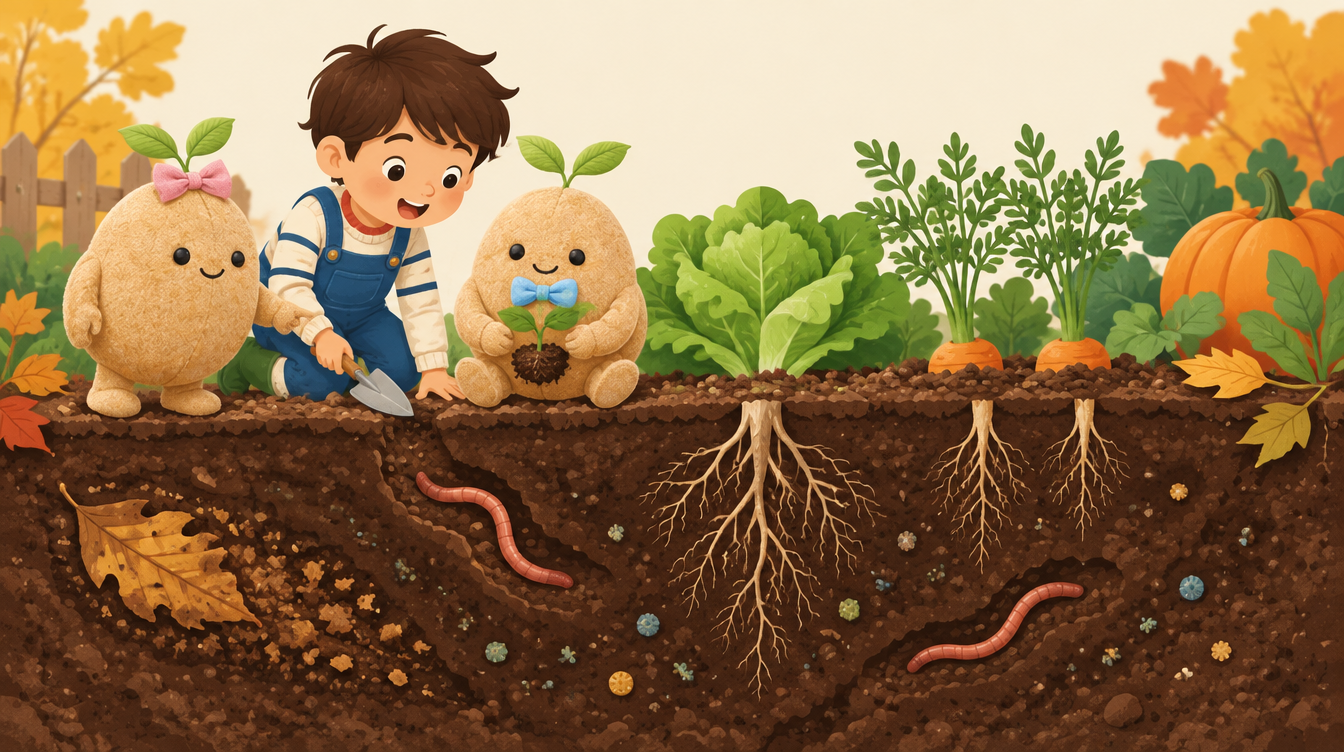
Beneath the vegetable garden, a whole world is at work: that’s where we start with kids.
Why teach kids about soil?
Teaching kids about soil means showing them that earth is not dead matter but a living environment. A handful of garden soil is home to billions of microorganisms, fungi and earthworms, which break down dead leaves and turn them into humus (the dark, fine material that gives soil its color and its softness). This living soil holds water, feeds roots and, at the end of the chain, fills our plates. A child who has understood this looks differently at a vegetable peel, a puddle or a carrot. They also understand why you don’t throw just anything into the garden, and why “more” doesn’t mean “better.” These ideas appear in the French science curriculum from elementary school, then in life and earth sciences (SVT) in middle and high school: what plants need, decomposers, photosynthesis, the nitrogen cycle.
The real challenge is how to say it. At 4, you talk about a sleeping seed. At 9, about nitrogen, phosphorus and potassium. At 15, about nitrates in rivers. Each age has its own words, and that’s what most resources you find online are missing: they speak to “the child” in general.
The Germis’ tip
Always start from the child’s question rather than from a lesson. “Why does the worm eat the dirt?” is worth more than ten definitions. Answer in one sentence, then show: lift a stone, a board, an old pot. Underneath, the living soil is already at work.
To explain soil to kids without mixing everything up, we use the same method we use with farmers and gardeners, simply told in different words.
The Germis’ method, told for kids
First a home for the roots, then a meal at the right time, and finally the right dose. Children remember the order; the older ones understand the logic behind it.
What can a child understand about soil at each age?
A 4-year-old understands that a seed needs water and that earthworms live under our feet. At 8, a child can do an experiment and draw a conclusion. In middle school, they connect soil to climate and water quality. Les Petits Germis follows this progression in four tracks. Each one has seven steps: the stories, the videos, the comics, the quiz and three small games (feed the plant, sort the compost, the raw materials memory game). Each completed step earns a Germis sticker, and when the sticker book is full, the child prints their diploma.
| Age | Track | What the child understands | Formats |
|---|---|---|---|
| Ages 3-5 | Little Sprouts, “Les Petites Pousses” (with an adult) | The sleeping seed, water, sun, the earthworm, peels that turn back into soil | Ten stories read aloud, picture quizzes, tap-and-play games, plush-puppet videos, two audio comics |
| Ages 5-7 | Germi’s Stories, “Germi raconte” | Germination, roots that drink, leaves that catch the sun, compost, “just what’s needed” | Fifteen stories to listen to or read, clay-animation videos, three games, two comics |
| Ages 8-10 | The Germi Explorers, “Les Germis explorateurs” | N, P and K; humus the sponge; pH with red cabbage; the difference between fertilizer and soil amendment | Cut-paper investigation videos, two detective comics |
| Ages 11-18 | Germis for middle and high school, “Germis collège et lycée” | Photosynthesis, the nitrogen cycle, nitrates and water quality, soil carbon, reading a “6-4-8” bag | Pixel-art video missions, two comics, linked to the life and earth sciences (SVT) curriculum |
One common thread runs through all four tracks: learning to reason. The games talk about raw materials (mineral, plant and animal), the families of fertilizing materials and good practices. Everything works on computer, tablet, phone and projector, and progress stays on the child’s device.
What lives beneath our feet: how do you explain it simply?
The easiest way is to talk about soil as a house with several floors. At the top, dead leaves and plant debris: the pantry. Just below, humus, dark and soft, where most of the residents live. Further down, the lighter-colored soil where roots go looking for water. At the very bottom, the rock that crumbles very slowly, and where some of the minerals come from. To go further with older kids, our article What exactly is soil? describes these layers in detail.
Soil in cross-section, kids’ version
Four floors, one idea: the soil is alive. This diagram is based on the video “Investigation: which soil holds water?” from the ages 8-10 track.
The earthworm, the garden’s plowman
To answer the question from the start: the earthworm swallows soil mixed with bits of leaves, keeps what feeds it and releases the rest, richer and better mixed. As it digs, it opens tunnels that let air and water reach the roots. That’s why it’s called the garden’s plowman: it does for free, day and night, what a spade does, without turning the soil’s floors upside down. A child who has watched a worm slide down into its tunnel never again sees it as a disgusting creature.
Humus, the soil’s sponge
Humus is what leaves and plant debris become once they’ve been digested by worms, fungi and bacteria. It works like a sponge: it holds water after rain and gives it back to the roots when it’s dry. It also holds on to minerals, which would otherwise be washed away faster by water. With 8- to 10-year-olds, the experiment is simple: pour the same amount of water over a pot of sand and a pot of potting soil, and compare what drains out the bottom.
Three soil experiments to do at home
These three experiments are available as printable sheets on Les Petits Germis, with a list of materials and a page for recording observations. All they take is kitchen items and half an hour of preparation.
From age 5: the lentil in cotton
Place a few lentils on damp cotton in a saucer near a window. In two to three days, a little root comes out; then a stem, then two leaves. The child measures and draws it every day. The lesson comes after a few weeks: the seedling eventually turns yellow. The seed held a food reserve to get started, but the cotton gives it no minerals at all. It’s the most beautiful demonstration of what soil gives a plant. Download the lentil activity sheet (PDF) (in French)
From age 8: the magic red cabbage, a pH test
An adult boils a few red cabbage leaves and saves the purple juice. Pour some into three glasses: one with a little vinegar, one with water, one with a pinch of baking soda. The juice turns pink, stays purple, turns blue-green. The cabbage’s pigments (anthocyanins) change color depending on acidity, in other words the pH. To test garden soil, mix a spoonful of soil with distilled water, let it settle, filter it, then add the juice. pH matters in the garden: it partly determines which nutrients the roots can absorb. Download the red cabbage activity sheet (PDF) (in French)
The Germis’ tip
Filter the soil well: a muddy mix clouds the color. And take the experiment for what it is: an indication. To really know what your vegetable garden needs, a laboratory soil analysis remains the benchmark.
From age 11: compost in a bottle
Cut a large plastic bottle, then alternate layers of soil, vegetable peels and dry leaves. Moisten, cover with a cloth and keep out of the sun. For four weeks, the teenager notes what changes: the peels darken, shrink and disappear. It’s a chance to talk about the C/N ratio (the balance between carbon and nitrogen in a material): “green” peels are rich in nitrogen, dry “brown” leaves in carbon, and good compost needs both. Download the compost activity sheet (PDF) (in French)
How do you explain compost to kids?
Compost is the soil’s kitchen: worms, fungi and bacteria eat our vegetable peels and turn them into rich earth, humus. Nothing is lost, everything turns back into soil, and that soil will feed next year’s vegetables. With the youngest, we talk about the leaf that disappears: that’s the story of the comic “Where Did the Leaf Go?” From age 5, the video “The Super Compost Factory” shows the whole process in two minutes. In middle school, we explain that composting heats up (the microorganisms work so hard that they give off heat) and that a well-managed pile kills some of the weed seeds and unwanted germs.
At home, the habit that works best is the simplest one: sort the week’s vegetable peels together, then take them out to the compost. The child sees the start of the chain. Three months later, they see the end of it.
Fertilizer, soil amendment, N-P-K: which words to use from age 8?
From age 8, a child can tell two families apart. A soil amendment acts first on the soil itself: it improves its structure, its ability to hold water and the life it shelters (we explain this in detail in Soil amendments, the key to living soil). A fertilizer supplies the nutrients the plant needs, mainly three of them: nitrogen (N), phosphorus (P) and potassium (K). On Les Petits Germis, the formula to remember is “leaf, root, fruit”: nitrogen for the leaves, phosphorus for the roots and flowers, potassium for the fruit. It’s a simplification, but it holds up.
In middle school, you can add how to read a bag. A fertilizer labeled “6-4-8” contains 6% nitrogen, 4% phosphorus (expressed as P2O5) and 8% potassium (expressed as K2O). You can also distinguish organic fertilizer, made from living matter, from mineral fertilizer, made from rocks or by synthesis, and from organo-mineral fertilizer, which combines the two: our article Organic or mineral fertilizer covers the whole question for parents.
Common mistake: “fertilizer is what makes the plant grow”
In reality, the plant makes most of its own matter, using sunlight, water and carbon dioxide from the air: that’s photosynthesis. The soil supplies the water and the mineral elements (nitrogen, phosphorus, potassium, magnesium…) it needs to build its leaves, roots and fruit. Fertilizer tops up these elements when the soil doesn’t supply enough of them. Saying “fertilizer feeds the plant” is correct; saying “fertilizer makes the plant” is not.
“Too much is as bad as too little”
It’s the sentence we repeat in every track, and it’s probably the most important one. A plant that lacks nutrients stays small and pale. A plant that gets just what it needs grows well. But beyond that point, each extra application brings back less and less: that’s the law of diminishing returns, known to agronomists since the 19th century. And what the plant doesn’t take up doesn’t disappear: excess nitrogen can be carried by rain into groundwater and rivers, in the form of nitrates. That’s the story of the comic “Mission Nitrogen: The Green River” in the ages 11-18 track.
Conceptual diagram. Staying in the green zone is the reason farmers split their applications: several small doses at the right time rather than one big dose all at once.
How can you use Les Petits Germis in class?
For a class, an after-school program or an educational farm, everything fits on a single projected screen. The teacher opens a free account on the Germis Academy, the “Académie des Germis” (it takes one minute and an email address), and launches the team quiz (in French). Students don’t need anything: they answer by holding up printable cards, A with a bee, B with a banana, C with a ladybug. The questions are sorted by age, from 3 to 18.
The videos can be downloaded, and there is an offline version for rooms without a network connection. For printing, you’ll find the three experiment sheets, coloring pages from age 3, stickers on round labels and diplomas for the whole class (little gardener, young agronomist).
The Germis’ tip
France’s Taste Week, the “Semaine du goût,” comes back every October. The quiz offers a special “from soil to plate” game, which links what students eat to the soil that grew it. It’s a ready-to-use session: a projector, the cards and forty minutes are all you need.
And coming next, we’re working on a 3D garden game, “Germis: The Soil Odyssey.” The child plays as Germi or Germinette: they sow, water, mulch, feed the soil, harvest and compost, and an underground view shows the roots and earthworms at work. It will work without an account, on computer, tablet and phone.
Where does the material in an organic fertilizer come from?
On Les Petits Germis, 8-year-olds discover that organic fertilizers come from very real materials: feathers, bones, grape seeds, oilseed cakes (what’s left of the seeds once the oil has been extracted). The 11-18s go one step further, with a video devoted to Mazor® and the Cronops® process.
Mazor® is Germiflor’s in-house compost, and it rests on the same idea as garden compost: plant residues turn back into fertile soil. At the factory, the transformation is simply controlled from start to finish. Oilseed cakes from medicinal plants, grape and olive pulp, coffee grounds: in their raw state, these materials would be unstable in the garden. Composted with the Cronops® process, patented by Germiflor (patent FR2103847), they change in nature. Controlled composting stabilizes the carbon, balances the C/N ratio, eliminates unwanted germs and develops a beneficial microflora. The result is a biological base containing one billion microorganisms per gram, which goes into most Germiflor fertilizers. You’ll find all the details on our Our process page and in the article Mazor, a patented innovation.
For a child, the message fits in one sentence: it’s the same compost as theirs, made on a very large scale and with a lot of care. The video “How Is a Fertilizer Made?”, featured in all four tracks, takes them on a tour of the factory where we have been working, in the Tarn (France), since 1885.
In short: the Germis’ method, family edition
| Step | What we explain | The activity | On Les Petits Germis |
|---|---|---|---|
| 1. Soil support | Soil is alive: earthworms, fungi, microorganisms, humus that holds water | Lifting a board in the garden; compost in a bottle | Videos on humus and compost; sheet 3 |
| 2. Nutrition | The plant builds its own matter with light; the roots draw up water and minerals | The lentil in cotton | “Feed the plant” game; sheet 1 |
| 3. Adjustments | Observe before acting; too much is as bad as too little | The magic red cabbage | Sheet 2; “The Green River” comic |
The parents’ checklist
☐ Start from the child’s question rather than from a lesson
☐ Lift a stone or a board in the garden to see the life in the soil
☐ Choose the Les Petits Germis track that fits the child’s age
☐ Sprout a lentil in cotton (from age 5)
☐ Test pH with red cabbage juice, with an adult (from age 8)
☐ Start a compost in a bottle and watch it for four weeks (from age 11)
☐ Sort the week’s vegetable peels together
☐ Repeat the golden rule: not too much, not too little
☐ Watch the factory tour together as a family (“How Is a Fertilizer Made?”)
☐ Print the diploma when the sticker book is full
Frequently asked questions
▸ At what age can you start explaining soil to kids?
From age 3, with an adult, as long as you talk about things the child can see: a seed sprouting, an earthworm, a leaf that disappears. Concepts with numbers (nitrogen, phosphorus, potassium, pH) come around age 8, and the link with water and climate in middle school.
▸ How do you explain to a child, simply, what a plant eats?
A plant makes most of its food from light, water and air, thanks to its leaves. Through its roots, it drinks water from the soil and draws minerals from it, such as nitrogen for the leaves, phosphorus for the roots and potassium for the fruit.
▸ Why are earthworms useful in the garden?
Earthworms dig tunnels that let air and water reach the roots. They swallow soil mixed with dead leaves and release it richer and better mixed, which helps make humus.
▸ How do you do a pH test with red cabbage?
Boil some red cabbage leaves and keep the purple juice. Added to an acidic liquid, it turns pink; added to a basic liquid, it turns blue-green. For soil, mix a spoonful of soil with distilled water, filter it, then add the juice: the result is an indication, not a lab analysis.
▸ What experiment can you do with seeds at home?
The simplest is the lentil on damp cotton: a root comes out in two to three days, then a stem and leaves. After a few weeks, the seedling turns yellow for lack of minerals, which shows the child what soil gives a plant.
▸ Is Les Petits Germis free, with no sign-up?
Yes. Les Petits Germis is free and open to everyone, with no account or sign-up, and no data is collected: progress stays on the device. Only a teacher who runs the team quiz in class opens a free account.
▸ What soil activity can you run during France’s Taste Week?
The Les Petits Germis team quiz offers a “from soil to plate” game, projected on the board, with printable answer cards. It links foods to the soil that grew them and takes about forty minutes to play. France’s Taste Week (Semaine du goût) takes place every year in October.
How about heading out to the garden?
A family raised vegetable bed is all you need to put everything into practice: sowing, watering, mulching, watching the worms at work. We explain how to set one up in our guide to raised vegetable beds.
Before sowing, a plant-based soil amendment like Orvega®, from the Marcel le Jardinier range, makes the soil looser and helps it hold water by feeding soil life (plant-based organic soil amendment NF U 44-051, 65% organic matter, approved for organic farming [AB] and Vegan). View Orvega®
During the season, Potager, an organo-mineral fertilizer from the same range, feeds vegetables gradually as they grow (NPK 4-8-10 with magnesium, approved for organic farming [AB]). View Potager
Further reading
What exactly is soil? The soil’s layers, its life and its role, explained for adults.
The Fertilization Lexicon and the Germis Academy For parents and teachers who want to go further than their kids.
Soil amendments, the key to living soil Why we feed the soil first, before feeding the plant.
Getting raised vegetable beds right The ideal playground for a first family season in the garden.
Our process How we make Mazor® and our fertilizers, step by step.
Our company Five generations of a family from the Tarn, serving the soil since 1885.
Open Les Petits Germis with your child
Pick their age, start the first story, and see how far their questions will sprout. Free, no account needed.
Play with the Germis (in French) Questions? Write to usArticle written by the Germis. Reviewed by the Germiflor technical team (Mazamet, Tarn, France). Published on .